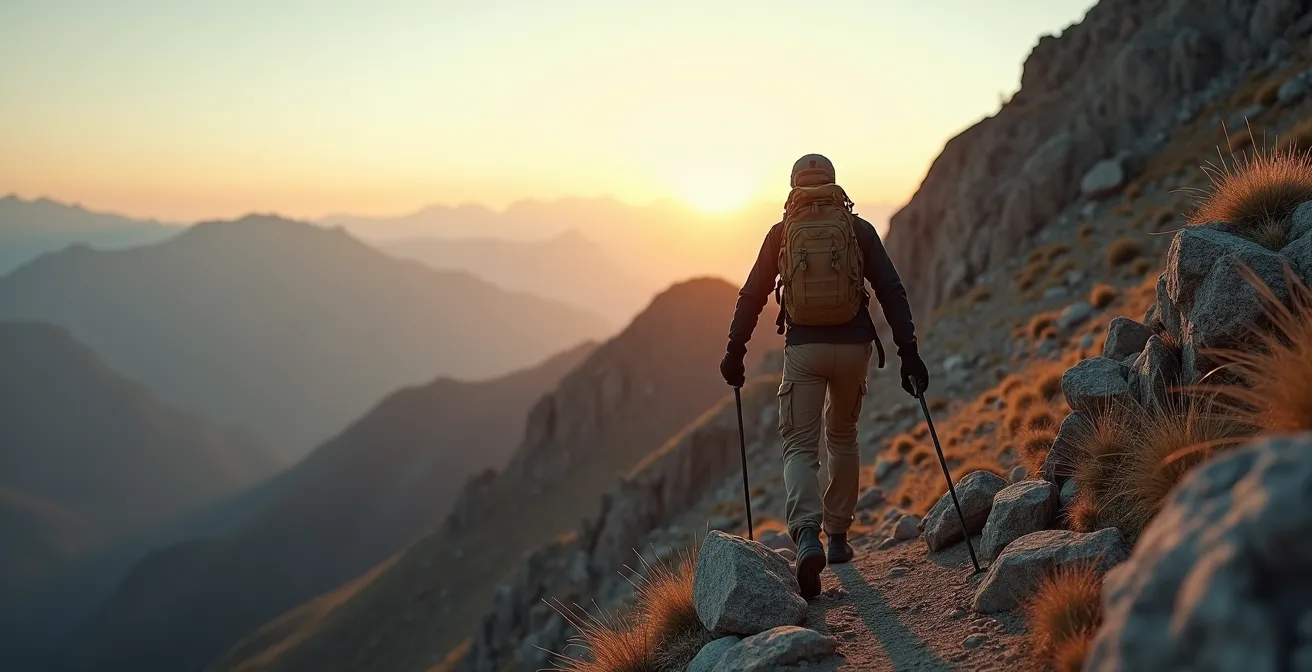
True outdoor safety isn’t about owning military gear; it’s about adopting the tactical mindset of efficiency, modularity, and redundancy.
- Intelligently integrating select tactical items solves specific problems without adding unnecessary weight or an aggressive look.
- The goal is a “hybrid kit” that blends the best of civilian hiking comfort with military-grade reliability for critical tools.
Recommendation: Start by assessing your current kit not by what you have, but by what problems you can solve with it, then fill the gaps with targeted, high-value tactical solutions.
For many civilian hikers and campers, the term “tactical gear” conjures images of camouflage, heavy armor, and an aesthetic that feels out of place on a peaceful trail. The common advice is often to stick to brightly colored, lightweight recreational equipment. Yet, a quiet but significant shift is happening. Experienced outdoor enthusiasts are looking past the stereotypes and realizing that the principles behind tactical equipment—durability, modularity, and immediate accessibility—offer a powerful upgrade to their safety and preparedness. The goal isn’t to look like a soldier, but to think like one when it comes to efficiency and survival.
The disconnect often comes from a fundamental misunderstanding. Integrating tactical gear isn’t an all-or-nothing proposition. It’s not about trading your comfortable hiking boots for stiff combat boots. Instead, it is a surgical process of identifying the weakest points in a standard civilian kit and reinforcing them with gear forged in environments where failure is not an option. This is the essence of the “hybrid kit”: a setup that marries the comfort and low-profile nature of hiking gear with the bomb-proof reliability of select tactical tools. It’s a philosophy focused on problem-solving layers, where each piece of gear has a clear purpose and is placed for maximum efficiency.
This guide moves beyond the generic advice of “buy a durable pack.” As a survival instructor, I will bridge the gap between the two worlds, showing you how to adopt the tactical *mindset* first. We will explore how to choose gear that performs without broadcasting a military presence, understand the critical trade-offs between weight and reliability, and organize your tools so that your most vital equipment is accessible in seconds, not buried at the bottom of your pack. This is how you genuinely improve safety.
To help you navigate this integration process, this article is structured to address the most critical questions and concepts. We will cover everything from organizing your supplies with advanced systems to prioritizing your actions in a genuine survival scenario, ensuring you have the knowledge to build a smarter, safer hiking kit.
Summary: Beyond the Backpack: How a Tactical Mindset Elevates Your Hiking Safety
- Why MOLLE Systems Are Superior for Organizing Emergency Supplies?
- How to Choose Tactical Pants That Blend Into Civilian Trails?
- Mil-Spec vs Commercial Grade: Is the Extra Weight Worth It for Day Hikes?
- The Error of Packing Too Many Tactical Gadgets for a Simple Trek
- How to Configure a Tactical Chest Rig for Instant Map and Compass Access?
- What to Pack in an Altoids Tin Survival Kit for Day Hikes?
- Why Following the Cairn Line Isn’t Always the Safest Path in Fog?
- The Rule of Threes: How to Prioritize Survival Actions in the First 24 Hours?
Why MOLLE Systems Are Superior for Organizing Emergency Supplies?
The true genius of the MOLLE (Modular Lightweight Load-carrying Equipment) system isn’t just about attaching more pouches; it’s about the philosophy of purposeful organization and instant accessibility. A standard hiking backpack treats all gear with equal priority, burying a first-aid kit under a rain jacket and a bag of trail mix. A MOLLE system allows you to treat your pack like a cockpit. Critical gear—like your Individual First Aid Kit (IFAK), navigation tools, or hydration source—can be externally mounted, exactly where you need it, when you need it. This modular approach ensures you’re not wasting precious seconds digging through your pack during an emergency.
This system allows you to create a “hybrid kit” that is adaptable to any mission. Heading out for a short day hike? You might only need a water bottle pouch and a small admin pouch for your map and compass. Embarking on a multi-day trek in remote territory? You can add pouches for a larger medical kit, shelter components, or extra water. The ability to customize your loadout based on the specific challenges of your hike is a core tenet of tactical preparedness. It shifts your thinking from “what can I fit in my bag?” to “what problems might I face, and where is the tool to solve it?” This is the accessibility mindset in action.
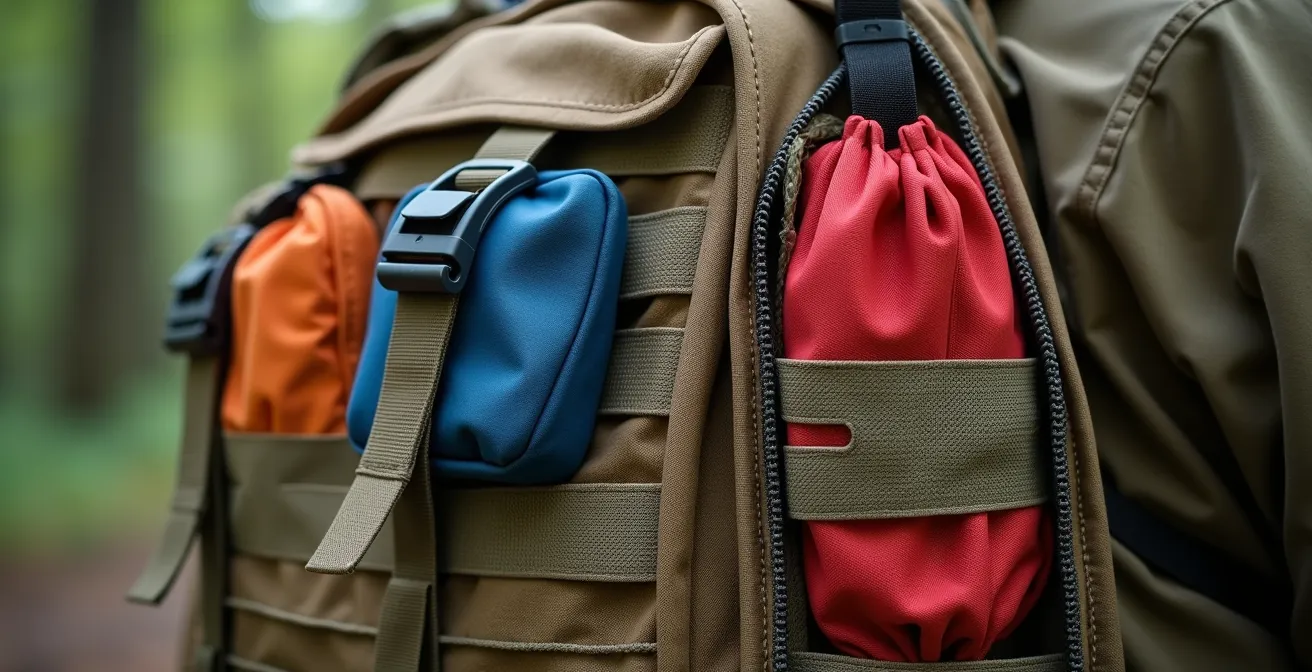
As the image demonstrates, the interwoven grid provides a secure and stable platform. According to insights on tactical approaches, the MOLLE system allows you to easily attach additional pouches, keeping smaller items secure and readily accessible. For a hiker, this means your IFAK can be placed on your pack’s hip belt for immediate access, or your water purification kit can live in a dedicated side pouch. It’s a deliberate, systematic approach to carrying gear that recreational packs simply cannot replicate.
How to Choose Tactical Pants That Blend Into Civilian Trails?
One of the biggest hesitations for hikers considering tactical apparel is the fear of looking out of place. The classic image is of baggy, military-style cargo pants in overt camouflage patterns. However, the market has evolved dramatically. The key to successful “civilian blending” is to focus on materials, features, and color, rather than outdated military styles. Modern tactical pants now come in a wide range of earth tones—like coyote brown, ranger green, wolf grey, and khaki—that blend seamlessly into natural environments and are indistinguishable from high-end hiking pants.
The real advantage lies beneath the surface in the fabric technology and thoughtful design. Look for pants made from lightweight, synthetic blends with ripstop weaves. These materials offer superior durability to standard cotton or denim while providing crucial features like four-way stretch for unrestricted movement, quick-drying properties, and a Durable Water Repellent (DWR) coating. Features like articulated knees and a gusseted crotch, once exclusive to climbing or tactical pants, are now recognized as essential for comfort on long treks. Pockets are also designed for efficiency, with low-profile cargo pockets that don’t billow out and internal dividers to organize small items like a knife or flashlight.
As the Tac Essentials Research Team notes in their report on the latest gear trends, ” Modern tactical gear is increasingly incorporating advanced materials and construction techniques to enhance durability, comfort, and functionality.” This evolution is what makes them ideal for the serious hiker.
The following table provides a clear comparison of materials, showing how modern fabrics outperform traditional ones in key areas for a hiker. This data, drawn from an analysis of tactical pack materials, also applies to apparel.
| Material Type | Weight (oz/yd²) | Noise Level | Stretch Factor | Durability Score |
|---|---|---|---|---|
| Cotton/Poly Ripstop | 8-10 | Medium-High | Minimal | 7/10 |
| Schoeller Dryskin | 6-7 | Very Low | 4-way stretch | 9/10 |
| Tweave Durastretch | 5-6 | Low | 2-way stretch | 8/10 |
| 1000D Cordura | 12-14 | High | None | 10/10 |
By choosing pants made from materials like Schoeller or Tweave in a subtle color, you get military-grade performance with a look that is perfectly at home on any trail.
Mil-Spec vs Commercial Grade: Is the Extra Weight Worth It for Day Hikes?
The “Mil-Spec” (Military Specification) label is often seen as the gold standard for durability, but it’s a term that needs careful consideration. Mil-Spec means an item is built to a specific, often rigid, set of government standards. While this guarantees a certain level of toughness, it frequently comes with a significant penalty: weight. For a soldier, whose life depends on their gear’s absolute reliability under fire, that extra weight is a necessary trade-off. For a civilian on a day hike, it might be an unnecessary burden.
This is where the “hybrid kit” philosophy is most critical. You don’t need a Mil-Spec backpack for a 5-mile loop trail. In fact, research shows that heavy-duty tactical packs can weigh almost 7 pounds before you even start loading gear. That extra weight translates to more energy expended and increased fatigue. The intelligent approach is to differentiate between “mission-critical” and “comfort-oriented” items. Your pack, your clothing, and your sleeping system can be high-quality commercial hiking gear, optimized for light weight and comfort.
However, for certain tools, the extra durability is worth the weight. A reliable fixed-blade knife, a quality compass, or a bomb-proof fire starter are items where failure is not an option. For these, choosing a product from a reputable brand known for supplying military or law enforcement can provide peace of mind that a cheaper, lighter commercial version might not. The key is to be selective. Ask yourself: “If this item fails, what are the consequences?” If the answer is “severe inconvenience,” a commercial-grade item is likely fine. If the answer is “a life-threatening situation,” the extra weight of a more robust, potentially Mil-Spec or “Mil-Grade,” option is a wise investment.
The Error of Packing Too Many Tactical Gadgets for a Simple Trek
The allure of tactical gadgets is strong. The market is flooded with multi-tools, survival bracelets, and an endless array of small, specialized items promising to save your life. This leads to a common mistake among aspiring prepared hikers: over-packing. They fall into the trap of thinking that more gear equals more safety, resulting in a heavy, cluttered pack full of redundant or useless items. The tactical mindset, however, prizes efficiency over volume. Every item must justify its weight and space with clear, practical utility, preferably across multiple scenarios.
Before adding any new “gadget” to your kit, it must be evaluated as a tool, not a toy. A tool solves a real-world problem efficiently. A toy is novel but impractical. For example, a large, heavy “survival” knife with a hollow handle and a saw-back spine is often less useful than a simple, robust fixed-blade knife and a separate, lightweight folding saw. The latter combination is more effective, more reliable, and often lighter. This principle of carrying a few high-quality, multi-functional items is the core of a smart loadout. Essential items always include tools for shelter, fire, water, and navigation. Having these core items is far more important than having a dozen niche gadgets, as survival research indicates that 35 percent of lost hikers who survived had food they could ration to keep energy levels up, underscoring the importance of packing essentials over novelties.
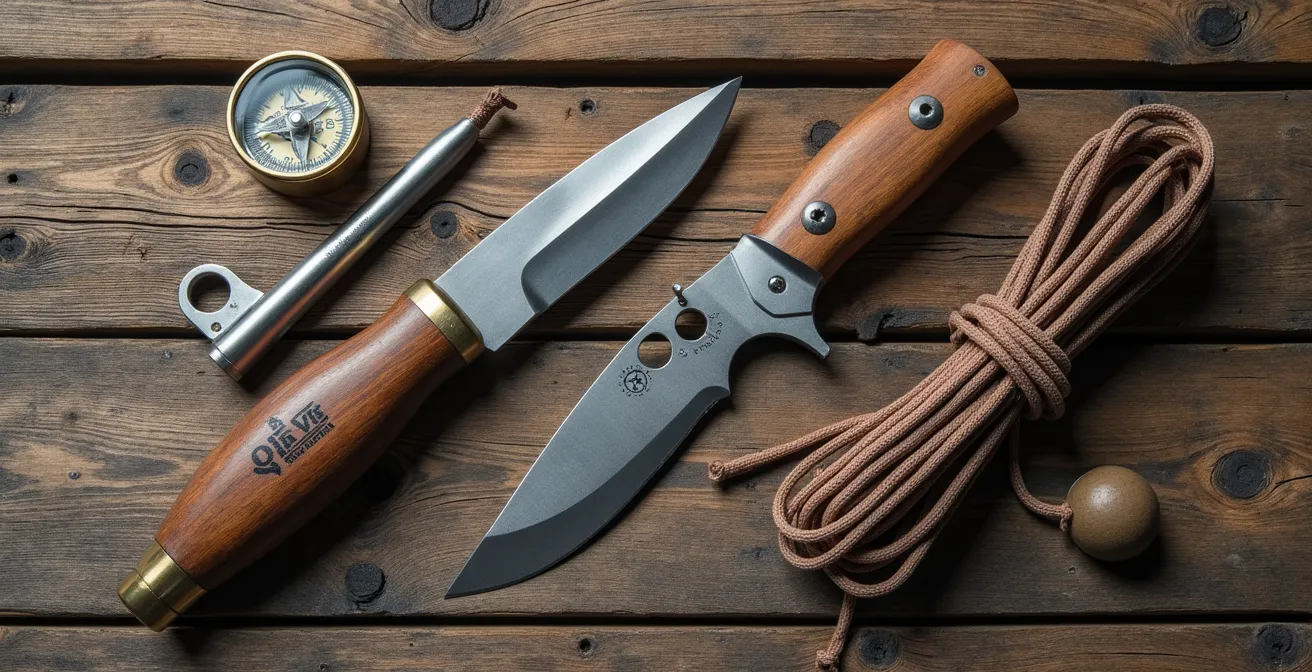
This minimalist approach ensures that you have what you need without being weighed down by what you don’t. A quality knife, a ferro rod for fire, a reliable compass, and a means to purify water form a foundation that will solve 90% of potential survival problems. Only after these core capabilities are covered should you even consider adding more specialized tools.
Action Plan: The Tool vs. Toy Assessment
- Assess Functionality: Can the item serve at least three different, practical functions in a survival context?
- Evaluate Reliability: Will it function without batteries or an external power source, especially in wet or cold conditions?
- Test Usability: Have you personally tested it and can you operate it effectively with cold or wet hands?
- Consider Weight-to-Value: Does its function justify its weight (e.g., under 8 ounces), or would a simpler, lighter alternative work just as well?
- Confirm Necessity: Does this tool solve a probable problem, or is it for a highly unlikely “what if” scenario? Prioritize the probable.
How to Configure a Tactical Chest Rig for Instant Map and Compass Access?
While a MOLLE backpack excels at organizing your overall load, a tactical chest rig serves a more specialized and immediate purpose: it creates a “clean cockpit” for your most critical navigation and communication tools. In dense woods, bad weather, or situations where you need to move quickly, stopping to take off your pack to access a map is inefficient and potentially dangerous. A chest rig keeps these essential items on your torso, accessible with either hand without breaking stride. This is the accessibility mindset taken to its logical conclusion.
Configuring a chest rig for hiking is different from a military setup. You’re not carrying ammunition magazines; you’re carrying your “holy trinity” of navigation: your map, compass, and GPS unit. A proper setup prioritizes an ergonomic workflow. For example, a dedicated map pouch can be positioned on your non-dominant side, angled for easy viewing while you walk. Your compass should be attached with a retractable lanyard to prevent it from being dropped or lost. Small pouches can hold a GPS unit, a small notebook and pen, or a personal locator beacon (PLB).
This approach emphasizes redundancy, a core tactical principle. As noted by tactical experts, “GPS is helpful—until your signal dies.” A chest rig makes it effortless to cross-reference your GPS position with your map and compass bearing, ensuring you’re never dependent on a single, fallible system. The goal is a “clean cockpit,” where there are no dangling straps to snag on branches and every item has a dedicated, secure home. Silent-opening pouches can also be a benefit in wildlife areas, helping you maintain noise discipline. By dedicating a space for these tools, you are far more likely to use them proactively, preventing navigational errors before they happen.
What to Pack in an Altoids Tin Survival Kit for Day Hikes?
The concept of an Altoids tin survival kit embodies the principle of efficiency and minimalism. It’s not meant to be a comprehensive survival system but a pocket-sized “problem-solving layer” that contains the absolute bare minimum to address the most immediate survival priorities. Its small size ensures you’ll always have it on you—in a pocket or a pouch—even if you become separated from your main backpack. It serves as your final line of defense, a collection of micro-tools designed to make a huge difference in a worst-case scenario.
Packing this kit is an exercise in prioritization. Every item must be tiny, multi-functional, and critical. The contents should be organized around the core needs of fire, shelter, water, signaling, and first aid. You are not packing for comfort; you are packing for survival. For example, petroleum jelly-soaked cotton balls are one of the most compact and effective fire tinders available. A P-38 can opener is a legendary military tool that weighs almost nothing but can serve as a small cutting edge, a scraper, or a screwdriver. A small signal mirror or whistle can alert rescuers from miles away, using far less energy than shouting.
The key is to view this kit as a cohesive system. The fishing line can be used for procuring food, but also for creating tripwires or repairing gear. The water purification tablets can make found water safe to drink, staving off dehydration. It’s a testament to the idea that with the right knowledge, a handful of small, well-chosen items can dramatically increase your chances of survival. A well-stocked tin should contain the following items, or similar substitutes:
- Fire: 3 petroleum jelly cotton balls, a mini ferrocerium rod with a striker.
- Shelter & Cordage: 10ft of fishing line (or Kevlar thread), a heavy-duty needle.
- Water: 2-4 water purification tablets, a small, folded plastic bag or unlubricated condom for water collection.
- Navigation & Signaling: A button compass, a signal mirror, and an emergency whistle.
- Medical & Tools: 2 butterfly closures, a small packet of antibiotic ointment, a single-edge razor blade, and a P-38 can opener.
Why Following the Cairn Line Isn’t Always the Safest Path in Fog?
Cairns—stacks of rocks used to mark trails—are a welcome sight for any hiker, especially in open, rocky terrain where the path is unclear. They represent a collective wisdom, a breadcrumb trail left by those who came before. However, blindly trusting a line of cairns, particularly in low-visibility conditions like fog or a whiteout, is a critical navigational error. It violates the core tactical principle of redundancy and verification. You are outsourcing your safety to an unverified, unofficial system.
The problem is threefold. First, not all cairns are official; many are built by well-meaning but misguided hikers, leading to “social trails” that may dead-end or lead into dangerous terrain. Second, in fog, it’s easy to mistake a random pile of rocks for a cairn or to lose sight of the line entirely, causing you to wander off course. This is a common scenario, with one study noting that forty-one percent of survivors began their odysseys by accidentally straying from the trail. These decision points can funnel hikers into confusing mazes of rugged terrain.
The correct, tactical approach is to use cairns as a single data point, not as your sole source of truth. You must constantly verify their direction with your primary navigation tools: your map and compass. Before heading to the next visible cairn, take a bearing with your compass. Does it align with the direction the trail should be heading on your map? If there’s a discrepancy, you must stop and trust your verified tools over the unverified rock pile. This discipline of active, constant verification is what separates a prepared navigator from a lost hiker. In low visibility, it’s safer to slow down and navigate deliberately by compass bearing from your last known point than to chase a potentially false trail.
Your Cairn Verification Protocol
- Initial Bearing Check: At a confirmed cairn, take a compass bearing to the next visible one.
- Map Cross-Reference: Check if that bearing corresponds with the trail’s direction on your topographical map.
- Look for Official Signs: Scan the area for official trail markers or blazes, which often accompany official cairns.
- Assess Construction: Official cairns are typically stable, well-built, and uniform in size. Be wary of small, flimsy stacks.
- Backtrack if Unsure: If you reach a cairn and cannot confidently spot the next one or verify its path, do not guess. Backtrack to your last confirmed position.
Key Takeaways
- Tactical Mindset First: Safety comes from adopting principles of efficiency, modularity, and redundancy, not just from owning gear.
- The Hybrid Kit: Blend lightweight civilian gear for comfort with select, durable tactical tools for critical survival functions.
- Accessibility is Key: Use systems like MOLLE and chest rigs to keep essential tools (navigation, first aid) immediately accessible, not buried in a pack.
The Rule of Threes: How to Prioritize Survival Actions in the First 24 Hours?
In a survival situation, panic is the enemy. It leads to poor decisions, wasted energy, and a failure to address the most immediate threats. The “Rule of Threes” is not a rigid law but a mental framework used across military and survival communities to instantly prioritize actions. It provides a simple, powerful hierarchy of needs: a human can generally survive for 3 minutes without air, 3 hours without shelter in extreme conditions, 3 days without water, and 3 weeks without food. This rule immediately tells you what to focus on in the critical first 24 hours.
Your first priority after getting lost or injured is rarely finding food. It’s almost always shelter. Exposure is a fast and insidious killer. This is especially true if you are wet. As survival experts warn, even in seemingly mild weather, your situation can be dire. For instance, if you’re wet and it’s 65 degrees, you can still get hypothermic. Therefore, your first actions should be to get out of the wind and rain, put on dry layers if you have them, and begin constructing a simple shelter or deploying an emergency bivvy. Only once you have stabilized your core body temperature should you turn your attention to the next priority: water.
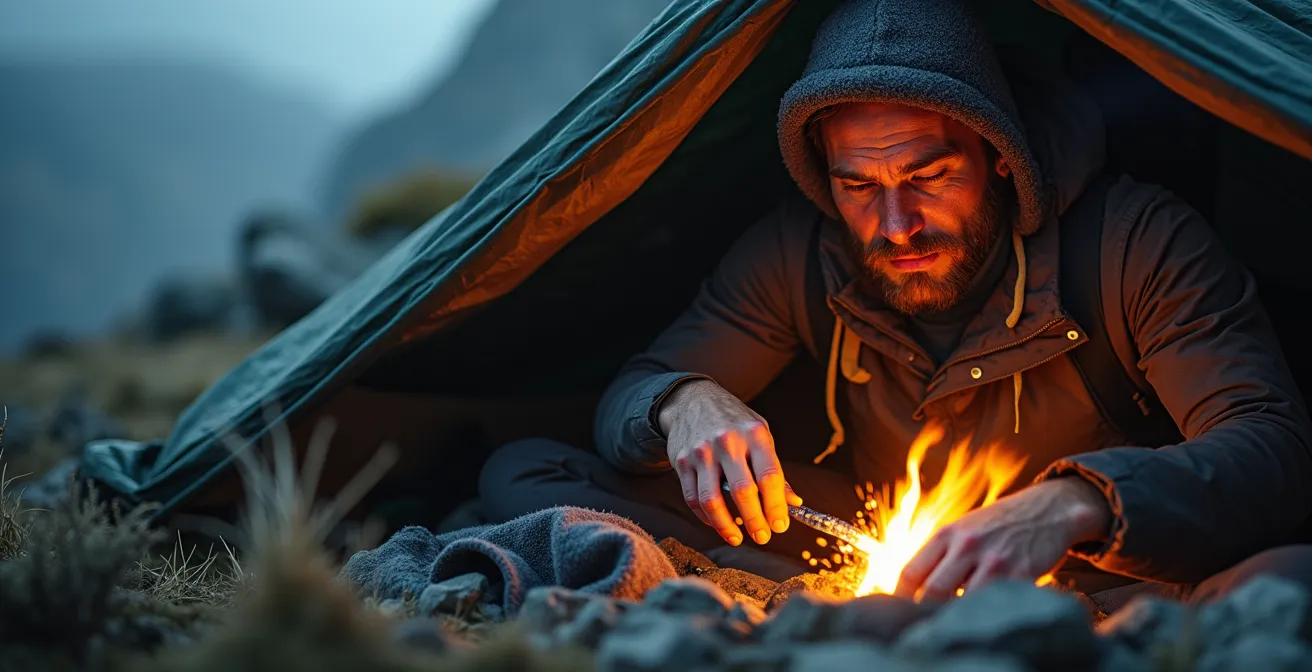
This framework should directly inform how you pack your “hybrid kit.” Your most accessible items should be those that address the top of the list. An emergency blanket, a fire kit, and a rain jacket are far more critical in the first three hours than a fishing kit. Data from survivor studies confirms this, showing that warmth and shelter are paramount. The most frequently mentioned source of warmth for survivors was their clothing, and their prevailing form of shelter was the camping gear they already had. This all points to one conclusion: the best way to survive is to already have the gear and knowledge to address the Rule of Threes before you even step on the trail.
By starting to view your hiking gear through this tactical lens—assessing every item for its role in solving the most critical survival problems—you can build a system that dramatically enhances your safety and confidence in the outdoors. The next step is to begin your own “Tool vs. Toy” assessment of your current kit.