
Tired of watching one trout species feed actively while the other ignores your perfect drift? The solution isn’t just changing flies; it’s understanding their fundamentally different biology.
- Brown Trout operate on a conservative energy budget, making them opportunistic but often cautious feeders, heavily influenced by structure and perceived threats.
- Rainbow and Brook Trout have higher metabolic rates in specific temperature bands, driving more aggressive, predictable feeding patterns, especially in relation to seasonal changes and hatches.
Recommendation: Stop fishing for “trout” and start targeting the specific species by adapting your approach, timing, and presentation to their unique metabolic and sensory ecology.
You’re standing in a pristine alpine stream. The water is crystalline, the air is crisp, and you can see fish holding in the current. You’ve spent an hour meticulously matching the hatch, presenting your fly with a drag-free drift that would make a guide proud. Yet, you’re only catching feisty brook trout, while the larger, golden-flanked brown trout you spotted earlier remains utterly indifferent. This common angler’s frustration—knowing fish are present but failing to connect—often leads to a cycle of changing flies and guessing at what they want. The conventional wisdom tells us to “match the hatch” or “be stealthy,” but what if that’s only half the story?
The truth is, brown, brook, and rainbow trout are not interchangeable. They are distinct species with unique evolutionary histories that dictate everything from their temperature tolerance to their response to a perceived threat. Simply presenting the “right” fly isn’t enough if you’re not presenting it in the right way, at the right time, for the specific species you’re targeting. The real key to consistently fooling these wary fish, especially the notoriously fickle browns, isn’t found in your fly box alone. It’s rooted in their biology.
This guide moves beyond angler lore and into the science of trout behavior. As a biologist and guide, I’ll break down the metabolic, sensory, and environmental triggers that drive their different feeding habits. We will explore why one species feeds ravenously in cold water while another becomes lethargic, how their vision dictates your approach, and even why they fight differently once hooked. By understanding the “why” behind their actions, you can transform your approach from one of guesswork to one of informed, strategic angling. This knowledge is the ultimate advantage for any angler seeking to unravel the puzzles of an alpine stream.
This article dives deep into the specific biological and environmental factors that differentiate trout species. The following sections provide a roadmap to understanding their behavior, enabling you to adapt your techniques for greater success on the water.
Summary: Decoding the Behavior of Alpine Trout
- Why Brook Trout Feed Actively in Colder Water Than Browns?
- Spring vs Fall: When Are Trout Most Aggressive and Protective?
- The ‘Cone of Vision’: How to Approach Trout Without being Seen?
- Aerial Jumps vs Deep Dives: How to Fight Different Trout Species?
- How to Handle Trout to Ensure Survival After Catch and Release?
- How to Identify Aquatic Insects and Tie Imitations on the Stream?
- Trout as Indicator Species: What Their Presence Says About Water Quality?
- How to Wade Safely in Fast-Flowing Alpine Rivers Without Losing Footing?
Why Brook Trout Feed Actively in Colder Water Than Browns?
The answer lies in their fundamental biology, specifically their metabolic rate and evolutionary origins. Brook trout (Salvelinus fontinalis) are native to the cold, clean headwaters of Eastern North America. They are genetically programmed to thrive in colder temperatures than the European-native brown trout (Salmo trutta). A brook trout’s metabolism is optimized for colder water, meaning they can actively digest food and expend energy on feeding when browns are becoming lethargic to conserve energy. Scientific studies on salmonid metabolism show that growth and metabolic associations are inverted between cool and warm regimes; what is optimal for one species can be stressful for another.
This difference in thermal preference dictates their feeding windows. On a cold spring morning, you might find brook trout aggressively chasing nymphs, while browns remain tucked under a log, waiting for the sun to warm the water by a few degrees. This metabolic efficiency in the cold is a key survival advantage for brook trout in their native high-altitude environments.
Furthermore, when these species coexist, their feeding strategies can shift due to competition. This is a concept known as sympatric competition. As one study from the journal Knowledge and Management of Aquatic Ecosystems points out, when in the presence of brown trout, brook trout’s diet can change significantly. The researchers noted:
However, in sympatry, brook trout consumed higher proportion of terrestrial invertebrates, while brown trout showed no changes either in the proportions of aquatic and terrestrial prey utilized or in the selectivity for prey categories in comparison to allopatric conditions.
– Study authors, Knowledge and Management of Aquatic Ecosystems
This suggests that brook trout are more adaptable or are pushed into a different feeding niche by the presence of browns, often looking to the surface for ants and beetles while browns continue to focus on their preferred aquatic prey. Understanding this interaction is crucial for the observant angler. If you see both species, don’t assume they are eating the same thing.
Spring vs Fall: When Are Trout Most Aggressive and Protective?
Seasonal aggression in trout is almost entirely driven by two factors: spawning and metabolism. Both spring and fall are periods of heightened activity, but the drivers and the species involved are different. Spring is the spawning season for rainbow trout, while fall is for brown and brook trout. During these times, their behavior becomes far more aggressive and territorial not just for feeding, but for procreation.
In the spring, as water temperatures rise, rainbow trout begin their spawning rituals. Males become brilliantly colored and will aggressively defend their chosen spawning areas (redds) from rivals and any perceived threat, including your fly. This is a time when they may strike out of pure territorial aggression rather than hunger. In the fall, the same behavior is exhibited by brown and brook trout. Large male browns, in particular, become notoriously belligerent, chasing away smaller fish and attacking streamers that invade their space. This pre-spawn aggression is often the best time to catch a trophy-sized, otherwise reclusive, brown trout.
Metabolism, tied to water temperature, also plays a key role. Spring and fall offer optimal temperature ranges where trout are most comfortable and their metabolic engines are running efficiently, requiring them to feed actively to prepare for or recover from the strenuous spawning process. Hormonal changes are a significant trigger; for instance, in response to environmental stress like temperature shifts, studies have shown that hormonal changes trigger complex physiological responses that can manifest as aggression or altered feeding. However, the famously quirky nature of brown trout means these rules are not absolute. An article in Hatch Magazine aptly describes their unpredictability, noting that even during a prolific hatch, browns might feed sporadically or not at all, a behavior that frustrates and fascinates anglers in equal measure.
For the angler, this means that while both seasons are excellent, your target and tactics should shift. In spring, focus on areas with clean gravel where rainbows might spawn. In fall, target deeper pools and undercut banks where large browns are staging. In both cases, be prepared for reaction strikes by using slightly larger, more attention-grabbing patterns.
The ‘Cone of Vision’: How to Approach Trout Without being Seen?
A trout’s primary defense is its eyesight, which is exquisitely adapted to its environment. To approach a trout undetected, an angler must understand the fish’s “cone of vision,” also known as Snell’s Window. Because of the way light refracts as it enters water, a trout’s view of the world above the surface is limited to a circular window directly overhead. The size of this window is determined by the trout’s depth; the deeper the fish, the wider its window. Outside of this cone, the water’s surface acts like a mirror, reflecting the streambed and hiding you from view. The area directly behind and below the fish is a significant blind spot.
This principle dictates a low-profile approach. Stay low, move slowly, and whenever possible, approach from directly downstream and behind the fish. Avoid casting your shadow over the water and wear drab clothing that blends with the background vegetation. In the clear, often shallow, water of alpine streams, these principles are doubly important. Any sudden movement or unnatural silhouette will send a trout bolting for cover.
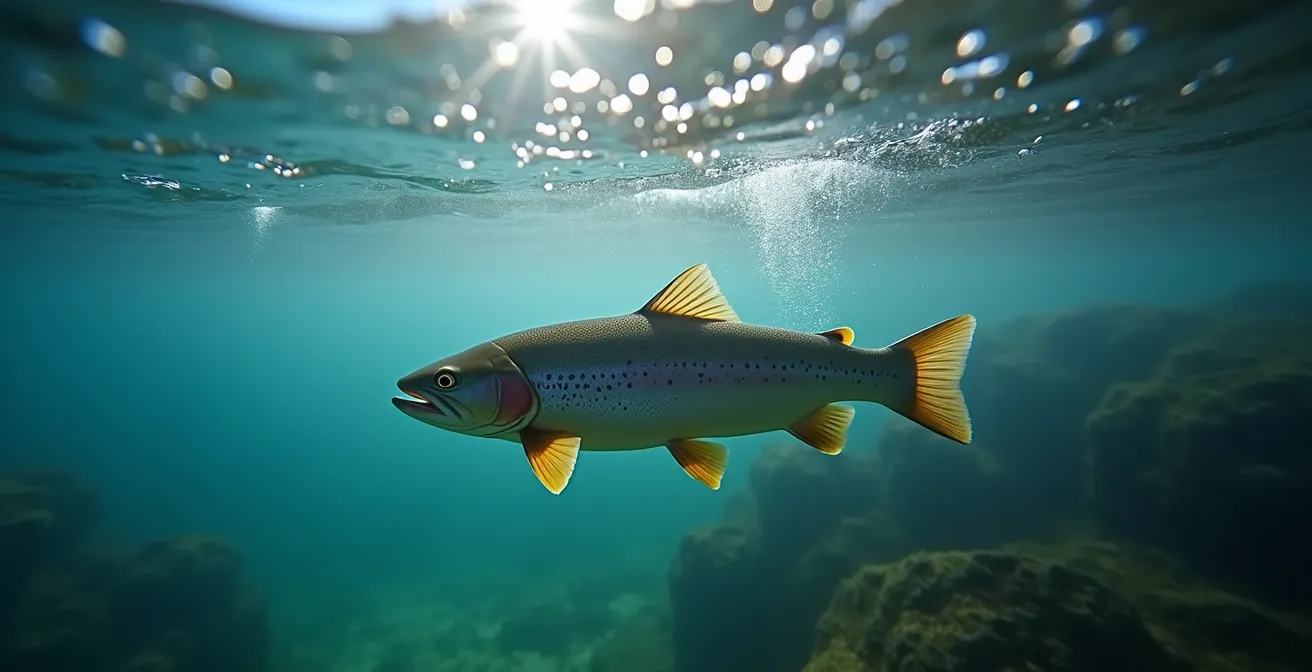
However, the science of trout vision is more nuanced than just a simple cone. Recent research indicates that trout visual capabilities vary with their development. The study highlights that the sensory capabilities are affected by the fish’s size, suggesting a smaller, juvenile trout may perceive threats and food differently than a large, mature adult. This means that larger, more experienced fish may have more refined visual acuity, making them even more challenging to approach. They learn to associate shadows and clumsy movements with danger.
Therefore, your approach must be adapted not just to the fish’s position, but its likely size and experience. Use available cover like rocks and vegetation, make your casts from further away, and keep your movements deliberate and slow. The goal is to present the fly before the trout ever knows you are there.
Aerial Jumps vs Deep Dives: How to Fight Different Trout Species?
The moment a trout is hooked, its species-specific survival instincts kick in, resulting in distinct fighting styles. Rainbow trout are renowned for their spectacular aerial displays and blistering runs. Brown trout, in contrast, are more likely to execute deep, powerful, “bulldogging” dives, using their weight and the current to their advantage, often heading for the nearest logjam or undercut bank. These differences are not random; they are rooted in their physiology and preferred habitat.
Rainbow trout, often found in more open water and faster currents, rely on speed and acrobatics to throw a hook. Their jumps are an attempt to use the weight of their own body and the lack of water resistance to create slack and dislodge the fly. As a biologist, I can tell you this explosive expenditure of energy is a high-risk, high-reward strategy. Studies on metabolic responses show that rainbow trout can adopt a new metabolic phenotype under stress, essentially preparing their bodies to sequester and rapidly use energy for intense bursts of activity, which explains these explosive fights. Your job as an angler is to absorb these runs and reduce the angle of the line when they jump by lowering your rod tip—a technique often called “bowing to the fish.”
Brown trout behavior is different. Having evolved with a preference for structure—undercut banks, logjams, and deep pools—their immediate instinct when hooked is to return to that safety. They dive deep, using their broad tails for powerful, deliberate runs rather than speed. They will try to wrap your line around a rock or root. The key to fighting a large brown is to apply steady, firm side pressure. This keeps their head turned and prevents them from gaining momentum towards their chosen snag. It’s a test of wills and tackle, not a race.
Your Action Plan: Fighting Different Trout Species
- When a rainbow jumps, keep your rod tip low to reduce tension and prevent the hook from pulling out.
- When a brown trout dives, apply steady side pressure to guide it away from structure like logs and rocks.
- Anticipate a rainbow’s explosive surface runs and be ready to give line to avoid a break-off.
- Maintain constant, firm pressure on a brown trout during its powerful, bulldogging runs toward the bottom.
- Allow a rainbow some slack during its aerial displays to prevent the line from snapping under sudden tension.
By understanding these instinctual responses, you can anticipate their next move and react appropriately, significantly increasing your chances of landing the fish.
How to Handle Trout to Ensure Survival After Catch and Release?
Catch and release is a cornerstone of modern trout conservation, but its success depends entirely on proper handling. A fish that swims away weakly may not survive. The primary goal is to minimize stress, physical damage, and time out of the water. This starts the moment the fish is hooked. Using barbless hooks is the single most important step, as it makes removal faster and causes far less tissue damage.
Fighting the fish quickly is also crucial. A long, drawn-out battle leads to an extreme buildup of lactic acid and exhaustion, from which the fish may not recover. This is especially true in warmer water, where a trout’s metabolic rate is already high. In fact, research shows that temperature significantly affects trout survival, with a dramatic increase in metabolic rate as water warms, making them more susceptible to handling stress. A fish caught in 20°C (68°F) water is under far more physiological stress than one caught in 13°C (55°F) water.
Once the fish is at hand, always wet your hands before touching it. A trout’s body is covered in a protective slime coat that acts as a barrier against infection and parasites. Dry hands strip this layer, leaving the fish vulnerable. Keep the fish in the water as much as possible, even while unhooking it. If you must take a photo, make it quick—a few seconds out of the water is all it should take. Support the fish’s weight horizontally with two hands; never hold it vertically by the gills or jaw.
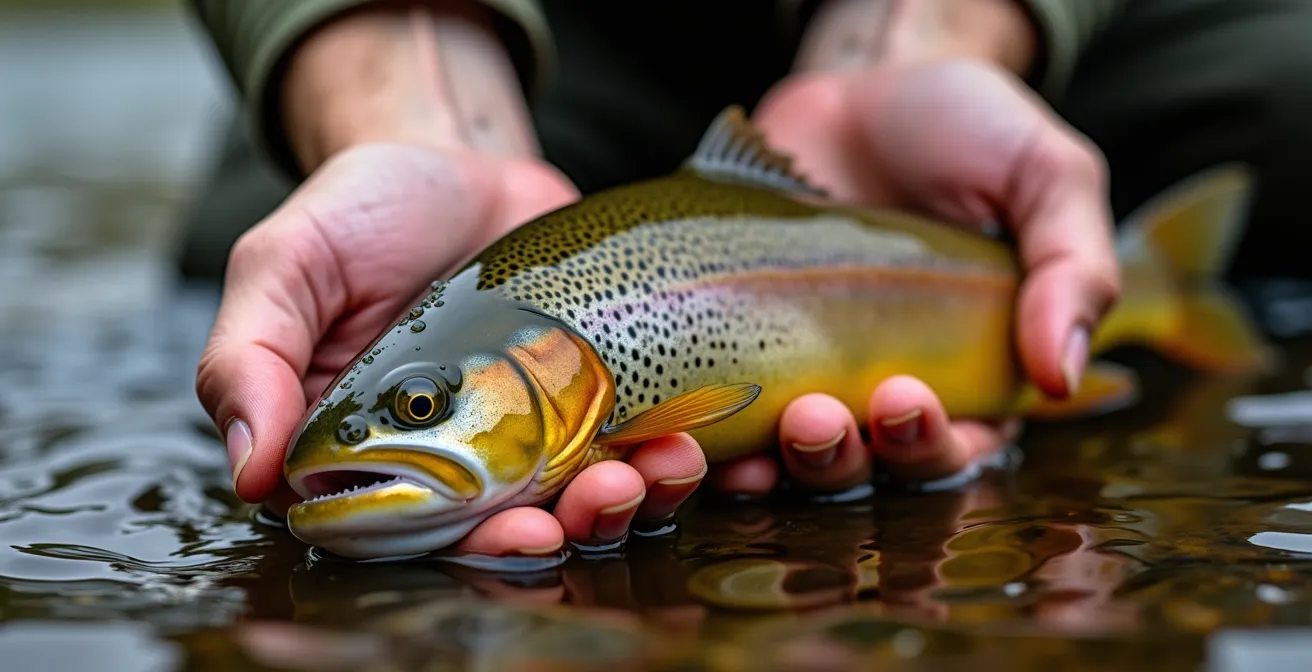
Finally, the revival is key. Hold the fish gently in the water, facing into the current. This allows water to flow over its gills, replenishing its oxygen. Do not move it back and forth. When the fish is ready, it will give a strong kick and swim out of your hands. Following these best practices ensures the trout you release has the best possible chance to survive, grow, and be caught again another day. Here are the essential steps to follow:
- Use barbless hooks to minimize tissue damage and handling time.
- Land the fish quickly before it becomes overly exhausted.
- Wet your hands thoroughly before handling to protect the slime coat.
- Keep the fish in the water as much as possible during unhooking.
- Use needle-nosed pliers or hemostats for quick hook removal.
- If a hook is deeply embedded, cut the leader close to the hook’s eye.
- Revive the fish in the current by holding it facing upstream until it swims away strongly.
How to Identify Aquatic Insects and Tie Imitations on the Stream?
The mantra “match the hatch” is famous for a reason: trout are often selective feeders, keying in on the most abundant food source available. In alpine streams, this food source is predominantly aquatic insects. Being able to identify these insects and carry a reasonable imitation is a fundamental skill. The primary insect groups an angler should know are mayflies, caddisflies, stoneflies, and midges.
Identifying them on the stream doesn’t require an entomology degree. Look for clues:
- Mayflies (Order Ephemeroptera): Look for sailboat-like wings held vertically at rest. Nymphs are typically slender with three (sometimes two) distinct tails.
- Caddisflies (Order Trichoptera): Adults look like small, drab moths with wings folded tent-like over their body. Larvae are famous for building protective cases out of sand, twigs, or pebbles.
- Stoneflies (Order Plecoptera): Adults are larger, with two pairs of wings that lay flat over their back. Nymphs are robust, with two distinct tails and visible gills along their thorax. They are a critical food source, as stonefly nymphs are often swept from rocks and drift helplessly in the current.
- Midges (Order Diptera): These are tiny, mosquito-like insects that often hatch in massive numbers, even in winter. Their larvae are small, worm-like creatures that provide a consistent year-round food source for trout.
While tying complex flies streamside is impractical, carrying a selection of “guide flies”—simple, versatile patterns—allows you to imitate the general size, shape, and color of what you’re seeing. For example, a Parachute Adams can imitate a wide range of mayflies, while an Elk Hair Caddis is a go-to for caddis hatches. The table below, based on common findings such as those from sources like in-depth analyses of trout diets, provides a basic roadmap for your fly box.
| Insect Type | Peak Season | Preferred Habitat | Fly Pattern |
|---|---|---|---|
| Baetis (BWO) | Spring/Fall | Slower pools | Size 18-22 Parachute |
| Midges | Year-round | All water types | Size 20-24 Thread body |
| Terrestrials | Summer | Near banks | Foam ants, beetles |
| Caddis | Spring/Summer | Riffles | Elk Hair Caddis |
The goal is not a perfect imitation, but a good impression. Observe the water for insects, turn over a few rocks to see what nymphs are crawling around, and choose a fly that best matches the general profile and size of the prevalent food source.
Trout as Indicator Species: What Their Presence Says About Water Quality?
The presence of wild trout in a river is more than just a boon for anglers; it’s a powerful signal about the health of the entire ecosystem. Trout, particularly native species like brook trout, are indicator species. This means their populations are highly sensitive to environmental changes, and their presence or absence can tell us a great deal about water quality, habitat integrity, and the overall health of the watershed.
Trout require cold, clean, well-oxygenated water to survive. They cannot tolerate high levels of pollution, sediment, or elevated water temperatures. For example, studies confirm that species like brook trout have a very narrow thermal tolerance, with survival rates dropping dramatically as temperatures rise. Finding a thriving population of these fish is a clear sign that the river has low levels of pollutants, healthy riparian (streamside) vegetation providing shade and stability, and a functional food web of aquatic insects.
Conversely, the disappearance of trout from a stream where they once thrived is an urgent alarm bell. It can indicate problems like agricultural runoff, warming waters due to climate change or loss of tree cover, or acid rain. As a biologist, I look at a trout stream not just as a place to fish, but as a living laboratory. The size, age structure, and health of the trout population provide critical data on the long-term trends of the environment. A river full of only small, young fish might suggest high fishing pressure or periodic poor conditions that prevent fish from reaching maturity. A healthy population with a wide range of sizes indicates a stable, resilient ecosystem.
However, it’s crucial to understand that trout face a complex web of challenges. As one research team wisely points out, the focus cannot be on a single factor. In a paper for Conservation Physiology, they state:
This study focused solely on elevated temperature, whereas brown trout in the wild may experience multiple interacting stressors. These include hypoxia, food scarcity, and disease outbreaks, which can compound the effects of thermal stress.
– Research team, Conservation Physiology
This highlights that a healthy river is a balanced system. The presence of trout is the result of many factors working in harmony, and their protection requires a holistic approach to conservation that considers the entire watershed.
Key Takeaways
- Trout species have different metabolic efficiencies at various temperatures, dictating their feeding activity and seasonal aggression.
- A trout’s vision is not static; its sensory capabilities and perception of threats change with size and age, demanding a more nuanced approach from anglers.
- Fighting styles are instinctual; rainbows use explosive, energy-burning acrobatics, while browns use deep, structure-oriented power dives.
How to Wade Safely in Fast-Flowing Alpine Rivers Without Losing Footing?
While understanding trout biology is key to catching them, understanding river dynamics is key to staying safe while you do it. Alpine rivers are beautiful but powerful, and a misstep in a fast current can have serious consequences. Safe wading is a non-negotiable skill that requires respect for the river’s power, the right gear, and a methodical approach.
The most important piece of safety gear is a good pair of wading boots with either felt or, preferably, studded rubber soles for grip. A sturdy wading staff is equally critical; it provides a third point of contact with the streambed, acting like a trekking pole for the river and dramatically increasing your stability. Always use the staff on your downstream side to brace against the current. Plan your route across a river carefully, looking for the widest, shallowest path. Avoid deep, fast channels and be wary of large, smooth rocks, which can be incredibly slippery.
The technique is to move slowly and deliberately. Face upstream, take small side-steps, and plant your feet firmly. Maintain at least two points of contact (two feet, or one foot and the wading staff) at all times. Test each foothold before committing your full weight. A simple but effective rule of thumb used by safety experts is to consider the combined force of water depth and speed. As a general guideline, safety experts recommend calculating that if the water depth in feet multiplied by the water speed in feet per second is greater than 10, the crossing is dangerous.
Checklist: Safe Wading in Fast Water
- Always use a wading staff as your third point of contact, keeping it on your downstream side.
- Plan your route across the stream, choosing the widest and shallowest point to minimize water force.
- Move deliberately, maintaining two points of contact at all times and testing each foothold before transferring weight.
- When crossing, face upstream and move with sidesteps to present a narrower profile to the current.
- If you fall, immediately assume the defensive swimming position: lie on your back with your feet pointed downstream to fend off rocks.
Finally, always wear a wading belt snugly. If your waders fill with water, the belt will trap a layer of air and help prevent the waders from dragging you down. By treating the river with the respect it deserves, you ensure that your focus can remain on the fish, not on a struggle for survival.
By shifting your perspective from simple imitation to a deeper biological understanding, you move beyond just fishing; you begin to interact with the river on a more intimate and effective level. This holistic, science-based approach is the most reliable path to becoming a more complete and successful angler.