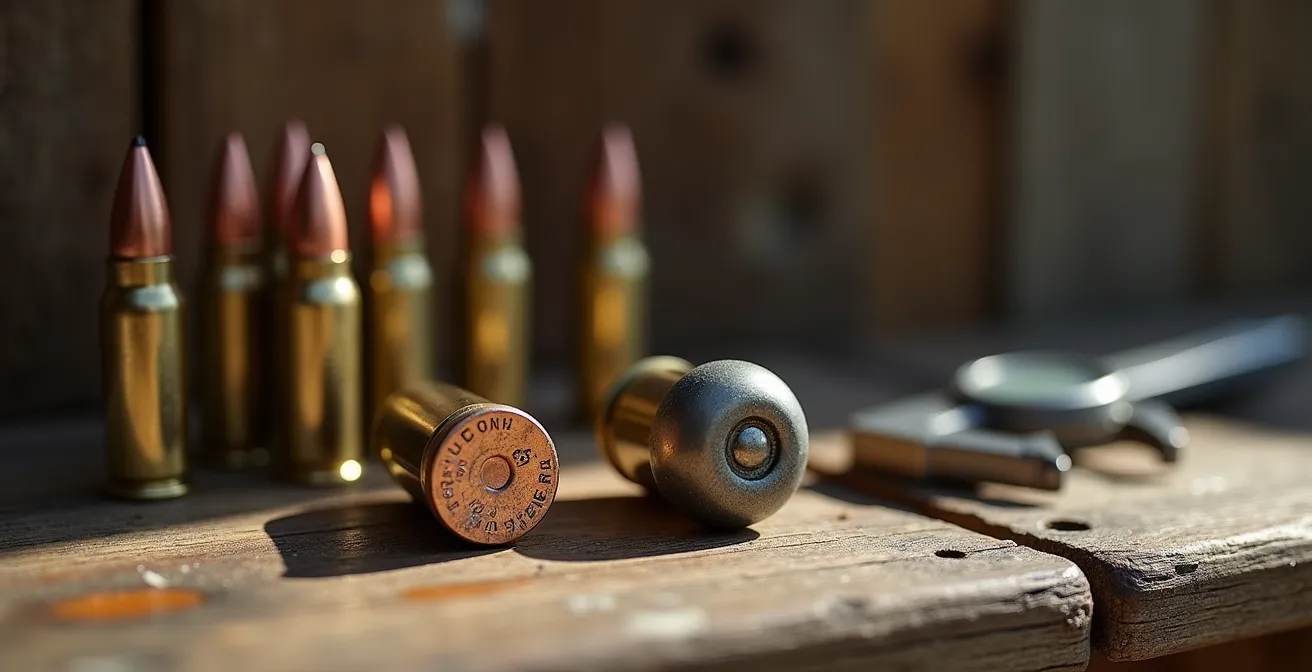
Successfully transitioning to copper ammunition is a full system recalibration, not just a simple zero adjustment.
- Copper bullets require higher impact velocities than lead to perform effectively, fundamentally changing their terminal ballistics.
- The extreme fragmentation of lead bullets poses a scientifically proven, lethal threat to wildlife, making the switch an ethical imperative.
Recommendation: Approach the transition by methodically testing your new ammunition’s performance, adjusting your cleaning regimen, and understanding the trajectory differences at various hunting ranges.
For many hunters, the decision to switch from traditional lead-core bullets to non-toxic copper ammunition seems straightforward. You buy a new box, head to the range, and expect a few clicks of the turret to get your rifle back on target. The common wisdom suggests they’re just lighter, faster, and require a quick re-zero. However, this simplistic view overlooks a much deeper reality. The shift to copper isn’t just about changing your point of impact; it’s about fundamentally recalibrating your entire hunting system.
This transition challenges you to go beyond the basics of zeroing. It demands a more profound understanding of terminal ballistics, a more disciplined approach to rifle maintenance, and a conscious acceptance of your role as a primary conservationist. The differences between a fragmenting lead projectile and a monolithic copper one are vast, impacting everything from downrange energy and expansion reliability to the very quality of the meat you harvest and the health of the ecosystem you hunt in. What if the key to mastering this switch wasn’t just in adjusting your scope, but in adjusting your entire mindset?
This guide will walk you through that comprehensive system recalibration. We will explore the critical science of why copper bullets demand more velocity, reveal the stark ecological consequences of lead fragmentation, and provide practical steps for managing copper fouling and adjusting your optics. Ultimately, you’ll see why embracing non-toxic ammunition is a critical step in upholding the principles of Fair Chase for the modern era.
To navigate this essential topic, this article is structured to guide you from the underlying science to the practical field applications. Explore the sections below to master every aspect of the transition to non-toxic ammunition.
Summary: A Complete Guide to Switching from Lead to Copper Ammunition
- Why Copper Bullets Need More Velocity to Expand Than Lead?
- How Lead Fragments in Gut Piles Kill Eagles and Condors?
- Why Copper Fouling Builds Up Faster and How to Remove It?
- Is the Higher Price of Non-Toxic Ammo Worth It for Meat Quality?
- California and Beyond: Which States Now Mandate Lead-Free Hunting?
- Low Power Variable Optics: Are They Faster Than Red Dots for Hunting?
- Modified vs Improved Cylinder: Which Choke Is Best for Flushing Grouse?
- Why Fair Chase Principles Are Critical for the Future of Public Hunting?
Why Copper Bullets Need More Velocity to Expand Than Lead?
The fundamental difference between lead and copper bullets lies in their construction, which dictates their terminal performance. A traditional lead-core bullet features a soft lead center designed to deform and fragment violently upon impact. This process can begin at relatively low speeds. In contrast, copper bullets are monolithic, meaning they are made from a single, solid piece of metal. They are engineered to expand into a “mushroom” shape, retaining weight and driving deep, but this process requires significantly more force—and therefore, more velocity.
This isn’t a minor detail; it’s the core of their ballistic integrity. To achieve reliable expansion, a copper bullet must strike its target above a specific velocity threshold. For many popular designs, this is often a minimum of 1500-1800 fps required for expansion. Below this speed, the bullet may fail to expand, acting like a full metal jacket projectile that pencils through the animal without creating an adequate wound channel. This can result in a lost or unethically wounded animal, even with a perfectly placed shot.
Therefore, a hunter’s responsibility shifts from simply knowing their bullet’s drop at 400 yards to understanding its effective velocity window. You must know the range at which your chosen copper load drops below its minimum expansion velocity. This might mean that a shot that was ethical with a lead bullet at 500 yards is no longer ethical with your copper load beyond 350 yards. It’s a critical piece of data that is essential for a clean and humane harvest.
How Lead Fragments in Gut Piles Kill Eagles and Condors?
The transition to non-toxic ammunition is driven by a stark and scientifically proven reality: lead bullets fragment extensively, and these fragments are poisoning our nation’s most iconic raptors. When a hunter field-dresses a big game animal harvested with a lead bullet, the remaining gut pile becomes a buffet for scavengers. While this is a natural part of the ecosystem, the lead particles left behind introduce a deadly toxin. Eagles, condors, and other wildlife consume these fragments and suffer from acute or chronic lead poisoning, leading to a slow, agonizing death.
The scale of this problem is staggering. A landmark 2022 study in the journal *Science* found that 47% of bald eagles and 46% of golden eagles show evidence of chronic lead poisoning directly attributable to ammunition. The mechanism for this contamination is the microscopic fragmentation of lead bullets. An X-ray examination of harvested deer demonstrates this vividly; one study found that 34% of processed venison packages contained up to 150 separate lead fragments, often spreading far from the primary wound channel. These are the same fragments left behind in the field.

This visual evidence makes the issue undeniable. Unlike a solid copper bullet that retains its mass, a lead bullet disintegrates into hundreds of tiny, toxic pieces. Choosing copper is a direct act of conservation ballistics; it removes this poison from the food chain, protecting the wildlife that defines the very landscapes we hunt. It ensures that the cycle of life that follows a successful hunt remains healthy and untainted.
Why Copper Fouling Builds Up Faster and How to Remove It?
One of the first practical challenges hunters face when switching to copper is increased barrel fouling. Many report a loss of accuracy after fewer shots compared to their experience with lead-core bullets. This isn’t because copper is “dirtier,” but due to a specific chemical and physical interaction within the barrel. The issue often begins with residual fouling from previously fired lead-core ammunition. Small deposits of lead and carbon create a rough, abrasive surface inside the barrel.
When a softer, monolithic copper bullet travels down this pre-fouled barrel, the rough surface essentially “grabs” and strips away small amounts of copper. This copper fouling then builds upon itself, layer by layer, quickly degrading accuracy. This is why ammunition manufacturers like Barnes Bullets strongly recommend a thorough cleaning to remove all existing carbon and lead fouling before firing the first copper round. You must start with a chemically clean slate to prevent rapid accuracy degradation.
Proper cleaning becomes a critical part of the system recalibration. It’s no longer enough to run a boresnake through the barrel; you need to use the right solvents to target specific types of fouling. A good cleaning regimen involves using a carbon solvent first, followed by a dedicated copper solvent. The color of your cleaning patches will tell you what’s happening inside your barrel, as this diagnostic table shows.
The following table, based on common wisdom from experienced reloaders, can help you diagnose the type of fouling in your barrel. A link to the original forum discussion providing these insights can be found for more context from the community at sources like the 6.5 Grendel forum.
| Patch Color | Fouling Type | Cleaning Action Required |
|---|---|---|
| Blue/Green | Copper fouling | Continue with copper solvent |
| Black/Grey | Carbon/powder fouling | Use carbon solvent first |
| White/Clean | No fouling | Barrel is clean, ready for copper |
By learning to read your patches and using the correct solvents in the right order, you can effectively manage copper fouling and maintain your rifle’s peak accuracy for longer shot strings.
Is the Higher Price of Non-Toxic Ammo Worth It for Meat Quality?
The most common objection to switching to copper ammunition is the price. A box of premium copper hunting rounds can indeed cost significantly more than standard lead-core options. However, framing this as a simple cost comparison misses the larger point about the value of an ethical harvest. The higher price is an investment in both environmental health and, crucially, the quality and quantity of the meat you put on your family’s table.
The primary value proposition lies in weight retention. As we’ve seen, lead bullets are designed to fragment, shedding a large percentage of their mass as tiny particles throughout the surrounding tissue. This not only contaminates the meat but also results in significant loss due to “bloodshot” tissue that must be discarded. In contrast, monolithic copper bullets are engineered for high weight retention. Studies show that copper bullets retain 95% or more of their original weight, while fragmenting lead bullets can retain less than 80%, and sometimes far less. This means more clean, edible meat from every animal harvested.
Ballistic gel tests, like those conducted by MeatEater, illustrate the trade-offs. At ideal impact velocities (e.g., 140 yards), a copper bullet can create a devastating and clean wound channel, often outperforming lead. However, these same tests show that at extended ranges (e.g., 500 yards), where velocity drops off, a bonded lead bullet might produce better expansion and hydrostatic shock than a copper bullet that fails to reach its expansion threshold. This doesn’t mean copper is inferior; it means you must match your bullet to your expected hunting distance. When used within their effective velocity window, copper bullets provide a cleaner, safer, and often more efficient harvest.
California and Beyond: Which States Now Mandate Lead-Free Hunting?
The push to phase out lead ammunition is not a fringe movement; it’s a growing regulatory trend across the country and the world, driven by decades of scientific evidence. For hunters, staying ignorant of these laws is not an option. Understanding and complying with regional regulations is a fundamental part of legal and ethical hunting. The regulatory landscape is a patchwork, but the direction of travel is clear.
The most comprehensive regulation in the United States is in California, which implemented a complete ban on the use of lead ammunition for all hunting statewide in 2019. This followed a phased rollout and was a landmark moment in wildlife conservation policy. However, federal regulations have existed for much longer. The use of lead shot for waterfowl hunting has been banned nationwide on federal lands since 1991, a policy that has had a demonstrably positive impact on wetland ecosystems.
Beyond these major bans, many other states have implemented partial restrictions, such as requiring non-toxic shot on state wildlife management areas or for specific species like doves or small game. The movement is also international, with countries like Denmark and the Netherlands having already enacted widespread bans on lead ammunition. Several other states, including Washington and New York, are currently considering or debating expanded restrictions. The list below summarizes the current state of affairs:
- California: Complete ban on lead ammunition for all hunting since 2019.
- Federal Lands: Lead shot has been banned for all waterfowl hunting nationwide since 1991.
- State-Specific Restrictions: Numerous states have partial bans, often on state-owned lands or for particular game species.
- International Precedent: Nations like Denmark and the Netherlands have already adopted broad lead ammunition bans.
- Future Outlook: States like Washington and New York are actively considering expanded restrictions on lead ammo.

This regulatory momentum underscores the importance of making the switch. By proactively adopting non-toxic alternatives, hunters can position themselves as leaders in conservation, staying ahead of mandates and demonstrating a commitment to protecting the future of hunting and wildlife.
Low Power Variable Optics: Are They Faster Than Red Dots for Hunting?
The discussion of copper vs. lead ballistics directly impacts your choice and use of optics, especially modern Low Power Variable Optics (LPVOs). An LPVO offers the flexibility of a true 1x magnification for fast, close-quarters shots (like a red dot) and the ability to zoom in for precise shot placement at distance. However, many hunters are frustrated to find their trusted BDC (Bullet Drop Compensating) reticle is suddenly inaccurate after switching to a lighter, faster copper load.
The reason for this is simple, as explained by optics and ballistics experts like Caylen Wojcik of Modern Day Sniper: most BDC reticles are calibrated for a standard lead-core M193 or M855 trajectory. These reticles are not universal. The hash marks for 200, 300, and 400 yards are calculated based on the specific ballistic coefficient and muzzle velocity of those common lead-core rounds. A monolithic copper bullet, with its different weight, shape, and velocity, will have a completely different trajectory. Your BDC hash marks will no longer correspond to the correct ranges, rendering the reticle unreliable for holdovers.
This is a perfect example of the need for a full system recalibration. You cannot simply switch ammo and expect your gear to work the same way. You must re-validate your entire system. This means either using a custom turret dialed for your specific copper load or meticulously documenting the new points of impact for each hash mark in your BDC reticle at various distances. For any hunter serious about ethical shots at range, this verification process is non-negotiable.
Action Plan: LPVO Zero Adjustment Process for Copper Bullets
- Barrel Sanitation: Clean the barrel completely to remove all lead and carbon fouling before beginning the zeroing process.
- Fouling Shots: Fire 3-5 “fouling” shots with your new copper ammunition to condition the clean barrel before making any adjustments.
- Establish New Zero: Shoot a 5-shot group at 100 yards to establish the new point of impact. Adjust your turrets to bring this group to your desired zero.
- Anticipate Shift: Be prepared for a typical point-of-impact shift. With lighter, faster copper bullets, this is often 2-3 inches high and slightly to the right at 100 yards.
- Verify at Range: Confirm your zero at extended ranges (200, 300 yards, etc.) and carefully note the trajectory differences and new holdovers for your BDC reticle.
Modified vs Improved Cylinder: Which Choke Is Best for Flushing Grouse?
The principles of transitioning to non-toxic ammunition are not limited to rifles; they are just as critical for shotgunners. The material properties of non-toxic shot, such as steel, bismuth, or tungsten, behave very differently from traditional lead shot as they travel through a choke tube and pattern downrange. Simply swapping your lead game loads for steel and using the same full choke you’ve used for years is a recipe for poor patterns and, potentially, damaged equipment.
Lead is a soft, malleable metal. As lead pellets travel through a tight choke, they can deform and swage against each other, helping to create a dense, tight pattern. Non-toxic alternatives like steel are significantly harder and do not deform easily. Forcing a payload of hard steel shot through an overly constricted choke (like a Full or Extra Full) can damage the choke, create unpredictable “blown” patterns with holes, and deliver subpar performance. As a general rule, you should use a more open choke with steel shot than you would with lead to achieve a similar pattern density. For example, an Improved Cylinder or Modified choke with steel might produce a pattern equivalent to a Modified or Full choke with lead.
This isn’t a new challenge for the hunting community. The mandatory transition to non-toxic steel shot for waterfowl hunting in 1991 forced an entire generation of shotgunners to re-learn patterning and choke selection. That historical precedent proves that switching to non-toxic alternatives requires a systematic process of testing and adjustment, not just ammunition substitution. The following table provides a general guideline for choke selection based on shot type.
| Shot Type | Recommended Choke | Pattern Characteristic | Effective Range |
|---|---|---|---|
| Lead Shot | Modified to Full | Tight patterns, deforms on impact | 35-45 yards |
| Steel/Bismuth Shot | Improved Cylinder to Modified | Wider patterns, harder material | 30-40 yards |
| TSS (Tungsten) | Modified or tighter | Dense patterns, minimal deformation | 40-50+ yards |
For flushing grouse in thick cover, where shots are fast and close, an Improved Cylinder choke is often ideal with steel shot, providing a wide, effective pattern at 20-30 yards. The key is to pattern your specific gun, choke, and load combination on paper to know for sure.
Key Takeaways
- The performance of copper bullets is dictated by velocity; they must impact above a specific speed threshold to expand reliably.
- Lead bullet fragmentation is a primary source of lethal lead poisoning in eagles and other scavengers, making the switch to non-toxic ammo a crucial conservation act.
- Transitioning to copper is a full system recalibration that requires changes to your rifle cleaning methods, optic zeroing process, and ethical range limitations.
Why Fair Chase Principles Are Critical for the Future of Public Hunting?
At its heart, the conversation about copper versus lead ammunition is a conversation about the modern application of Fair Chase principles. Fair Chase is the ethical core of North American hunting, demanding that a hunter uses skill and effort to ensure a clean, humane harvest, giving the animal a fair chance. In the 21st century, this principle must extend beyond the moment of the shot to encompass the full ecological impact of our actions. Embracing conservation ballistics is the next logical evolution of this ethic.
Choosing an ammunition that minimizes harm to non-target wildlife is a profound expression of respect for the entire ecosystem. It acknowledges that our responsibility does not end when we tag an animal. Hunters have always been at the forefront of conservation, a fact supported by data showing that, according to a Ducks Unlimited survey, hunters are three times more likely to participate in conservation efforts than the general public. Leading the charge on non-toxic ammunition is our generation’s opportunity to continue that legacy.
This proactive stance is not only ethical but also strategic for securing the future of public hunting. As our society becomes more urbanized and disconnected from the realities of wildlife management, the actions of hunters are under increasing scrutiny. By voluntarily addressing the proven problem of lead poisoning, we demonstrate a collective commitment to science-based conservation and responsible stewardship. As conservation biologist Vincent Slabe stated in National Geographic, hunters are not the problem, but the key to solving it.
Hunters are the primary solution to this problem.
– Vincent Slabe, quoted in National Geographic
By making the conscious, informed decision to switch to non-toxic ammunition, we are not simply complying with regulations; we are actively shaping a positive narrative and ensuring that the tradition of hunting is preserved for generations to come.
Embrace your role as a conservation leader. Take the time to understand the science, test your equipment methodically, and make the switch to non-toxic ammunition to protect the wildlife and preserve the hunting heritage you cherish.