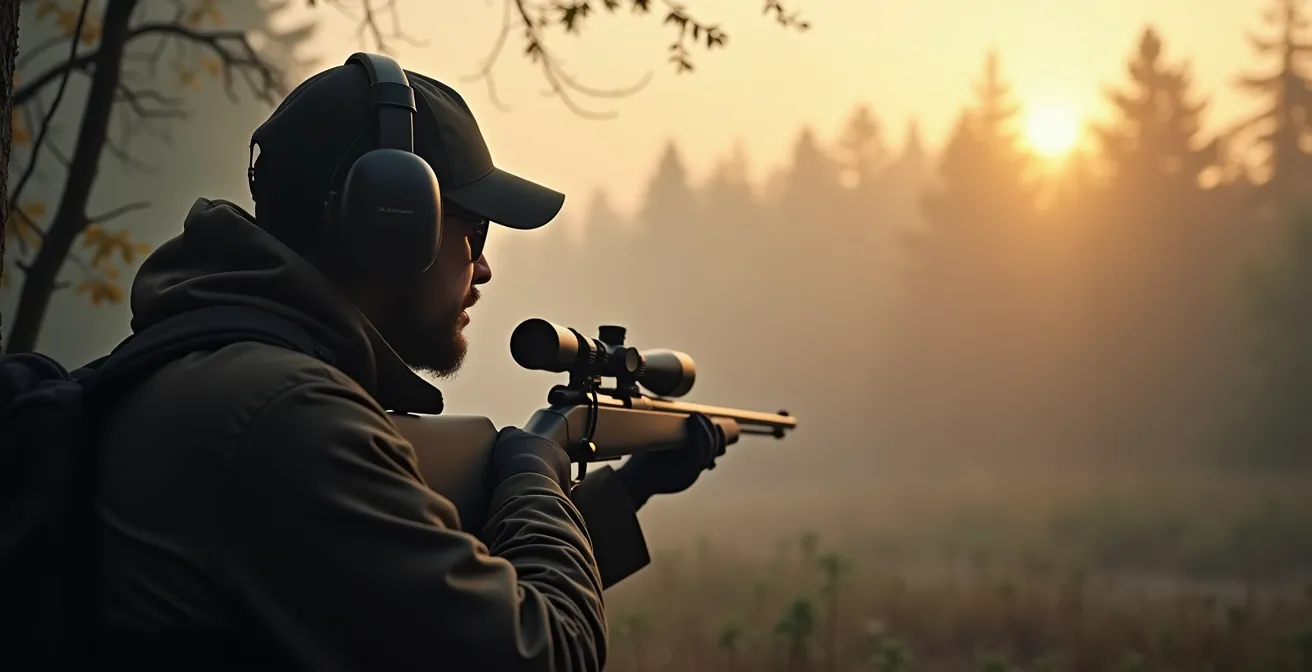
The best hearing protection for a hunter isn’t the one with the highest NRR, but the one that creates the best auditory signal-to-noise ratio.
- Electronic muffs use sound compression and stereo microphones to surgically isolate critical game sounds from distracting background noise.
- Passive protection (plugs/muffs) offers simple, reliable defense but creates total auditory isolation, a significant disadvantage when stalking prey.
Recommendation: Adopt a hybrid strategy. Use electronic muffs for superior situational awareness during active hunting, and switch to passive plugs for stationary positions or to conserve battery life in harsh conditions.
The central paradox for any serious shooter or hunter is the delicate balance between auditory acuity and self-preservation. You must be able to detect the subtle snap of a twig 50 yards away, a sound that exists at the very threshold of human hearing. Yet, moments later, you may unleash a gunshot, an impulse noise powerful enough to cause immediate and irreversible hearing damage. For years, the debate has been framed as a simple choice: inexpensive, reliable passive protection versus expensive, complex electronic systems. Most discussions revolve around a single metric: the Noise Reduction Rating (NRR).
However, from an audiologist’s perspective, this view is dangerously incomplete. The true goal is not simply noise reduction, but the creation of an optimized auditory environment. It’s about maximizing the auditory signal-to-noise ratio, where the “signal” is the sound of approaching game and the “noise” is everything else—wind, rustling clothing, and especially the damaging peak of a gunshot. The most advanced systems don’t just block sound; they act as an external processor for your ears, surgically filtering out harmful impulses while enhancing the specific frequencies that signal opportunity.
This guide moves beyond the surface-level debate. We will dissect the science of sound compression, the critical importance of psychoacoustic directionality for locating game, and the practical, real-world factors that can render even the most expensive headset useless. We will explore how to manage gear compatibility, overcome environmental challenges like cold weather, and ultimately build a hearing strategy that provides both bionic awareness and clinical-grade protection.
To navigate these critical considerations, this article is structured to answer the most pressing questions an expert shooter would ask. The following summary outlines the key areas we will explore in detail, providing a roadmap to mastering your auditory environment in the field.
Summary: An Audiologist’s Analysis of Hunter’s Hearing Protection
- How Fast Must Electronic Muffs Compress Sound to Stop Gunshot Damage?
- Why Stereo Microphones Are Critical for Locating Game Sound Direction?
- How to Wear Eye Protection With Earmuffs Without Breaking the Seal?
- The Cold Weather Battery Drain That Kills Headsets in Winter
- Foam Plugs or Electronic Muffs: Which Is Better for All-Day Stalking?
- How to Test Jacket Noise in Cold Weather Before Buying?
- How to Use a Signal Mirror to Contact Aircraft 10 Miles Away?
- 8×42 or 10×42:Why Adhering to Harvest Quotas Actually Increases Game Populations Long-Term?
How Fast Must Electronic Muffs Compress Sound to Stop Gunshot Damage?
The magic of electronic hearing protection isn’t amplification; it’s compression. Specifically, it’s the speed at which the device can detect a dangerously loud sound, shut off the microphones, and passively block the noise. This is known as “attack time.” To be effective, this action must occur faster than the damaging sound wave can pass through the electronics. From a clinical standpoint, any delay exposes the delicate hair cells of the inner ear to a potent, damaging impulse. Understanding this timing is crucial for evaluating a headset’s true protective capability.
The science is unforgiving. As research on gunshot duration shows, each gunshot’s sound wave lasts up to 5 milliseconds. This means a headset’s circuitry must react in a fraction of that time to prevent the initial, most powerful part of the wave from reaching your eardrum. An attack time measured in single milliseconds is adequate, but a sub-millisecond attack time is the gold standard for clinical-grade protection, especially during rapid fire or at indoor ranges where sound reverberates.
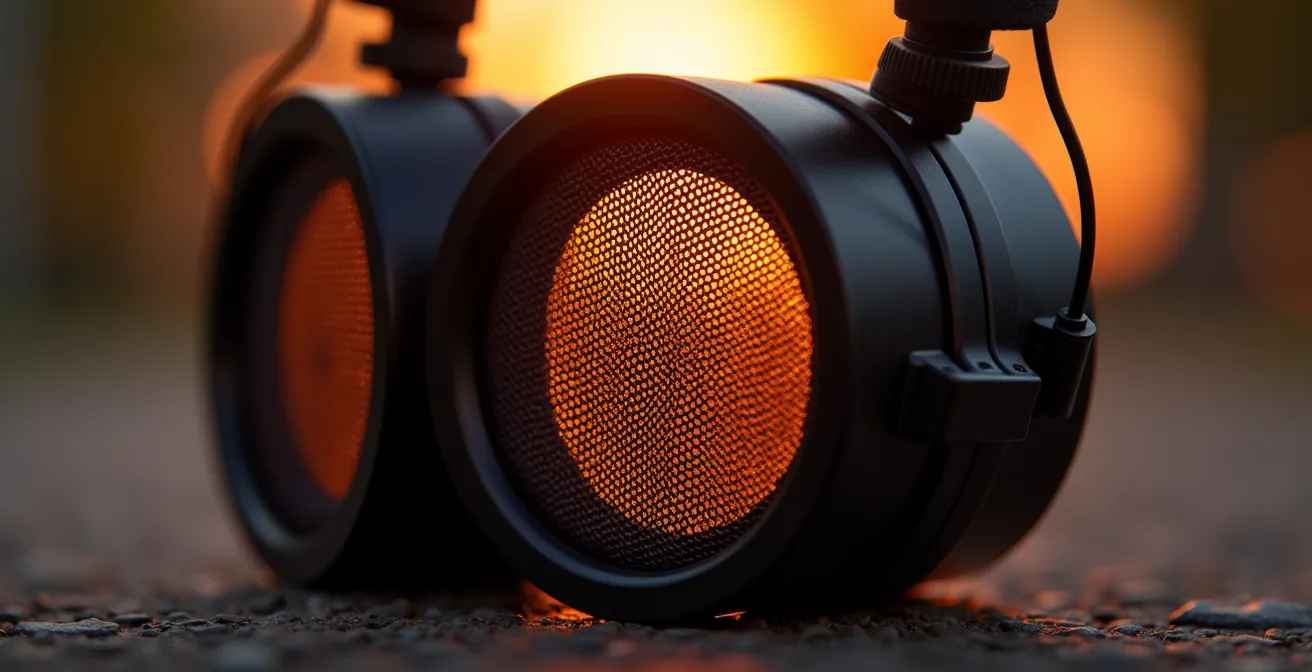
This visualization shows the core principle: the system must identify and “clamp” the peak of the impulse waveform before it reaches a damaging level. A slow attack time, even by a few milliseconds, allows a significant portion of the acoustic energy to leak through, leading to cumulative damage over time. When selecting a device, the attack time specification is a more critical indicator of impulse noise protection than the NRR alone.
The following table breaks down how different attack time specifications translate to real-world protection quality. As an audiologist, I advise shooters to aim for the “Good” to “Premium” tiers to ensure the integrity of their long-term hearing health.
| Performance Level | Attack Time | Protection Quality | Use Case |
|---|---|---|---|
| Premium | <0.5ms | Excellent – Minimal exposure | Indoor ranges, large calibers |
| Good | <1ms | Very Good – Adequate protection | Most shooting scenarios |
| Average | 5-10ms | Moderate – Some exposure risk | Outdoor, smaller calibers only |
Why Stereo Microphones Are Critical for Locating Game Sound Direction?
While sound compression protects your hearing, stereo microphones are what give you a tactical advantage. The human brain locates sound through a process called binaural hearing, interpreting the infinitesimal time and volume differences between what each ear hears. A single-microphone (mono) electronic earmuff amplifies sound but feeds the exact same signal to both ears, completely destroying this directional information. The result is a disorienting auditory experience where a snapped twig sounds like it’s inside your head, not 30 yards to your left. This is where psychoacoustic directionality becomes paramount.
True stereo systems use at least one independent microphone for each ear cup. This setup mimics natural hearing, preserving the subtle time and intensity cues your brain needs to build an “environmental auditory map.” High-quality systems feature high-gain directional microphones that are incredibly sensitive, allowing them to pick up faint sounds. However, this sensitivity can also capture unwanted static or wind noise, making the quality of the microphone and its filtering circuitry a key differentiator between budget and premium models. For a hunter, the ability to instantly and accurately pinpoint the origin of a sound is non-negotiable, and only a true stereo system can provide this.
You can and should test this capability before trusting a headset in the field. A simple test can reveal the difference between a true stereo system and a disorienting mono amplifier.
Your Action Plan: Testing Your Headset’s Directional Accuracy
- Preparation: Put on your electronic hearing protection and turn the amplification to a comfortable level.
- Positioning: Have a friend stand at different positions around you (front, back, left, right) while you close your eyes.
- Sound Cue: Ask them to make a consistent, subtle sound (like jingling keys or snapping fingers) from each position.
- Localization: Without opening your eyes, point to where you believe the sound originates.
- Evaluation: Compare your accuracy. A true stereo system should provide significantly better directional awareness, allowing you to pinpoint the source with confidence.
How to Wear Eye Protection With Earmuffs Without Breaking the Seal?
The most advanced electronic earmuff is rendered ineffective if the protective seal around the ear is compromised. The NRR rating printed on the box is achieved under perfect laboratory conditions. In the field, the single most common point of failure is the interference caused by the arms of shooting glasses. Even a small gap of a millimeter can allow a significant amount of acoustic energy to bypass the muff’s protection, directly exposing the ear to harmful noise levels. This is a matter of biomechanical seal integrity.
The problem is twofold. First, thick-armed safety glasses create a channel for sound to leak in. Second, they create uncomfortable pressure points against the skull, leading to headaches and fatigue during all-day wear. The solution requires a systems-based approach, considering the interaction between your head, your eyewear, and your hearing protection. The best practice is to select shooting glasses with very thin, flat, or flexible temple arms designed specifically for use with earmuffs. These minimize the gap and distribute pressure more evenly.
Furthermore, upgrading the earmuff’s cushions from standard foam to gel-filled cups can make a dramatic difference. Gel is more pliable and conforms more effectively around the thin arms of glasses, preserving the seal where foam would be held open. As one experienced user noted, the cost of this upgrade is minimal compared to the alternative:
Thin seals can be defeated by safety or prescription eyeglass earpieces. When considering cost remember good hearing aids run $4 to 6k and insurance does not cover them.
– MSA Sordins user, Defensive Carry Forum discussion
This highlights a critical truth: investing in a proper seal is not a luxury, but an essential component of the entire hearing protection system. Neglecting it is a direct gamble with your long-term auditory health.
The Cold Weather Battery Drain That Kills Headsets in Winter
Electronic devices and cold weather have always been adversaries. For a hunter relying on electronic muffs for both protection and situational awareness, a dead battery is not just an inconvenience; it’s a mission failure. Standard alkaline batteries can see their effective capacity drop by 50% or more in freezing temperatures. This means a headset that runs for 100 hours in mild weather might die after a single cold day in the field, often without warning. This leaves the hunter with two poor choices: hunt without amplification, losing a key advantage, or hunt without any protection at all.
The problem is exacerbated by modern features. While the ability to connect to radios or phones via a 3.5mm jack is useful, the increasing reliance on Bluetooth connectivity for communication with newer smartphones puts an even greater strain on battery life. The constant power draw of a Bluetooth radio is significant, and in cold conditions, this can drain a battery exponentially faster. As noted in analyses of professional use, reliable communication is essential for guides and teams, making battery management a critical safety issue.
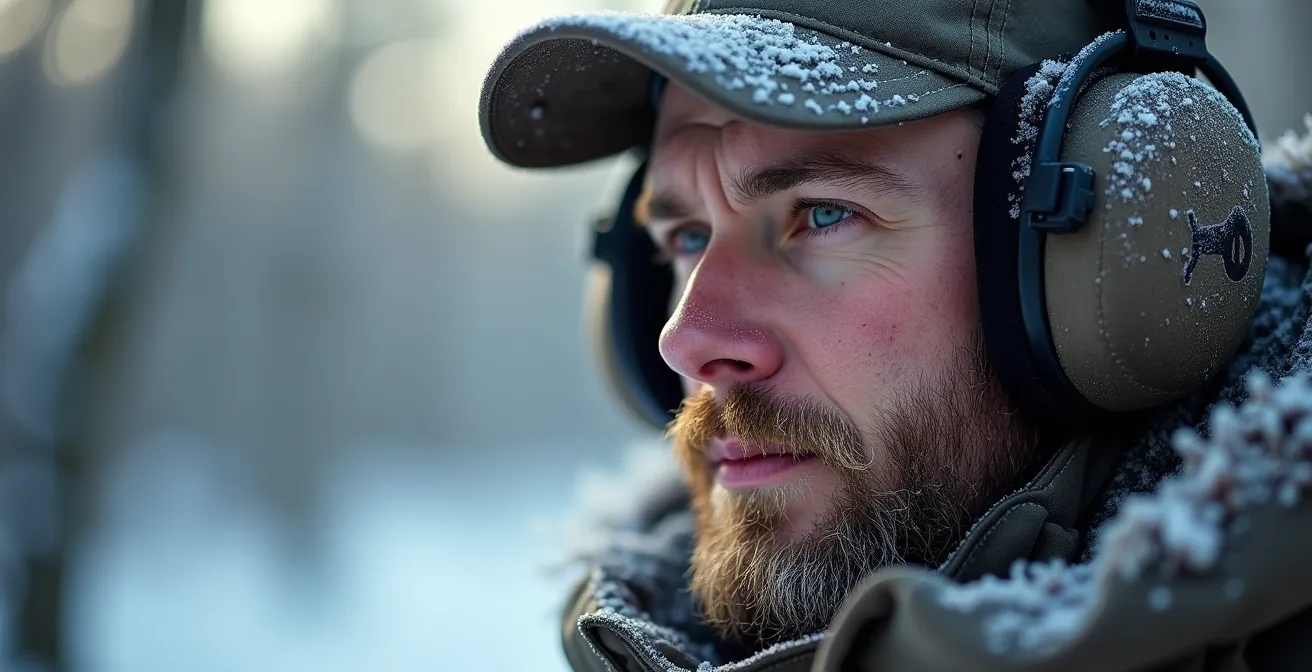
The solution lies in proactive power management. First, always use lithium batteries in cold weather. They maintain their performance far better in low temperatures than their alkaline counterparts. Second, carry a spare set of batteries in an insulated inner pocket, close to your body heat, to keep them warm. Third, use features like Bluetooth sparingly, turning them on only when communication is actively needed. Finally, consider turning the amplification off or using passive plugs during long periods of stationary waiting to conserve power for when it matters most.
Foam Plugs or Electronic Muffs: Which Is Better for All-Day Stalking?
The question of the ideal protection for an all-day hunt is not a simple “either/or” proposition. Both foam plugs and electronic muffs have distinct advantages and disadvantages that make them suited for different phases of the hunt. Choosing the right one—or a combination of both—depends on balancing comfort, situational awareness, and mobility. A comprehensive strategy often involves using both types of protection at different times.
Foam plugs are unbeatable for their simplicity, low cost, and high NRR. They are impervious to weather and require no batteries. However, they create total auditory isolation, which is a major drawback when you need to hear your surroundings. Furthermore, for some users, the constant pressure inside the ear canal can become irritating or painful after several hours. Electronic muffs, conversely, offer superb situational awareness but come with their own set of compromises. They can be bulky, interfere with a proper cheek weld on a rifle stock, and the ear cups can cause heat buildup and pressure points during extended wear.
The following table provides a direct comparison of these factors, highlighting the trade-offs involved in choosing one over the other for a long day in the field.
| Factor | Foam Plugs | Electronic Muffs |
|---|---|---|
| All-day Comfort | Can cause ear canal irritation after 4+ hours | Heat buildup and pressure points after extended wear |
| Situational Awareness | Blocks all sounds equally | Amplifies important sounds while blocking gunshots |
| Mobility/Movement | No interference with rifle stock or movement | Can interfere with cheek weld on rifles |
| Weather Resistance | Unaffected by rain or cold | Electronics vulnerable to moisture and cold |
The most sophisticated approach is a hybrid protection strategy, where you adapt your gear to the situation. This allows you to leverage the strengths of each system while mitigating its weaknesses.
- Early Morning Stalk: Use foam plugs for maximum stealth, silence, and no battery concerns as you move to your position.
- Active Stalking Phase: Switch to electronic in-ear protection for the best balance of sound awareness and mobility.
- Stationary Waiting (Treestand): Use electronic over-ear muffs for maximum comfort and amplification while stationary.
- Range Time or Sighting-In: Double up with foam plugs under electronic muffs for maximum NRR and protection.
- End of Day: Return to foam plugs for the walk out, preserving the battery life of your electronic set for the next day’s hunt.
How to Test Jacket Noise in Cold Weather Before Buying?
The most advanced, high-gain electronic headset is rendered completely useless if the noise generated by your own clothing is louder than the sounds you’re trying to detect. As one gear expert bluntly puts it:
Your $300 electronic headset is useless if the ‘noise’ from your own jacket rustling overpowers the ‘signal’ of a deer walking 50 yards away.
– Hunting Gear Expert, Field Testing Analysis
This perfectly illustrates the concept of the auditory signal-to-noise ratio in a practical context. The crisp, crinkly sound of a nylon shell is a high-frequency “noise” that can completely mask the low-frequency “signal” of an animal’s movement. This problem is magnified in cold weather, as many synthetic fabrics stiffen and become significantly louder. Therefore, testing a jacket’s noise profile, especially under cold conditions, is not an optional detail—it’s a critical part of building an effective hunting system.
You don’t need a laboratory to perform this test. A thoughtful approach in the store can reveal a jacket’s true acoustic properties before you spend your money. The key is to simulate realistic movements and, if possible, realistic temperatures.
Your Checklist: In-Store Jacket Noise Testing Protocol
- Movement Simulation: In the changing room, perform realistic hunting movements. Draw an imaginary bow, shoulder an imaginary rifle, and twist your torso slowly from side to side.
- Auditory Assessment: Listen carefully with your eyes closed. How much noise does the fabric produce against itself and any underlayers?
- Cold Test: Find the store’s refrigerated or freezer section. This is your cold-weather laboratory. Spend a minute there to let the fabric stiffen.
- Re-evaluation: Repeat the movement tests inside the cold section. Is the noise level noticeably higher? A quiet jacket should remain quiet.
- Material Comparison: Compare different materials directly. Soft fabrics like wool and high-quality fleece are typically the quietest, while crisp nylon and untreated hard shells are the loudest offenders.
How to Use a Signal Mirror to Contact Aircraft 10 Miles Away?
In an era dominated by electronic communication, the idea of using a simple mirror for signaling can seem archaic. However, for any hunter or outdoorsman operating in remote areas, mastering this passive skill is a critical layer of safety. As we’ve seen, electronic devices fail. Batteries die in the cold, GPS units lose signal, and satellite phones can be rendered useless by damage or terrain. In these situations, a signal mirror becomes one of the most powerful and reliable long-range communication tools available, capable of catching the eye of a pilot miles away. Its effectiveness is based on simple physics, not fragile electronics.
The principle is to aim the reflection of the sun at your target. Modern signal mirrors have a retro-reflective mesh sight in the center. To aim, you hold the mirror near your eye and look through the sight at your target (the aircraft). You then adjust the mirror until you see the bright reflection of the sun—often called the “fireball”—on a nearby surface, like your hand. By moving the mirror, you align that fireball with the hole in the sight. When the fireball disappears into the hole while you are still looking at the target, the reflection is perfectly aimed. The flash can be seen from immense distances, far beyond the range of a whistle or shout.
This backup capability is not just for individual emergencies. As studies on wildlife management logistics show, robust communication is essential for coordinating teams in the field. When electronic systems fail, passive signaling methods like mirrors become a vital tool for ensuring both hunter safety and the successful execution of management objectives. It is a fundamental skill that bridges the gap when technology fails.
Key Takeaways
- An attack time of less than 1 millisecond is non-negotiable for protecting your hearing from the instantaneous damage of a gunshot.
- True situational awareness comes from quality stereo microphones that preserve psychoacoustic directionality, not just from simple sound amplification.
- A hearing protection system is only as strong as its weakest link: a broken eyewear seal, a dead battery, or a noisy jacket can render expensive electronics useless.
8×42 or 10×42:Why Adhering to Harvest Quotas Actually Increases Game Populations Long-Term?
This question brilliantly links two pillars of the ethical hunter’s mindset: using the best tools for precise identification and adhering to the scientific principles of wildlife management. The choice between 8×42 and 10×42 binoculars and the discipline of following harvest quotas may seem unrelated, but they both serve the same ultimate goal: ensuring the health and sustainability of game populations for future generations.
The binocular choice is a technical one, rooted in optics. It’s about ensuring you can make a positive and ethical identification of your target. In low-light conditions at dawn or dusk, an 8×42 binocular often outperforms a 10×42. According to optical physics, the 8×42 model has a larger “exit pupil” (42mm/8 = 5.25mm) than the 10×42 (42mm/10 = 4.2mm). This means 8×42 binoculars can have over 20% more light-gathering surface area, delivering a brighter image and allowing a hunter to more clearly identify an animal’s age, sex, and health before making the decision to shoot. This precision prevents mistakes and supports selective harvesting.
This act of selective harvesting is the practical application of a core wildlife management principle, which directly addresses the second half of the question. Adhering to harvest quotas is not about limiting hunting; it’s about ensuring the long-term vitality of the herd through a concept known as “compensatory mortality.”
Case Study: The Harvestable Surplus and Compensatory Mortality
The concept of a “harvestable surplus,” famously observed by Aldo Leopold, is a cornerstone of modern North American wildlife management. It posits that in any healthy animal population, a certain percentage of individuals are “surplus” and will inevitably die during the harshest part of the year (typically winter) due to starvation, disease, or predation. As the Boone and Crockett Club explains, hunting mortality can compensate for this “natural” mortality. By allowing hunters to harvest these surplus animals in the fall, the total number of deaths over the year does not increase. The population entering the next breeding season remains stable and healthy, as hunting has simply replaced a death that would have occurred anyway. This regulated harvest prevents overpopulation, which can lead to habitat destruction and catastrophic die-offs from disease, ultimately resulting in a stronger, more resilient population over the long term.
Thus, the two parts of the question merge. The ethical hunter uses the best optical tools to make a clean, selective choice, and then acts within the scientific framework of harvest quotas to ensure their actions contribute to, rather than detract from, the health of the ecosystem.
Now that you understand the auditory science and ethical considerations behind your gear choices, the next logical step is to assess your specific hunting environment and choose the system that provides the best balance of protection, situational awareness, and reliability for your needs.