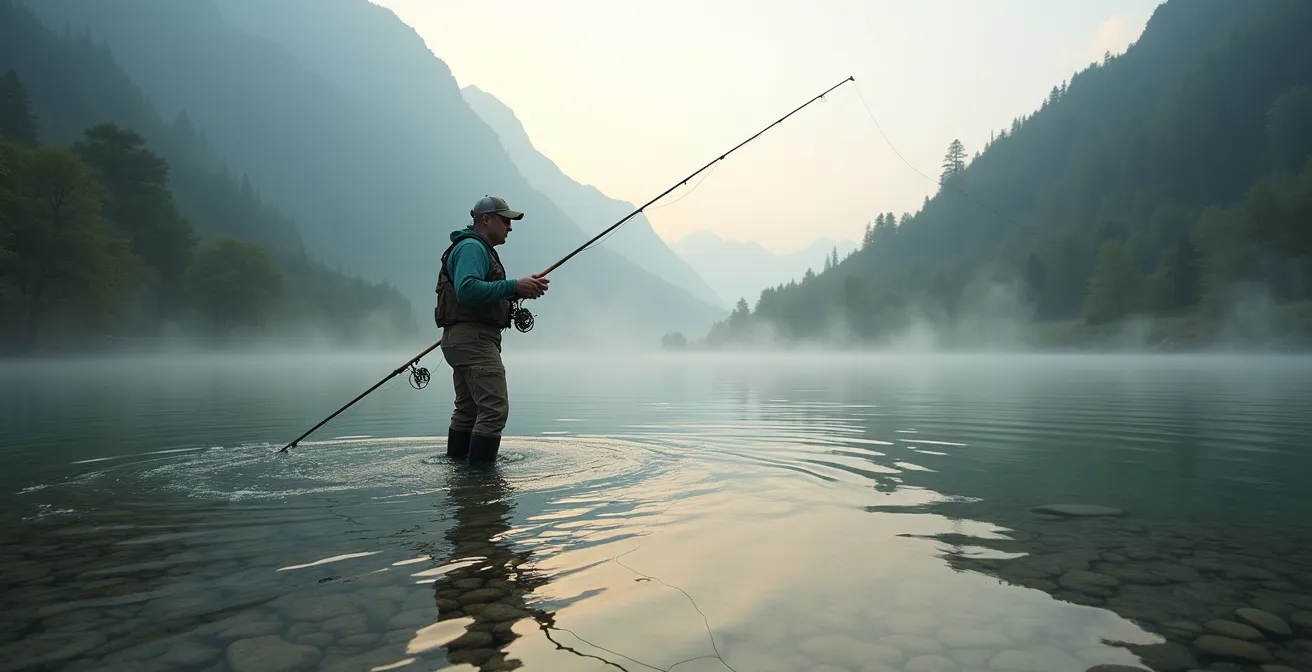
Getting your nymphs into the strike zone in deep, fast water is less about adding weight and more about mastering a complete presentation system.
- Floating lines excel in complex currents like eddies, but sinking lines are non-negotiable for defeating the uniform force of deep, heavy water.
- The effectiveness of a sinking line depends on a holistic system: the correct line density, a short leader for sensitivity, and a specialized cast to manage the weight.
Recommendation: Stop fighting gravity with split shot and start defeating current with a purpose-built sinking line system tailored to the specific depth and speed you’re fishing.
It’s one of the most common frustrations in fly fishing: you spot trout holding deep in a pool, seemingly safe from the current and your presentation. You’ve tried adding split shot until your leader looks like a string of pearls, you’ve used the heaviest tungsten nymphs in your box, but your flies still skate uselessly over their heads. The conventional wisdom to simply “add more weight” is a brute-force approach that often fails because it misunderstands the core problem. The challenge isn’t just gravity; it’s a battle against powerful, multi-layered currents that conspire to keep your flies out of the strike zone.
Many anglers believe a floating line and a long leader are sufficient for all nymphing situations. While this setup is versatile, it reaches its absolute limit in deep pools and fast runs. In these scenarios, the large diameter of a floating line acts like a sail, catching the faster surface currents and dragging your flies unnaturally. The true key to unlocking these deep-holding fish isn’t a heavier fly, but a smarter system. It requires a fundamental shift in thinking: from fighting gravity to efficiently slicing through the water column.
This is where the specialized world of sinking lines comes in. However, simply buying a sinking line is not the solution. The real breakthrough comes from understanding that the line, leader, cast, and presentation are all interconnected parts of a single presentation system designed for depth control. This article will deconstruct that system. We will explore how to choose the right line density, why a short leader is critical for strike detection, how to cast these heavy rigs without creating a tangled mess, and how to adapt your entire approach to the specific water and fish behavior you encounter.
To see the kind of reward that awaits when you get your presentation into the deep strike zone, the following video offers some stunning visual inspiration of the large trout that often inhabit these hard-to-reach lies.
This guide provides a structured approach to mastering the art of deep nymphing. Below, you’ll find a breakdown of the critical components, from gear selection to on-water tactics, designed to transform your subsurface game.
Summary: A Subsurface Angler’s Guide to Sinking Line Systems
- Type 3 vs Type 6:Full-Grain vs Split Leather: Which Resists Abrasion Better in Thorny Scrublands?
- How to Mend Line Without Pulling Your Fly Out of the Strike Zone?
- The ‘Chuck and Duck’ Technique: How to Cast Heavy Lines Safely?
- Why Short Leaders Are Mandatory When Using Sinking Lines?
- The Line Slap Noise That Scares Trout in Still Water
- Why a Tight Loop Is Critical for Accuracy and How to Form It?
- Why Eddies Behind Boulders Are Prime Energy-Saving Spots for Trout?
- Why Brook Trout Feed Actively in Colder Water Than Browns?
Type 3 vs Type 6:Full-Grain vs Split Leather: Which Resists Abrasion Better in Thorny Scrublands?
The first step in building your deep nymphing system is choosing the right tool for the job, and not all sinking lines are created equal. The most common designations you’ll encounter are “Type 3” and “Type 6,” which refer to their sink rate. This number is the key to matching your line to the depth and speed of the water. A Type 3 line sinks at approximately 3-4 inches per second, while a faster Type 6 line sinks at 6-7 inches per second. This difference is not trivial; it completely changes your presentation strategy.
Think of it as choosing between a broad search pattern and a targeted strike. A Type 3 line is your workhorse for covering wide, moderately deep feeding lanes. It sinks on a gentle angle, allowing you to perform a “diagonal sweep” through a pool and present your flies to fish holding at various depths between 5 and 15 feet. A Type 6 line, by contrast, is a specialized tool for “vertical bombing.” Its rapid descent is designed to punch through heavy current and get your flies into deep pockets, sharp drop-offs, or the buckets behind large boulders in the 15 to 30-foot range, where a slower line would be swept away before ever reaching the bottom.

The choice is strategic. Using a Type 6 line in a shallow, slow pool would cause you to snag the bottom instantly. Conversely, trying to fish a 20-foot-deep, fast-moving run with a Type 3 line is an exercise in futility; the current will carry your line downstream long before it reaches the fish. Understanding the capabilities of each line type is the foundation of effective depth control, a concept clearly outlined in this sinking line basics guide.
| Line Type | Sink Rate (IPS) | Best Application | Depth Range |
|---|---|---|---|
| Type 3 | 3-4 inches/sec | Broad feeding lanes, diagonal descent | 5-15 feet |
| Type 6 | 6-7 inches/sec | Deep pockets, vertical bombing | 15-30 feet |
| Intermediate | 1-2 inches/sec | Shallow runs, stealth approach | 2-8 feet |
Choosing the correct line density is the first and most critical decision in assembling a presentation system capable of defeating the current and reaching fish where they live.
How to Mend Line Without Pulling Your Fly Out of the Strike Zone?
With a floating line, mending is a constant activity. You throw slack, lift the line, and manipulate it on the surface to achieve a dead drift. Attempting these same mends with a full sinking line is a recipe for disaster. Once a sinking line is below the surface, any aggressive upstream or downstream mend will act like a lever, pulling your flies vertically and ripping them out of the strike zone. The key to managing a sinking line is to abandon traditional mending in favor of line control at the start of the cast.
This “no-mend” approach relies on setting up the perfect drift before the fly even sinks. Instead of casting directly across the current, you’ll cast upstream and across at a 45-degree angle. This initial angle of entry provides the necessary slack and time for the line to sink. Your job is then to simply “lead” the line with your rod tip, maintaining a direct connection but without imparting any drag. The thin diameter and density of the sinking line do the work of cutting through conflicting currents, something a floating line simply cannot do.
The Brooks Method for Heavy Water Nymphing
This technique isn’t new. As detailed in discussions about using sinking lines in rivers, the late author and angler Charlie Brooks pioneered a method for presenting large nymphs in the heaviest runs. Forgotten by many with the rise of indicator nymphing, his technique remains the most effective way to achieve a true dead drift with heavy flies in water 3 to 8 feet deep. It involves minimal false casting and uses the weight and belly of the sinking line to slice through currents, eliminating the need for surface mending entirely.
While the “no-mend” rule is primary, there are subtle adjustments. A “slip mend” involves feeding a small amount of line during the drift to maintain depth around a tricky current. A “lift mend” uses a high rod tip to guide the line over a rock or through a seam without creating slack. The goal is always to maintain contact and a natural drift by minimizing surface manipulation and maximizing the inherent properties of the sinking line.
The ‘Chuck and Duck’ Technique: How to Cast Heavy Lines Safely?
Casting a heavy sinking line with multiple flies and split shot, often called a “Chuck and Duck” rig, can be intimidating and even dangerous. A standard overhead fly cast relies on tight loops and timing that simply fall apart with this much weight. The result is often a tangle of line, or worse, a heavily weighted fly hitting your rod or your head. A safer and more effective method is to adopt a continuous motion cast, like the Belgian or oval cast.
Unlike a traditional cast with its distinct back-and-forth planes, the oval cast keeps the rod moving in a continuous, elliptical pattern. This keeps the heavy rig constantly in motion and on a plane away from your body, using water tension to load the rod. There is no pause on the backcast; power is applied smoothly throughout the stroke. For extremely heavy rigs, you must widen your casting arc from the typical 10-and-2 o’clock positions to a broader 9-and-3. This slows the cast down and prevents the rig from colliding with the line or rod, which is the primary cause of tailing loops and tangles with heavy setups.
Another critical adjustment is to drastically reduce false casting. As experienced guides recommend, focusing on shooting line is far more effective. Sinking lines are thinner and less rigid than floating lines, making them notoriously prone to tangling in the air. A single, smooth backcast that loads the rod, followed by a powerful forward stroke that shoots the line, is all that’s needed. Let the weight of the line do the work.
- Start with the rod tip low and the line straight behind you, anchored by the water.
- Execute a continuous oval motion, keeping the heavy rig on a constant plane away from your head.
- Use water tension to help load the rod during the “Duck” or backcast phase.
- Apply a non-stop power stroke during the “Chuck” or forward cast without any pause.
- Widen your casting arc for heavier rigs to prevent collisions and tangles.
- Minimize false casts; one or two at most before shooting the line.
By replacing the abrupt stops and starts of a traditional cast with a fluid, open-looped motion, you can handle even the heaviest deep nymphing rigs with safety, accuracy, and control.
Why Short Leaders Are Mandatory When Using Sinking Lines?
When fishing a floating line, a long leader of 9 feet or more is essential for stealth and a natural drift. When using a sinking line, that same long leader becomes your greatest enemy. The entire purpose of a sinking line is to create a direct, tight-line connection between your rod tip and your flies. A long leader introduces slack, sag, and stretch into this system, creating a fatal delay in strike detection.
Every foot of leader is a foot of material with more stretch and less density than your fly line. When a trout subtly inhales your nymph 15 feet down, that take has to travel up the leader before it ever registers on the sinking line and, finally, in your hand. This delay is significant; as Montana fishing guides recommend 3-4 foot fluorocarbon leaders, they note that each additional foot of leader can introduce a critical delay. By the time you feel the fish, it has likely already felt the unnatural tension and spit the hook. A short leader, typically 3 to 4 feet in length, maximizes your sensitivity and ensures you feel the take almost instantly.
This short leader should be made of fluorocarbon material. Its density helps it sink along with the fly line, and its low visibility provides stealth. While the standard is short, there are exceptions. In ultra-clear, slow-moving pools where fish are exceptionally spooky, extending the leader to 4-6 feet can be advantageous. This creates more distance between the fly and the more visible fly line. However, this is a conscious trade-off: you are sacrificing some strike detection sensitivity for increased stealth. For most deep nymphing situations, the rule is simple: keep it short to stay in contact.
The Line Slap Noise That Scares Trout in Still Water
Getting your flies deep is only half the battle; you have to do it without alerting every fish in the pool to your presence. One of the biggest mistakes anglers make with sinking lines is the noise created when picking the line up for a recast. Ripping a heavy, submerged line from the depths creates a loud “thwump” or “ripping” sound that travels underwater with alarming efficiency. In the turbulent water of a heavy run, this may be masked. But in a quiet, deep pool, this sound is a death knell for your chances. It’s the equivalent of shouting “I’m here!” before you’ve even made your next cast.
The acoustic signature of your presentation matters. A heavy “Chuck and Duck” cast creates a significant surface disturbance, while a light, tight-looped tuck cast with a floating line is nearly silent. The key to stealth with sinking lines is not just in the cast, but in the pickup. To solve this, you must learn the Roll Cast Lift technique. Instead of yanking the line from the water, you perform a gentle roll cast that brings the line and flies to the surface smoothly. Once the line is straight on the surface, you can then initiate your backcast with a quiet lift, eliminating the commotion entirely.
As this table shows, the technique used has a dramatic impact on the level of disturbance and the corresponding risk of spooking fish. Your choice of cast and pickup method should be as deliberate as your choice of fly, especially when targeting wary trout in calm water.
| Technique | Sound Level | Fish Spooking Risk | Best Water Type |
|---|---|---|---|
| Floating line with tuck cast | Minimal ‘plink’ | Low | Clear, calm water |
| Sinking line Chuck & Duck | Loud ‘thwump’ | High | Turbulent water |
| Euro-nymphing entry | Nearly silent | Very Low | All conditions |
| Roll cast lift technique | Gentle surface break | Low | When recasting sinking lines |
Action Plan: Auditing Your Line Pickup for Stealth
- Identify Contact Points: On your next outing, consciously observe your line pickup. Where does the loud “rip” originate? Is it the leader, the line belly, or the tip? Note all points where sound is generated.
- Collect Your Baseline: Perform your normal line pickup five times. Be honest about the amount of surface commotion. Is it a quiet lift or a loud tear? This is your starting point.
- Check for Coherence: Now, perform five Roll Cast Lifts. Compare the noise and water disturbance to your baseline. Does your old method align with the goal of a stealthy presentation?
- Assess Feel and Control: Note the difference in feel. The violent rip is uncontrolled. The Roll Cast Lift is a deliberate, controlled movement. Recognize that control equals stealth.
- Implement a Practice Plan: Dedicate the first 10 minutes of your next three fishing sessions exclusively to practicing the Roll Cast Lift. Your goal is to make it the default, muscle-memory method for recasting a sinking line.
A quiet presentation is a deadly one. By mastering techniques that minimize your acoustic footprint, you ensure your flies are the first thing a trout notices, not the sound of your line.
Why a Tight Loop Is Critical for Accuracy and How to Form It?
For dry fly fishing, the tight loop is king. A crisp, narrow loop that unrolls like a straight line is the hallmark of an expert caster, delivering the fly with pinpoint accuracy and delicacy. It’s formed by a short, sharp casting stroke (the classic 10-to-2 o’clock motion) and an abrupt stop on both the back and forward cast, which transfers energy efficiently down the line. A tight loop cuts through the wind and allows the angler to place a fly precisely in a teacup-sized target. Even with floating-line nymphing, a tight loop followed by a sharp stop creates the “tuck cast,” which drives nymphs downward on entry.
However, this same tight loop becomes a major liability when you switch to a heavy sinking line or a multi-nymph rig. The pursuit of a tight loop with a heavy rig is the number one cause of frustration, tangles, and “ticking,” where the fly hits the leader or line in mid-air. The increased mass of the sinking line and flies simply cannot change direction as quickly as a light dry fly line. Attempting to force it into a narrow, high-speed loop causes the rig to “overshoot” the loop’s path, resulting in the dreaded tailing loop or a knot that guides call a “wind knot” (which has nothing to do with wind).
When Tight Loops Become a Liability
As professional guides often explain, the transition to heavy subsurface rigs requires a fundamental shift in casting philosophy. You must move from forcing the line with a tight, fast stroke to guiding it with a slower, more open one. The casting arc must widen from 10-2 to 9-3, and the stroke must be a smooth acceleration rather than a crisp snap. This wider, more open loop gives the heavier rig the physical space it needs to travel without colliding with itself. The goal is no longer to form the tightest loop possible, but the most controlled and efficient loop for the weight being cast.
The key is to adapt your loop size to the rig you are fishing. You must let the weight of the line dictate the cast, not the other way around. Here is a quick guide to adjusting your loop:
- Dry Flies: Maintain a crisp 10-2 o’clock stroke with an abrupt stop for tight, accurate loops.
- Floating Line Nymphs: Use a tight loop with a sharp “tuck” at the end of the forward cast to drive nymphs down vertically.
- Sinking Lines: Widen your casting arc to 9-3 o’clock and reduce wrist snap to create a more open, controlled loop.
- Heavy Multi-Nymph Rigs: Slow down the entire casting stroke, emphasizing smooth acceleration and letting the line’s momentum do the work.
Why Eddies Behind Boulders Are Prime Energy-Saving Spots for Trout?
Not all deep water is created equal. While the main channel of a river may be deep, its uniform, powerful current often forces fish to expend too much energy. The most strategic holding positions for trout are spots that offer depth and safety right next to a food source, without the energy cost. Eddies, the soft cushions of water behind large boulders and other obstructions, are the perfect example of this. They are prime real estate for trout because they function as both a sanctuary and a cafeteria.
The physics are simple: as the main current flows past a boulder, it creates a zone of slack or even reverse-flowing water directly behind it. This is the “eddy.” The line where the fast main current meets this soft water is called the current seam. This seam acts as a conveyor belt, delivering a constant stream of dislodged nymphs and other food items. A trout can sit comfortably in the slow water of the eddy, expending almost no energy, and simply dart out into the seam to intercept passing meals. As research shows, trout expend minimal energy while feeding in eddy cushions, and with over 90% of their diet consisting of subsurface insects, these seams are a critical food source.
Interestingly, this is one of the few deep-water situations where a floating line often outperforms a sinking line. A sinking line cast into an eddy system is often at the mercy of the complex currents; the main flow will grab the line’s belly and drag the flies unnaturally out of the soft water. A floating line, however, allows for precise mending on the surface. You can drift your indicator rig down the current seam, and with a careful mend, “steer” your nymphs off the seam and allow them to swing naturally into the eddy. This perfectly mimics the behavior of a natural nymph being swept into the slack water, a trigger that few trout can resist.
Key Takeaways
- Sinking line selection is strategic: Use Type 3 for broad sweeps and Type 6 for vertical drops in deep water.
- Abandon traditional mending with sinking lines; control the drift with your initial cast angle and by leading the line.
- Use a short (3-4 ft) fluorocarbon leader to maximize strike detection and sensitivity. A long leader kills contact.
- Adapt your cast: Use wide, open loops (oval cast) for heavy rigs to prevent tangles and ensure safety.
Why Brook Trout Feed Actively in Colder Water Than Browns?
Mastering your presentation system is the final piece of the puzzle, and it requires adapting your approach to the specific species you’re targeting and the water temperature. Different trout species have different metabolic responses to cold water, which dictates their feeding behavior and, in turn, your line choice. Brook Trout, being native to colder climates, remain surprisingly active in water temperatures between 35-50°F. Brown Trout, on the other hand, become increasingly lethargic in the same temperature range.
This biological difference has huge implications for your strategy. An active Brook Trout in 45°F water might move several feet to intercept a fly presented on a floating or intermediate line. A lethargic Brown Trout in that same water will not. It will hold tight to the bottom in the deepest, slowest part of a pool to conserve energy. To catch that fish, you cannot expect it to come to your fly; you must take the fly directly to it. This is a prime scenario for a fast-sinking Type 6 line. The goal is to present the nymph directly in the fish’s holding zone with minimal required movement from the fish. It’s about making it too easy to refuse.
Seasonal Line Selection Strategy
Experienced guides live by this principle. During the extreme cold of winter or the heat of summer, when fish metabolism is low, success is all about getting the fly to the fish’s precise depth. Guides often report being shocked at how much weight or sink rate is truly needed. In these conditions, a fast-sinking line that delivers the fly directly to a lethargic fish is the most effective tool. Conversely, during the more moderate temperatures of spring and fall, when fish are active and willing to move, a floating line rig that allows you to cover more water with a natural drift becomes the superior choice.
The right line is not just about water depth; it’s about fish activity level. By understanding the temperature preferences of different species, you can make a much more informed decision about which presentation system will be most effective on any given day.
| Species | Water Temp | Activity Level | Recommended Line | Presentation Strategy |
|---|---|---|---|---|
| Brook Trout | 35-50°F | Moderately Active | Sinking Type 3-6 | Direct presentation to holding zone |
| Brown Trout | 35-50°F | Lethargic | Sinking Type 6 | Minimal movement required |
| Brook Trout | 50-65°F | Very Active | Floating with indicator | Broader searching pattern |
| Brown Trout | 50-65°F | Active | Floating or Intermediate | Natural drift presentation |
Your success in deep nymphing ultimately comes down to this synthesis of knowledge: choosing the right gear, applying the right technique, and adapting it all to the behavior of the fish in front of you.
To put these concepts into practice, the next logical step is to analyze your own gear and on-stream approach to identify the single biggest bottleneck in your current deep nymphing presentation system and work to resolve it.