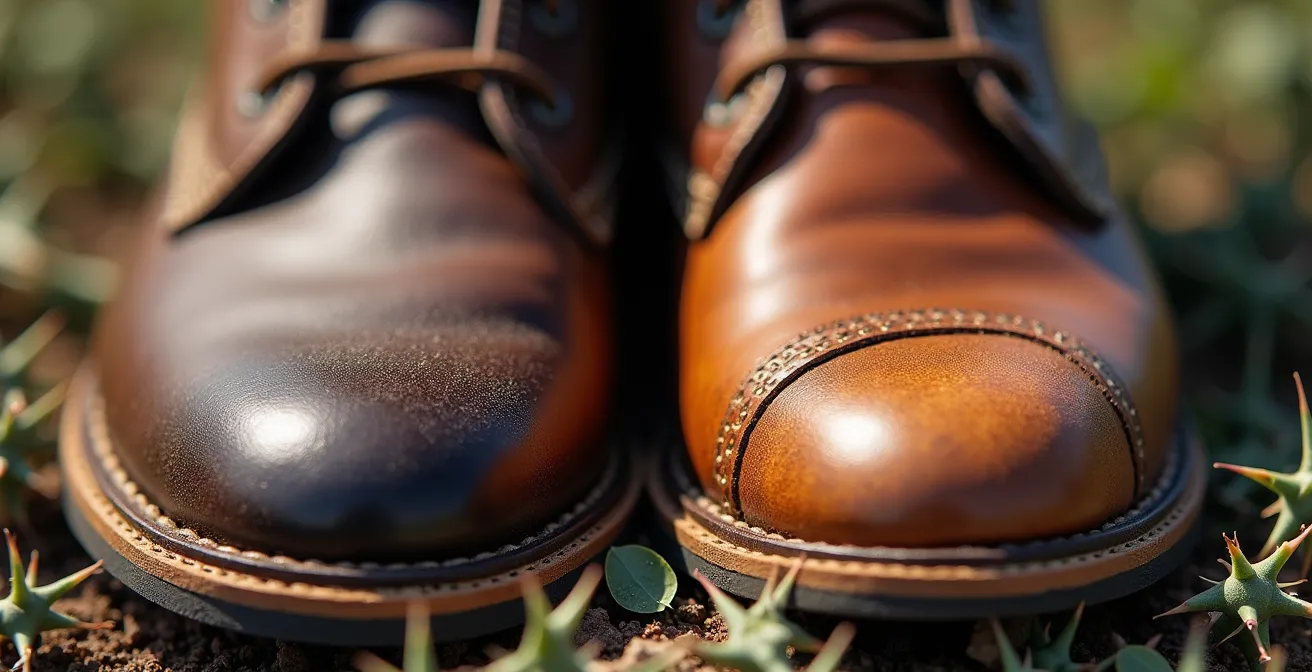
True durability in harsh environments is not determined by a material’s thickness, but by how its micro-structure manages stress and moisture to prevent catastrophic failure.
- Full-grain leather’s intact fiber matrix allows it to stretch and develop a protective patina under stress, while corrected or split leathers delaminate and peel.
- Untreated scratches and improper maintenance create critical weak points where moisture infiltration accelerates degradation, drastically reducing a material’s abrasion resistance.
Recommendation: Evaluate your gear as a complete system—material, construction, and maintenance protocol—not just by the name of the primary fabric.
For the off-trail hiker or hunter, the constant rasp of thorny brush and the scrape of sharp rock are not abstract concepts; they are the primary forces working to destroy expensive gear. The market is flooded with claims of “genuine leather” or “tough synthetic” materials, yet boots and pants often fail prematurely. This leads many to believe that sheer thickness or a recognizable brand name is the hallmark of durability. They invest in heavy, stiff gear only to see it crack, peel, or tear at the seams after a single demanding season.
The conventional wisdom often stops at a simple hierarchy: full-grain is good, split leather is bad. But this superficial understanding misses the critical point. It doesn’t explain the underlying physics of material failure. Why does one leather develop a beautiful, character-rich patina while another peels like a sunburn? Why does a lightweight synthetic sometimes outlast a heavy hide on jagged limestone? The answer lies not just in the material itself, but in its structural integrity, its construction, and the way it is maintained.
But what if the key to longevity wasn’t just choosing the “best” material, but understanding its specific failure mechanics? This expert analysis moves beyond brand names and marketing terms to dissect how these materials perform at a microscopic level. We will explore the structural differences that dictate performance, the critical role of maintenance in preserving fiber integrity, and how construction methods can mean the difference between a resoleable investment and a disposable product. This is a deep dive into the science of what makes gear truly resilient in the field.
This article provides a technical breakdown of the key factors that determine material resilience in the field. By examining each component, from the leather’s surface to the boot’s construction, you will gain the expertise needed to evaluate and maintain your gear for maximum lifespan in abrasive environments.
Summary: A Technical Guide to Material Durability
- Why Genuine Leather Peels While Full-Grain Develops a Protective Patina?
- How to Seal Deep Leather Scratches Before Water Seeps In?
- Leather vs Cordura: Which Material Survives Sharp Limestone Rocks?
- The Maintenance Error That Makes Leather Brittle and Prone to Tearing
- Where to Apply Toe Caps to Prevent Premature Leather Wear?
- Why Double-Front Pants Cause Overheating and How to Vent Them?
- Cemented vs Goodyear Welt: Which Construction Handles Rocky Terrain Better?
- Cream or Wax: Which Waterproofing Method Protects Leather Boots Longer in Rain?
Why Genuine Leather Peels While Full-Grain Develops a Protective Patina?
The distinction between peeling and patination is the most visible indicator of leather quality and durability. It’s a direct result of the material’s micro-structure. Full-grain leather is the outermost layer of the hide, left in its natural state. Its dense, interwoven fibrous matrix is intact, complete with the original pores and minor imperfections. When this leather is scratched or flexed, these fibers stretch and compress, distributing the stress. Over time, exposure to oils, sunlight, and friction causes the surface to darken and burnish, creating a protective layer known as a patina. This is not a sign of wear, but of graceful aging, a process that can become noticeable within six months of regular use.
In contrast, “genuine leather” is a marketing term that often refers to split leather or corrected-grain leather. These are lower layers of the hide that have been separated from the top grain. Their fibrous structure is looser and less durable. To create a uniform, appealing appearance, these leathers are often sanded to remove imperfections and then coated with a synthetic polymer or polyurethane finish. This coating is what gives the “leather” its color and texture. When this material is scraped or bent, the rigid synthetic coating cannot stretch with the underlying fibers. Instead, it cracks and begins to peel or delaminate, exposing the weaker material beneath. This is not aging; it is catastrophic surface failure.
Action Plan: Identifying Quality Leather That Will Patinate, Not Peel
- Check for natural grain patterns: Full-grain retains its original surface texture, including visible pores and natural markings. A perfectly uniform, plastic-like surface is a red flag.
- Perform the water drop test: A drop of water on full-grain leather will slowly absorb and darken the spot. On coated split leather, it will bead up and roll off instantly.
- Examine flexibility: Bend the leather. Full-grain will create fine, oily wrinkles that disappear. Coated leather may show sharp cracks or signs of the coating separating from the base.
- Look for edge finishing: The cut edge of full-grain leather will show a consistent, fibrous structure and color throughout. Split leather may reveal distinct, different-colored layers at the edges.
- Assess the feel and smell: High-quality full-grain leather has a rich, earthy smell and a substantial, slightly oily feel. Coated leathers often feel plasticky and may have a chemical odor.
Understanding this fundamental structural difference is the first step in selecting gear that will last. A material that develops a patina is a material that is working with environmental stresses, while a material that peels is one that is being actively broken down by them.
How to Seal Deep Leather Scratches Before Water Seeps In?
A deep scratch from a thorn or sharp rock is more than a cosmetic flaw; it is a critical breach in the leather’s primary defense. This opening acts as a point of stress concentration, where tearing forces are magnified. More importantly, it becomes a direct channel for moisture to infiltrate the leather’s fibrous matrix. Once inside, water displaces the essential oils and fats that keep the fibers lubricated and flexible. As the leather dries, these fibers can become brittle and fracture, leading to cracks and eventual tearing. Sealing the breach immediately is therefore a matter of structural preservation, not just aesthetics.
The most effective field-expedient method for sealing a deep puncture or scratch is the hot wax injection technique. This requires a small amount of a hard, non-silicone-based wax (like beeswax or a product such as Sno-Seal) and a heat source. The goal is to melt the wax to a liquid state and work it deep into the scratch, filling the void and creating a durable, hydrophobic barrier. This process bonds with the surrounding leather fibers, effectively re-sealing the surface against moisture and reinforcing the damaged area.
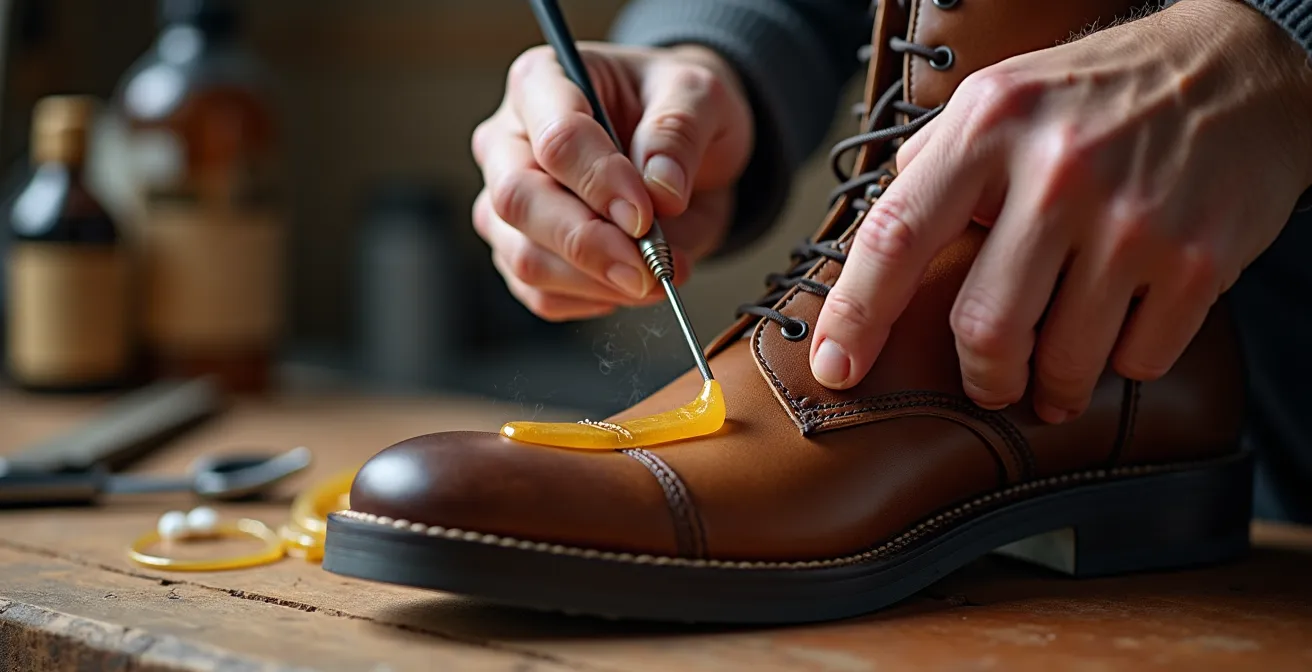
This repair is not just a temporary patch. The heated wax penetrates deeper than a surface-level cream could, restoring a significant measure of the leather’s water resistance and structural integrity. This proactive maintenance is crucial for preventing a minor scrape from evolving into a point of catastrophic failure. Field testing confirms the efficacy of this approach.
SATRA Abrasion Testing on Repaired Leather
In standardized tests emulating real-world abrasion, the SATRA technology center analyzed the durability of damaged leather. Their findings were definitive: leather samples with properly sealed punctures and scratches demonstrated significantly higher resilience. SATRA testing shows properly sealed leather can withstand 40% more abrasion time before failure. The study highlighted that untreated deep scratches act as initiation points for failure, where moisture infiltration rapidly accelerates the degradation of the leather’s structure.
This data underscores that repairing damage is not optional for those who depend on their gear. It is an essential part of a complete durability strategy, directly impacting the functional lifespan of the equipment in harsh conditions.
Leather vs Cordura: Which Material Survives Sharp Limestone Rocks?
The debate between leather and high-performance synthetics like Cordura often oversimplifies their performance. When facing the sharp, cutting edges of limestone or granite, their failure mechanics are fundamentally different. Full-grain leather, with its dense and non-uniform fiber structure, resists this type of abrasion through sacrificial tearing. A sharp edge will catch and gouge the surface, but the interwoven fibers distribute the force, preventing a clean cut from propagating. This results in deep scratches or gouges, which, while damaging, can often be repaired with fillers and conditioners. Leather’s weakness is its weight and its reduced performance when saturated with water, unless properly treated.
Cordura, a brand of nylon fabric, resists abrasion differently. Its strength comes from its woven structure of high-tenacity fibers. On a smooth, abrasive surface (like in a standardized Taber test), it can outperform leather significantly. However, against a sharp limestone edge, the failure mode changes. A sharp point can snag and break individual threads. This initial break creates a weak spot, leading to “thread fuzzing” and a progressive failure as adjacent threads are exposed and subsequently severed. While highly resistant to general scuffing, Cordura is more vulnerable to this localized, point-specific damage. Field repair is also more difficult, typically requiring patches or sewing, whereas leather can be temporarily treated with wax.
The following table, based on material science principles, breaks down their performance characteristics against rock abrasion. It highlights a critical trade-off between absolute abrasion cycles and the nature of the damage sustained, as confirmed by a recent comparative analysis.
| Material Property | Full-Grain Leather | Cordura Fabric |
|---|---|---|
| Abrasion Cycles (Taber Test) | 1,000+ cycles before failure | 3,000+ cycles before failure |
| Limestone Edge Damage | Deep gouges, repairable with filler | Thread fuzzing, progressive failure |
| Field Repair Capability | High – can apply wax/conditioner | Low – requires patches or sewing |
| Wet Abrasion Resistance | Maintains strength when conditioned | Weakens significantly when wet |
| Weight Penalty | Heavy (3-4 oz/sq ft) | Light (8-12 oz/sq yd) |
Ultimately, the choice depends on the specific threat. For relentless rubbing and scuffing, Cordura holds an edge. For environments with sharp, cutting risks where field repairability is paramount, leather’s ability to take a gouge without catastrophic failure is a distinct advantage. However, the material itself is only part of the equation, as noted by technical experts.
Even the toughest materials are useless if the seams are sawed through by rock edges
– Technical analysis from material science research, Material failure analysis in rocky terrain applications
The Maintenance Error That Makes Leather Brittle and Prone to Tearing
The single most common and destructive maintenance error is neglect, specifically the failure to regularly reintroduce oils and fats into the leather. Leather is not a static material; it’s a matrix of protein fibers (collagen) interwoven and lubricated by natural fats. This lubrication allows the fibers to slide against each other when the leather flexes. Without it, the fibers rub directly, creating friction, heat, and eventually, microscopic cracks. This process, known as fiber degradation, transforms supple leather into a brittle, cardboard-like material that is highly susceptible to tearing under load.
This error stems from a misunderstanding of leather care. Many users either do nothing or simply apply a surface-level waterproofing wax. While wax is excellent for repelling external moisture, it does not penetrate deeply to nourish the fibers. The essential maintenance step is applying a penetrating leather conditioner or oil. This replenishes the internal lubrication that is inevitably lost over time due to exposure to water, heat, and flexing. Professional leather care guidelines are clear on this point. Following this schedule can prevent over 90% of brittleness-related cracking issues, drastically extending the life of high-quality boots.
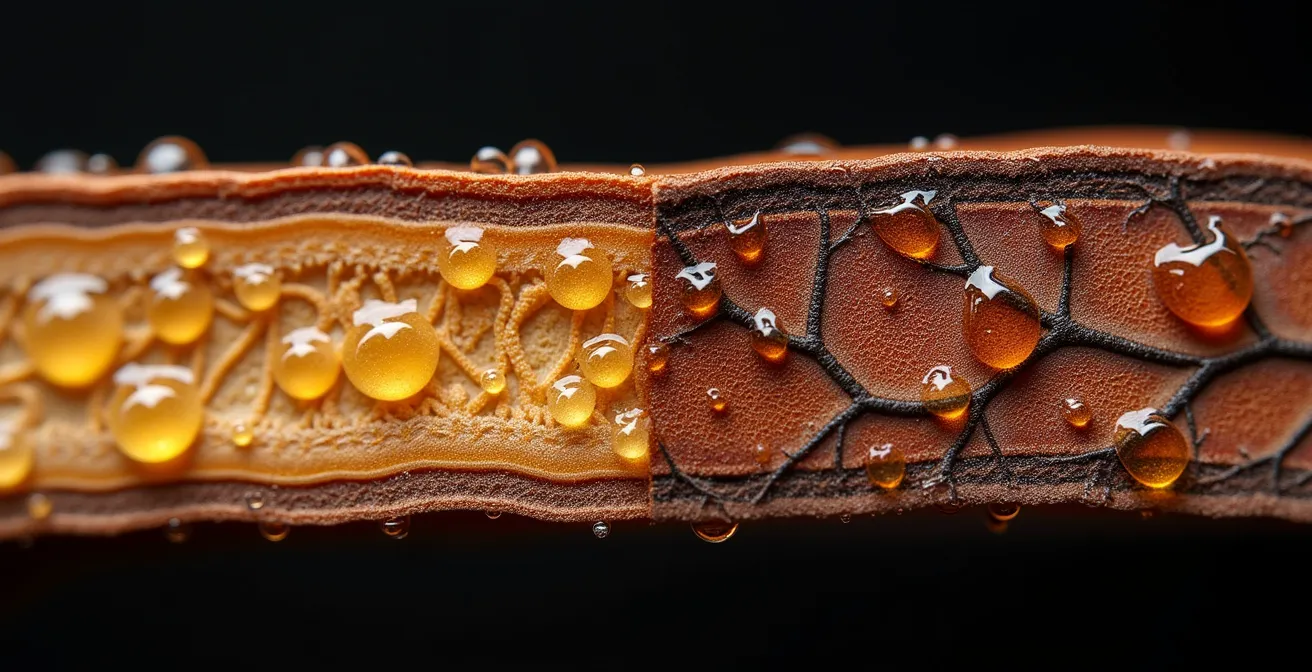
The image above illustrates this perfectly, showing a microscopic view of a healthy, conditioned leather fiber structure saturated with oils, contrasted with a dry, cracked section. Detecting brittleness before it leads to failure is possible with a simple diagnostic technique known as the “Pinch Test.”
- Clean a test area: Use a damp cloth to clean a small, flexible part of the boot and let it dry completely.
- Pinch the leather: Firmly pinch the leather between your thumb and forefinger to create a small, tight fold.
- Observe the crease: Healthy, well-conditioned leather will show fine, oily wrinkles within the crease, which quickly smooth out upon release.
- Check for warning signs: If the crease shows sharp, pale lines that look like tiny cracks, it is a clear indicator that the fibers are dry and beginning to fracture. This is the first sign of brittleness.
- Apply treatment: If these brittle indicators are present, a deep conditioning treatment is needed immediately to restore lubrication and prevent further damage.
Ignoring these signs and continuing to use the gear is the fastest way to cause irreparable damage. A regular conditioning interval of every 3-6 months, depending on use and environmental conditions, is the most effective preventative measure against this common form of material failure.
Where to Apply Toe Caps to Prevent Premature Leather Wear?
While full-grain leather is resilient, certain areas of a boot are subjected to disproportionately high levels of abrasion and impact. Simply having a tough material is not enough; strategic reinforcement in these high-wear zones is essential for maximizing lifespan. Applying a toe cap or rand is the most effective way to achieve this, but its placement must be guided by data on wear patterns, not just aesthetics. The goal is to create a sacrificial and more durable layer over the leather in the areas most likely to fail first.
A “toe cap” is not just for the very front of the toe. Analysis of boot wear in harsh, rocky environments reveals a consistent pattern of damage that extends beyond the apex. This data provides a precise map for where reinforcement is most critical.
Field Analysis of Critical Wear Zones
An extensive field analysis of work boot wear patterns by Thorogood identified three distinct zones of premature failure. The findings show that the apex (the very front of the toe) is not the only area of concern. While it experiences 45% of all impact damage from kicking and front-on contact, the medial scuff zone (the area on the inside edge by the big toe) accounts for 35% of abrasion wear from scraping against rocks and roots during traversal. Furthermore, the break crease, where the boot flexes, accumulates 20% of stress-related damage. Boot repair services confirm that applying reinforcement to these three specific zones can extend a boot’s functional lifespan by two to three years in demanding conditions.
Based on these failure points, the choice of toe cap material becomes a balance of abrasion resistance, flexibility, and repairability. Different materials offer different advantages in a scrubland environment.
| Toe Cap Type | Abrasion Resistance | Puncture Protection | Flexibility | Field Repairability |
|---|---|---|---|---|
| Leather Overlay | Good | Moderate | Excellent | High – can re-condition |
| Bed Liner Coating | Excellent | Good | Poor | Low – requires reapplication |
| Molded Rubber Rand | Excellent | Excellent | Good | Moderate – can patch |
| Tuff Toe Application | Excellent | Good | Moderate | Low – professional repair needed |
For off-trail use, a molded rubber rand that covers not just the apex but also wraps around to protect the medial scuff zone offers the best combination of abrasion and impact protection while maintaining reasonable flexibility. This targeted reinforcement provides a massive durability upgrade precisely where it is needed most.
Why Double-Front Pants Cause Overheating and How to Vent Them?
Double-front pants, favored in abrasive environments for their enhanced durability, present a significant thermal challenge. The second layer of fabric, typically a heavy canvas or duck cloth, creates an excellent barrier against thorns and abrasion. However, it also creates a trapped air layer between the outer panel and the base fabric of the pants. This pocket of air quickly becomes saturated with moisture from perspiration, effectively creating a vapor barrier that halts evaporative cooling—the body’s primary mechanism for shedding heat.
The physiological impact of this effect is significant. Field testing provides concrete data on the extent of the problem. When a worker or hiker is engaged in even moderate activity, the environment inside this trapped layer changes dramatically.
The Vapor Barrier Effect in Double-Layer Work Pants
In-field testing of double-front work pants demonstrated that the trapped air layer can reach 95% humidity within 30 minutes of sustained effort. At this point, sweat can no longer evaporate from the skin’s surface, leading to a rapid rise in local temperature. Test subjects reported a perceived temperature increase of 7-10°F in the thigh and shin area compared to wearing single-layer pants under the same conditions. This localized overheating increases discomfort, accelerates fatigue, and can contribute to heat-related stress.
The solution is not to abandon the protective benefits of double-front construction, but to introduce a mechanism for ventilation. The most effective method is the installation of mesh-backed ventilation zippers. Placing these zippers along the outer seam of the leg allows the user to open them during periods of high exertion, breaking the vapor barrier and allowing hot, moist air to escape. This creates convective airflow, restoring the body’s ability to cool itself. The same study found that this simple modification reduced the internal temperature by an average of 5°F, all while maintaining over 90% of the original abrasion protection when the zippers were closed. This provides a user-regulated system to balance protection and thermal comfort.
Cemented vs Goodyear Welt: Which Construction Handles Rocky Terrain Better?
While the upper material handles abrasion, the boot’s construction method dictates its structural integrity and ability to withstand the torsional forces of uneven, rocky terrain. The two most common methods, cemented and Goodyear welt, offer a stark contrast in this regard. A cemented construction involves gluing the boot’s upper directly to the outsole. This method is lightweight, flexible, and inexpensive, making it popular for light hikers and trail shoes. However, the adhesive bond is a critical point of failure. Under the repeated twisting and flexing stresses of side-hilling or navigating boulder fields, this bond can degrade and delaminate, causing the sole to separate from the upper—a catastrophic failure in the field.
The Goodyear welt, in contrast, is a far more robust system. It involves a strip of leather (the “welt”) that is first stitched to the upper and the insole. Then, in a separate operation, the outsole is stitched to this same welt. This creates a mechanical lock, not a chemical bond. The two rows of independent stitching provide redundancy and create an exceptionally strong and torsionally rigid platform. This rigidity prevents the boot from twisting excessively underfoot, providing a more stable base on uneven ground and reducing foot fatigue. While heavier and stiffer initially, this construction is built for durability and is fully resoleable, as the outsole can be removed without compromising the integrity of the upper.
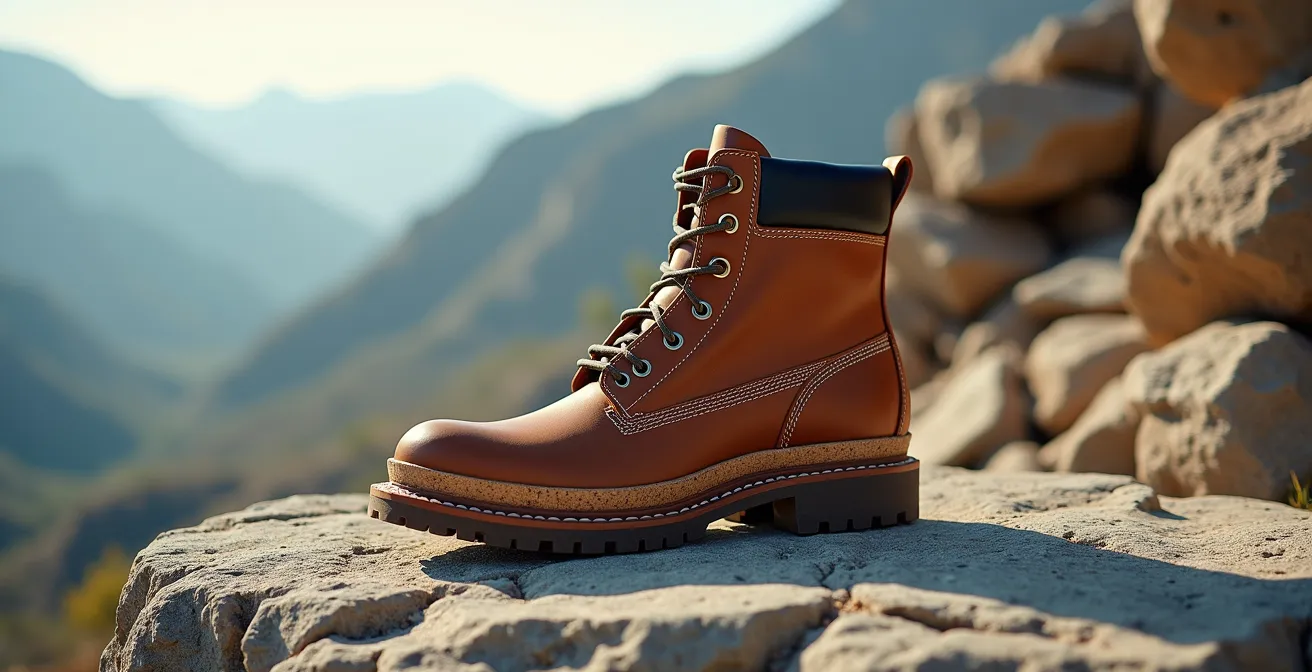
For the most demanding rocky environments, an even more robust variant exists: the Norwegian welt. As boot construction analysis highlights, “The Norwegian welt’s two rows of external stitching offer redundancy and the flared-out upper provides a better seal against debris and water.” This double-stitched system, visible on the exterior of the boot, offers the pinnacle of durability and water resistance for mountain and off-trail use. While a Goodyear welt is an excellent choice for durability, the Norwegian welt represents the gold standard for handling severe torsional stress and environmental ingress.
Choosing a welted construction is an investment in a stable, repairable platform. For terrain that constantly seeks to twist and tear a boot apart at its foundation, the mechanical strength of stitching will always outperform the simple bond of glue.
Key Takeaways
- Material failure is a science: Durability depends on micro-structure and stress management, not just thickness.
- Maintenance is non-negotiable: Unsealed scratches and dry fibers are the primary points of catastrophic failure in leather goods.
- Construction is the foundation: A welted boot provides the torsional rigidity and repairability necessary for long-term use in rocky terrain.
Cream or Wax: Which Waterproofing Method Protects Leather Boots Longer in Rain?
The question of “cream or wax” for waterproofing is a false dichotomy; the correct answer depends on the type of water exposure and the user’s priority between absolute water repellency and leather health. It’s a choice between creating a breathable, water-resistant barrier or an impenetrable, hydrophobic shell. A leather cream or conditioner is an emulsion of oils and waxes in water. It is designed to penetrate deeply into the leather’s fiber matrix to replenish lost fats, keeping the leather supple and healthy. This provides a baseline level of water resistance, effective against intermittent exposure like walking through wet grass or light showers, while maintaining maximum breathability.
A heavy wax, such as those based on beeswax or proprietary formulas like Sno-Seal, functions very differently. It is not designed to penetrate deeply. Instead, it is meant to be melted and applied to the surface, where it cools and hardens to form a thick, semi-permanent barrier. This surface sealant is exceptionally effective at repelling water, making it the superior choice for static water exposure, such as standing in water or trekking through deep, wet snow. However, this robust barrier significantly reduces the leather’s breathability, which can lead to moisture buildup from sweat inside the boot. Over-application can also seal out conditioning oils in the long run.
For users who face varied conditions, a two-system approach is optimal. This involves using a penetrating cream as the primary maintenance tool for leather health and baseline water resistance, supplemented with a heavy wax application at the start of the wet season for enhanced protection. The choice of treatment should be dictated by the anticipated environment.
| Water Exposure Type | Recommended Treatment | Application Frequency | Breathability Impact |
|---|---|---|---|
| Dynamic (wet grass, showers) | Leather Cream/Conditioner | Monthly | Minimal – maintains breathability |
| Static (standing water, snow) | Heavy Wax (Beeswax/Sno-Seal) | Every 2-3 months | Significant – reduces breathability |
| Mixed Conditions | Two-System Approach | Cream monthly, wax seasonally | Moderate – seasonal variation |
| Extreme Wet | Silicone Spray + Wax | Before each exposure | High – minimal breathability |
A strategic, seasonal protocol ensures the best of both worlds: leather that is healthy and supple, yet protected when it needs it most.
- Spring/Summer: Apply a penetrating cream conditioner monthly to maintain fiber health and provide resistance for light rain and morning dew.
- Pre-Fall: Deep clean boots with saddle soap, then apply the first heavy wax coat, using a heat gun or hair dryer to ensure maximum penetration, especially at the seams.
- Winter: Maintain the wax coating with touch-up applications every 6-8 weeks, focusing on high-wear areas like the toe flex and welt stitching.
- Post-Winter: Strip the old, dirty wax using saddle soap, allow the boots to dry completely, and then apply a deep conditioning cream to let the leather “breathe” and rehydrate.
This methodical approach treats waterproofing not as a single action, but as a cycle of preservation and protection, adapting the gear to the demands of the environment.
By applying this technical understanding of material science, construction, and maintenance, you can move from being a consumer of outdoor gear to an expert user who can maximize its performance and lifespan in the most demanding conditions.