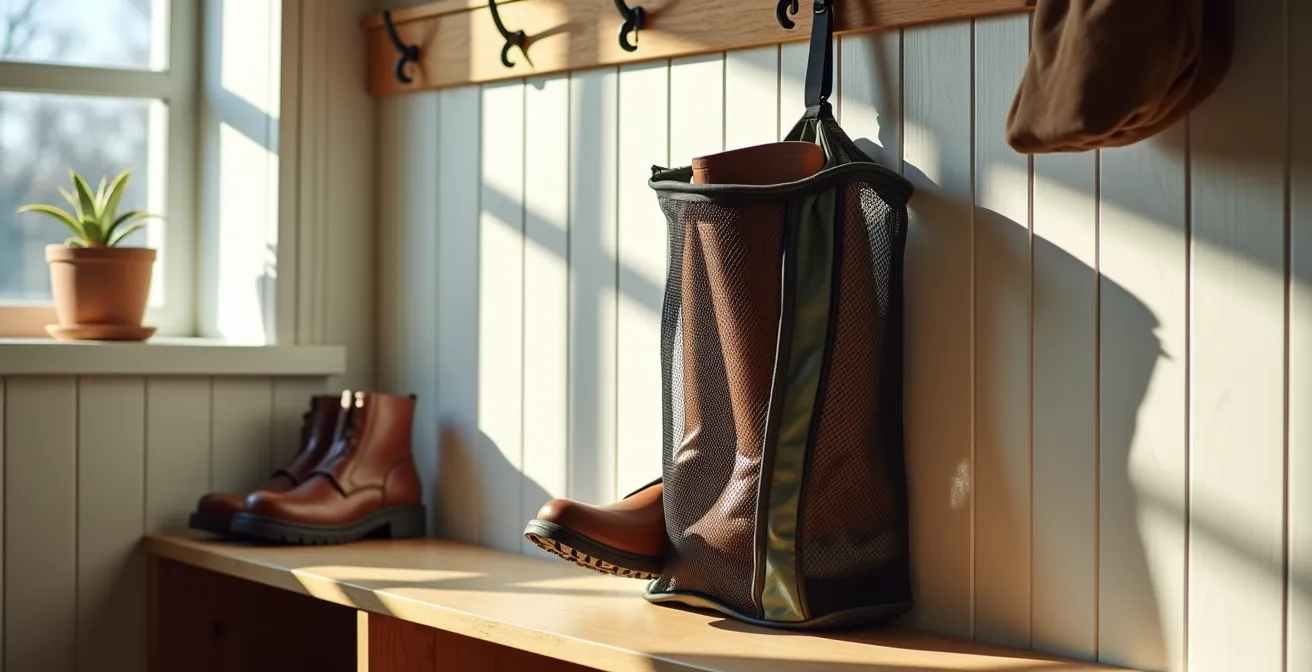
Contrary to popular belief, preventing boot mold isn’t about passive storage in a dry place. The real solution is an active microclimate management system that begins the moment you take your boots off. A ventilated boot bag is the cornerstone of this system, designed not just to hold your boots, but to actively expel moisture, neutralize odor-causing bacteria, and preserve the structural integrity of your gear for seasons to come.
For any traveler or hiker, there’s a familiar, disheartening moment: pulling your expensive boots from the closet or car trunk only to be hit by a wave of musty odor, or worse, discovering the tell-tale spots of mold and mildew. You cleaned them, you stored them in what you thought was a dry place, yet the damage is done. The conventional wisdom to “air them out” or “find a dry spot” is simply inadequate for gear that is constantly exposed to moisture, mud, and sweat. This advice fails to address the core of the problem: the boot’s internal moisture lifecycle.
Most storage solutions are passive; they simply contain the item. They don’t account for the residual moisture trapped deep within the liners and leather after a long day on the trail. But what if the key wasn’t finding a perfect external environment, but creating a perfect *internal* one? This is where the concept of a boot bag as an active hygiene control system comes into play. It reframes the bag from a simple transport vessel into a critical piece of gear designed for active microclimate management.
This guide will deconstruct this system piece by piece. We will explore how material choices impact airflow, establish a protocol for immediate post-hike containment, compare active ventilation against passive odor-fighting methods, and delve into the science of why certain cleaning agents can ruin your investment. By the end, you will understand how to build a comprehensive system that preserves your boots’ function and longevity.
To navigate this comprehensive guide, the following summary outlines the key components of a complete boot hygiene and storage system we will be covering. Each section builds upon the last, transforming your approach from simple storage to proactive gear preservation.
Summary: Building a Complete Boot Storage and Hygiene System
- Mesh vs Canvas Bags: Which Balances Protection and Airflow Best?
- How to Pack Muddy Boots in Your Car Without Soiling the Upholstery?
- Charcoal Inserts or Ventilated Bags: Which Fights Stink Better?
- The Stacking Mistake That Crushes Boot Collars in Storage
- Where to Store Spare Laces and Wax Within Your Boot Bag System?
- How to Clean Boots Before Summer Storage to Prevent Dry Rot?
- Why MOLLE Systems Are Superior for Organizing Emergency Supplies?
- Why Dish Soap Ruins Leather Boots and What to Use Instead?
Mesh vs Canvas Bags: Which Balances Protection and Airflow Best?
The foundation of any effective boot storage system is the material of the bag itself. This choice dictates the balance between two competing needs: protection from the outside world and ventilation from within. It’s a critical decision in your microclimate management strategy. Traditional canvas bags offer robust protection against scrapes, dust, and UV rays, but their tightly woven fabric can limit the air exchange necessary to expel moisture. This is a significant issue, as research shows leather is susceptible to mold at a 76% relative humidity threshold. Trapping damp boots in a low-airflow environment can quickly create a perfect breeding ground for fungus.
On the other end of the spectrum, full mesh bags provide maximum ventilation. They allow for continuous airflow, which is unparalleled for drying boots quickly and preventing odor. However, they offer minimal protection from debris, dust, and sunlight, which can degrade materials over time. The key is to analyze the trade-offs in the context of your specific use case, as detailed in the comparison below.
| Feature | Mesh Bags | Canvas Bags |
|---|---|---|
| Air Exchange Rate | High (continuous ventilation) | Moderate (breathable fabric) |
| UV Protection | Zero protection | Good UV blocking |
| Debris Infiltration | Varies by gauge (fine mesh blocks insects) | Excellent protection with tight weave |
| Moisture Management | Superior drying capability | Adequate with proper treatment |
| Long-term Storage | Best for humid climates | Better for UV-exposed areas |
Ultimately, the most advanced systems often don’t force a choice but instead adopt a hybrid design. This approach combines the best of both worlds, using solid panels for structure and protection while integrating large mesh panels for ventilation. As noted in a design for equestrian gear, this strategy creates an optimal microclimate. The solid fabric protects from scuffs in a car trunk, while the mesh ensures the moisture from a hard day’s ride is actively wicked away, not trapped.
Case Study: Hybrid Design in Equestrian Boot Bags
A strong, mesh front panel keeps air circulating allowing contents to dry quickly, decreasing odors, and makes for easy rinsing. This hybrid design approach demonstrates how combining materials—mesh panels for ventilation with solid fabric flaps for protection—creates an optimal microclimate for boot storage, a principle directly applicable to hiking and work boots.
How to Pack Muddy Boots in Your Car Without Soiling the Upholstery?
The moisture and hygiene lifecycle of your boots begins the second they leave your feet. For travelers and hikers, this often means placing dirty, wet gear directly into a vehicle. Without a proper system, this is a recipe for a soiled interior and a head start for mold growth. The solution is a “mobile decontamination system”—a multi-stage protocol designed to contain contaminants immediately while initiating the drying process. The first line of defense is a bag with a waterproof liner or base. This creates primary containment, preventing mud, water, and organic matter from ever touching your car’s upholstery.
This system acts as a portable ‘mudroom,’ allowing you to manage the mess before it spreads. The visual below illustrates how a dedicated boot bag with an integrated waterproof liner contains dirt and moisture, protecting the car’s interior. This separation is the most critical step in immediate, post-activity gear management.
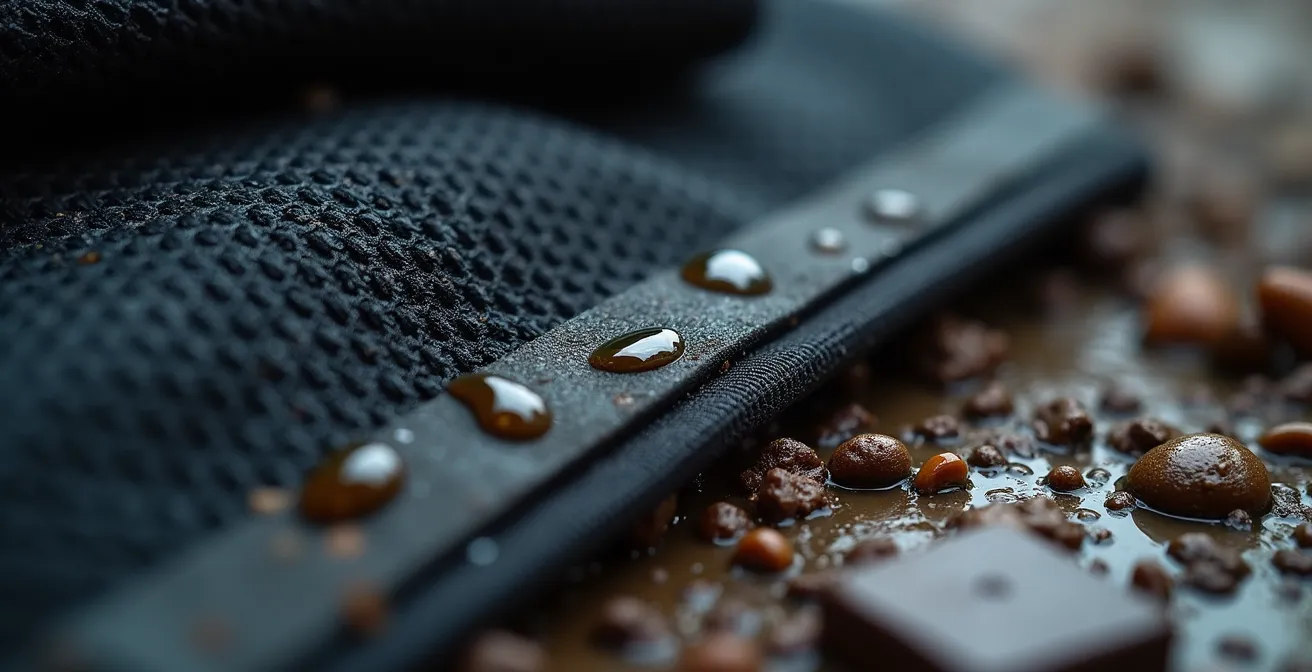
Once contained, the goal is to transition from containment to ventilation as quickly as possible. A bag with ventilated upper panels allows air to begin circulating immediately, starting the drying process even during the drive home. For truly fouled boots, a heavy-duty plastic bag can serve as temporary, disposable primary containment before they’re placed in the ventilated boot bag. The final step is to place the entire bag on a secondary surface, like a rubber floor mat with raised edges, for total peace of mind.
Action Plan: Setting Up Your Mobile Decontamination System
- Primary Containment: Use a boot bag with a waterproof liner or base. Knee-high waterproof materials like rubber or PVC are ideal for preventing seepage.
- Extreme Soil Containment: For exceptionally muddy boots, use a heavy-duty plastic bag as a temporary liner before placing them in the main boot bag.
- Initiate Drying: Ensure the boot bag is ventilated. Transferring boots to the bag immediately allows the drying process to begin during transport.
- Secondary Containment: Place the entire boot bag on a rubber floor mat with raised edges in your vehicle to catch any potential leaks.
- Post-Transport Cleaning: Once home, scrub the soles in a bucket of detergent, rinse, and then spritz with a 70% alcohol or quaternary disinfectant before storage.
Charcoal Inserts or Ventilated Bags: Which Fights Stink Better?
The battle against boot odor is a battle against bacteria, and bacteria thrive in moisture. This brings us to a crucial comparison: active ventilation versus passive absorption. Charcoal inserts, along with silica gel packets, are common passive absorbers. They work by trapping moisture and odor molecules from the air within their porous structure. They are effective at what they do, but their capacity is finite. Once saturated, they stop working and must be “recharged,” typically by heating them to release the trapped compounds. They are a good finishing tool, but they are not a primary solution for very damp boots.
A ventilated bag, conversely, is an active moisture removal system. It doesn’t just trap moisture; it facilitates its complete removal from the boot’s microclimate through evaporation and air exchange. As long as there is airflow, the bag is working to lower the humidity inside the boot. This is a preventative approach. By constantly moving damp air out and dry air in, it robs odor-causing bacteria of the moisture they need to multiply. The goal is to create an environment hostile to microbial life. Experts confirm that maintaining a relative humidity of 30–50% is essential for preventing the proliferation of mold and associated odors.
Therefore, the question isn’t which is better, but how they work together within a complete hygiene system. The ventilated bag does the heavy lifting, removing the bulk of the moisture that fuels bacterial growth. The charcoal insert acts as a polisher, absorbing the stubborn, residual odor molecules that might be trapped deep in the boot’s lining. Using both is the most comprehensive strategy: ventilation for prevention, and charcoal for perfection.
The Stacking Mistake That Crushes Boot Collars in Storage
Preventing mold is a primary concern, but preserving the structural integrity of your boots is equally important for their performance and lifespan. One of the most common and damaging storage mistakes is stacking boots or other gear on top of them. This creates pressure points that crush the boot’s collar and ankle shaft, leading to permanent creases and a breakdown of supportive materials. This compression also creates another problem: it eliminates the air gaps around the boots, severely restricting ventilation and trapping moisture precisely where it’s least wanted.
A proper storage system is designed to protect against this compression. Good boot bags often feature semi-rigid side panels or internal dividers that create a protective shell. This ensures that even if other gear is packed around the bag in a car trunk, the boots inside maintain their shape. The principle is about creating a “no-crush zone” around your footwear. As an example from general shoe care illustrates, maintaining airflow is as much about preventing physical damage as it is about moisture control.
Case Study: The Principle of Airflow in Storage Systems
The advice to use wire shelving instead of solid wooden shelves for shoe storage highlights a universal principle. Wire shelving allows for better air circulation around the shoes, reducing the risk of mold growth. This concept extends directly to boot bags; a system that prevents compression from stacking is crucial for maintaining 360-degree airflow, which prevents both collar damage and moisture accumulation.
To ensure your boots retain their shape and don’t become a habitat for mold, follow a dedicated protocol for shape preservation. Using shoe forms or even just stuffing them with acid-free tissue paper helps maintain their internal volume. Storing them horizontally in a “heel-to-toe” configuration can also eliminate vertical pressure on the delicate ankle shaft.
Where to Store Spare Laces and Wax Within Your Boot Bag System?
A truly effective boot bag is more than just a container for boots; it’s a mobile hub for your entire foot care system. This includes essential maintenance items like spare laces, cleaning brushes, and leather conditioners or waxes. However, simply tossing these items inside the main compartment with your boots is a mistake. Waxes and conditioners can leak and contaminate the breathable membranes of modern boots (like Gore-Tex), compromising their performance. Similarly, a dirty brush can re-introduce grit and organic matter into a clean boot.
The solution is a modular organization system, utilizing the external pockets and attachment points of a well-designed bag. This approach is about separation and accessibility. Your boot care items should be organized into small, dedicated kits—for instance, a “Lace Repair” pouch with spare laces and a lighter, and a “Leather Care” pouch with wax and a cloth. These can be stored in exterior pockets to prevent any cross-contamination. This makes them easy to grab without having to unpack the main compartment.
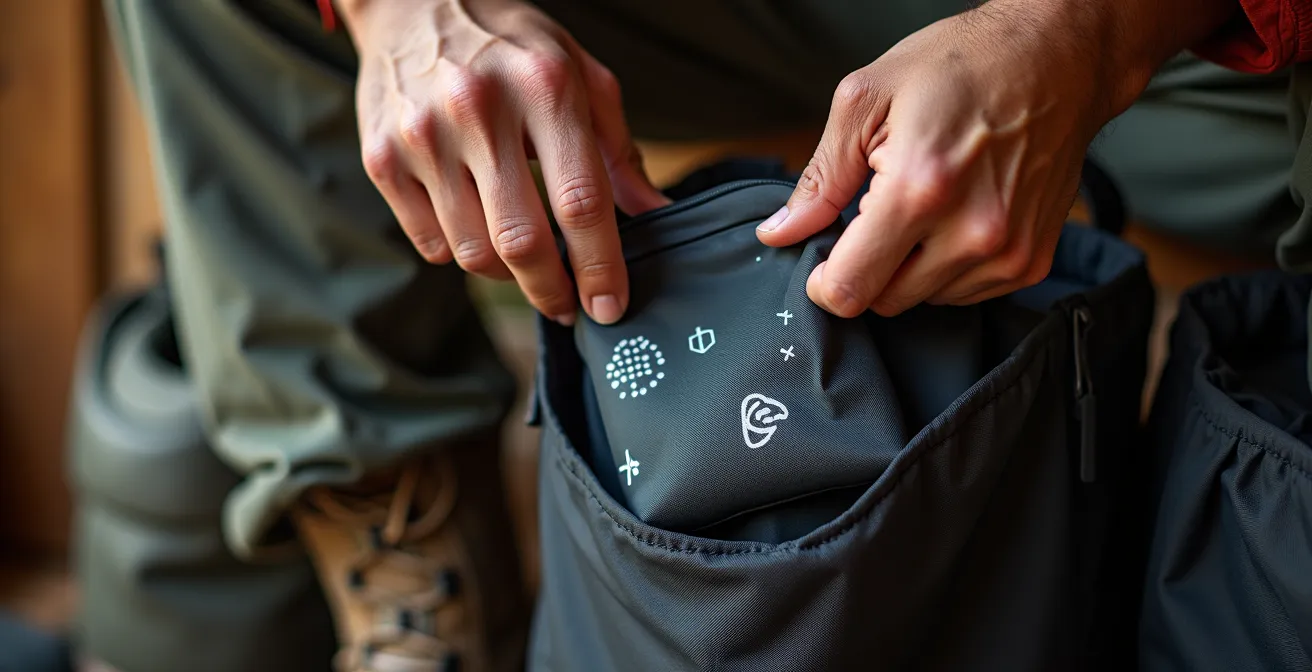
As the image above demonstrates, using external pockets keeps care supplies organized and readily accessible. This modular approach turns your boot bag into a self-sufficient maintenance station. Many high-quality bags also feature external loops or webbing (like MOLLE systems, which we’ll discuss later) that are perfect for clipping on extra items. You can use a carabiner to hang damp laces or a cleaning cloth to dry separately from the main bag, further enhancing the system’s efficiency.
- Create waterproof mini-kits using small dry bags or Ziploc bags for different purposes.
- Label kits clearly: ‘Lace Repair’ (spare laces, lighter) and ‘Leather Care’ (wax/conditioner, cloth).
- Store these kits in external pockets to prevent cross-contamination with boot linings or membranes.
- Utilize external loops with a carabiner or S-hook to hang damp items like laces to dry separately.
How to Clean Boots Before Summer Storage to Prevent Dry Rot?
Long-term or seasonal storage presents a different challenge than daily transport. During these extended periods, even a minuscule amount of trapped moisture or organic matter can lead to dry rot in leather or the proliferation of dormant mold spores. Preparing your boots for storage is a non-negotiable step in preserving them. The first and most crucial phase is a thorough cleaning. It is essential to remove all mud, grit, and organic material, as these can hold moisture and provide a food source for fungus. However, *how* you clean is as important as *that* you clean.
After cleaning with a proper, pH-neutral agent, the drying process is paramount. Boots must be allowed to air dry completely in a cool, dry place away from direct sunlight, which can crack and damage leather. This can take 24 to 48 hours. Never store boots while they are even slightly damp. Once fully dry, consider adding a desiccant like silica gel packets inside the boots as a final buffer against any ambient humidity. The goal for long-term storage is to maintain a stable, dry environment; a scientific review suggests an atmosphere of 65% RH or less is considered safe for permanent storage of materials like leather.
Finally, place the clean, dry, and conditioned boots into your ventilated bag. Here, the bag acts not as a primary dryer, but as a humidity stabilizer. In a basement or garage where ambient humidity can fluctuate, the bag’s ventilation helps buffer against sudden spikes in moisture, protecting the carefully prepared microclimate inside your boots. This final step ensures your boots emerge from storage seasons later in the same condition you put them away.
Why MOLLE Systems Are Superior for Organizing Emergency Supplies?
For the serious traveler, hiker, or preparedness-minded individual, a boot bag can evolve beyond simple storage into the foundation of a larger, modular gear system. This is where MOLLE (Modular Lightweight Load-carrying Equipment) comes into play. A boot bag equipped with MOLLE webbing transforms from a single-purpose item into a customizable, mission-specific platform. Unlike traditional bags with fixed compartments, a MOLLE system allows you to attach, remove, and reconfigure specialized pouches as needed. This offers unparalleled flexibility and efficiency.
Imagine your vehicle-based gear. With a MOLLE-compatible boot bag, you can attach a dedicated first-aid pouch, a tool kit, a hydration pouch, or a pouch for emergency navigation gear. Each critical item is externally accessible, meaning you don’t have to dig through the main compartment in a stressful situation. This principle of modularity and accessibility is the core advantage of the MOLLE system.
| Feature | MOLLE System | Traditional Bag |
|---|---|---|
| Modularity | Task-specific pouches can be swapped | Fixed compartments only |
| Weight Distribution | Strategic load balancing possible | Center-heavy design |
| Accessibility | External pouches for quick access | Must open main compartment |
| Expandability | Add pouches as needed | Limited to bag capacity |
| Emergency Access | Critical items accessible under pressure | Requires unpacking |
Even a lightweight boot storage system can serve as the core of this concept. By starting with a bag that is both spacious and feather-light, it becomes the perfect base to build upon. This elevates the boot bag from a simple container to a strategic piece of your overall equipment philosophy, where every item is part of an integrated, adaptable system.
Case Study: The Modular, Lightweight Boot Sack
Some modern boot sacks are engineered to be incredibly lightweight (as little as 40g/1.4oz) while offering a large storage space for a pair of boots and other items. When this ultralight core is combined with MOLLE attachment capabilities, the boot bag becomes an expandable and highly efficient vehicle-based emergency or gear hub.
Key Takeaways
- Mold prevention is an active process of microclimate management, not passive storage.
- A hybrid bag with both solid (protection) and mesh (airflow) panels offers the best balance for most users.
- Use a multi-stage “mobile decontamination system” for transport: contain moisture first, then ventilate.
Why Dish Soap Ruins Leather Boots and What to Use Instead?
The final, and perhaps most misunderstood, element of boot care is the chemistry of cleaning. Many people, in an effort to be thorough, reach for a common household cleaner: dish soap. This is a catastrophic mistake for leather boots. Dish soaps are powerful detergents designed to strip grease and oil. When applied to leather, they do exactly that—they strip the essential tanning oils and fats that keep the leather supple, strong, and water-resistant. This leaves the leather dry, brittle, and prone to cracking. It also makes it more porous and absorbent, ironically increasing its susceptibility to water damage and mold.
The problem lies in pH. Dish soaps are typically alkaline (high pH). This harsh alkalinity disrupts the delicate pH balance of tanned leather. Studies have shown that leather with a high pH level is more susceptible to mould infestation. By using dish soap, you are not only damaging the leather’s structure but also creating a more welcoming surface for the very fungus you’re trying to prevent. It’s a classic case of the cure being worse than the disease.
The correct approach is to use a product specifically formulated for the job: a pH-neutral saddle soap. Saddle soap is designed to gently lift dirt and grime without stripping the leather’s natural oils. Following a proper cleaning protocol is essential for long-term preservation.
- Never use dish soap: It strips essential oils and damages leather’s integrity.
- Use pH-neutral saddle soap: This is specifically designed for cleaning and preserving leather.
- Clean gently: Use a soft cloth and avoid saturating the leather with excessive water.
- Dry naturally: Allow boots to air dry completely at room temperature, away from direct heat or sunlight.
- Condition after cleaning: Apply a quality leather conditioner to replenish natural oils, restore suppleness, and maintain water resistance.
By viewing your boot bag not as an afterthought but as the cornerstone of an active hygiene and storage system, you transform gear preservation from a chore into a science. Start today by implementing these protocols to extend the life of your boots and ensure they are always ready for your next adventure.
Frequently Asked Questions on How Ventilated Boot Bags Prevent Mold Growth Between Seasons?
How do silica gel packets compare to ventilation for odor control?
Silica gel packets are excellent for absorbing ambient moisture within a contained space like a shoe box. They are small bags filled with beads that pull moisture from the air, helping to maintain optimal humidity levels. However, they are a passive system with a limited capacity, best used as a final polishing step after the bulk of moisture has been removed by active ventilation.
Can charcoal inserts become saturated and ineffective?
Yes, absolutely. Activated charcoal inserts work by adsorbing odor and moisture molecules. Once all their pores are filled, they become saturated and can no longer absorb anything else. They must then be “recharged,” usually by placing them in direct sunlight or heating them to release the trapped compounds. A ventilated bag, by contrast, works continuously as long as there is ambient airflow.
What’s the best combined approach for odor prevention?
The most effective strategy is a one-two punch. First, use a ventilated bag for primary moisture management. This removes the bulk moisture that fuels bacterial growth, preventing odors from forming in the first place. Second, add charcoal inserts into the boots as a finishing tool. The charcoal will then adsorb any stubborn, residual odor molecules that might be trapped deep within the boot’s lining, resulting in a completely fresh and dry environment.