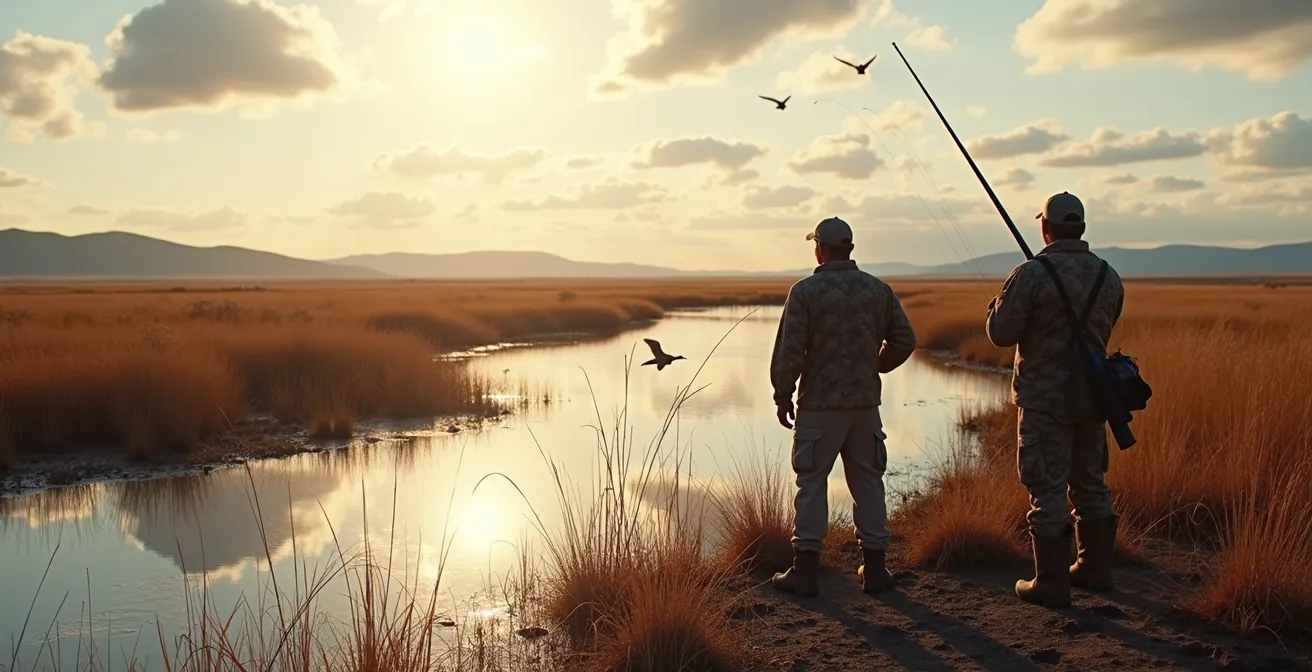
The financial and physical engagement of hunters and anglers creates a structural foundation for North American conservation, generating cascading ecological benefits that support entire ecosystems for all outdoor enthusiasts.
- Federal excise taxes on firearms, ammunition, and fishing gear provide the primary funding mechanism for state-level wildlife management and habitat restoration.
- Direct actions, such as removing invasive species and managing populations within an ecosystem’s carrying capacity, prevent habitat destruction and protect native biodiversity.
Recommendation: To understand the true state of conservation, look beyond surface debates and examine the underlying funding models and ecological principles that sustain wildlife and public lands.
In the ongoing debate over conservation, a hiker on a pristine public trail or a bird watcher enjoying a vibrant wetland might not consider the origins of their experience. The conversation often frames consumptive users, like hunters and anglers, in opposition to non-consumptive users, such as photographers and kayakers. A common platitude suggests that while hunters and anglers do pay for licenses, their impact is primarily extractive. This perspective, however, overlooks a fundamental truth of North American conservation history and policy: the system is built upon a “user-pays, everyone-benefits” model that is far more profound than a simple license fee.
The core of the argument isn’t about pitting one group against another. It’s about understanding the deep, structural symbiosis between the success of a consumptive sportsman and the health of an ecosystem. But what if the key to this contribution isn’t just the money they spend, but the ecological roles they fulfill? From funding land acquisition to actively restoring ecological balance, their investment creates a positive ripple effect—an ecological cascade—that sustains the very biodiversity cherished by all. This article will explore the specific mechanisms through which these contributions are made, moving beyond the dollar figure to reveal a story of active, and often essential, ecological stewardship.
This guide unpacks the foundational policies, direct environmental actions, and landscape-level impacts that define the role of consumptive users in conservation. By examining these interconnected pieces, we can build a more complete picture of how wildlife and wild places are sustained for everyone’s benefit.
Summary: The Hunter and Angler’s Role in Ecosystem-Wide Conservation
- Pittman-Robertson Act: How Buying Ammo Pays for Bird Watching Trails?
- Why Anglers Must Kill Invasive Carp to Save Native Biodiversity?
- Trout as Indicator Species: What Their Presence Says About Water Quality?
- Wolf Reintroduction: How It Impacts Elk Herds and Hunter Success?
- Why Protecting Beaver Habitats Benefits Ducks and Trout Alike?
- Carrying Capacity: Why Too Many Deer Can Destroy a Forest Ecosystem?
- How to Plant Food Plots That Benefit Non-Game Species Too?
- How to Participate in Habitat Restoration Projects on Your Local Public Lands?
Pittman-Robertson Act: How Buying Ammo Pays for Bird Watching Trails?
The most significant, yet often misunderstood, contribution from hunters to conservation is not the license fee but the Pittman-Robertson Act of 1937. This landmark legislation established an 11% federal excise tax on the sale of firearms, ammunition, and archery equipment. This is not a tax on the consumer at the counter, but on the manufacturer. The funds collected are then apportioned to state wildlife agencies for conservation projects. This creates a powerful cycle: the more people participate in shooting sports, the more funding is available for wildlife. For Fiscal Year 2024 alone, a report from the U.S. Fish and Wildlife Service confirmed that nearly $1 billion in Pittman-Robertson funding was apportioned to all 50 states.
This money is the lifeblood for state agencies, used to purchase wildlife management areas (WMAs), restore habitats, and conduct critical research. Crucially, these lands and projects benefit far more than just game species. The forests managed for turkey and deer are also home to countless songbirds, amphibians, and mammals. The trails built to provide hunter access are the same trails used by hikers, photographers, and school groups. The wetlands restored for waterfowl become essential stopovers for migratory shorebirds. For example, Texas leads the nation with $45.7 million in this funding for 2024, a direct result of its large number of licensed hunters. This funding underpins the state’s entire wildlife management infrastructure, which serves all Texans, not just those who hunt.
This self-sustaining financial engine, driven entirely by consumptive users, forms the bedrock of modern wildlife conservation in America, creating public resources enjoyed by all.
Why Anglers Must Kill Invasive Carp to Save Native Biodiversity?
Beyond passive funding, anglers and commercial fishermen often serve as frontline soldiers in the war against invasive species. No case is clearer than the fight against invasive carp (including silver, bighead, black, and grass carp) in North American river systems. These fish are ecological wrecking balls. They outcompete native species for food, degrade water quality, and alter entire aquatic food webs. In some sections of the Mississippi and Illinois River systems, studies have shown that Asian carp now make up more than 95% of the biomass, effectively pushing out native fish that support recreational angling and ecosystem stability.
In this context, the act of killing or removing these fish is a direct and necessary act of conservation. State agencies and commercial fishermen, often funded by angler-supported initiatives like the Dingell-Johnson Act (the fishing equivalent of Pittman-Robertson), employ aggressive removal strategies. The Modified Unified Method, used in places like Kentucky Lake, involves a coordinated effort of boats, nets, and electro-fishing gear to herd and harvest massive quantities of carp. In one such effort, over 69,000 pounds of invasive carp were removed from just two bays. This isn’t just “fishing”; it’s targeted ecological restoration. By removing the invasive threat, anglers help create the conditions necessary for native bass, bluegill, and catfish populations to rebound, thereby restoring biodiversity.
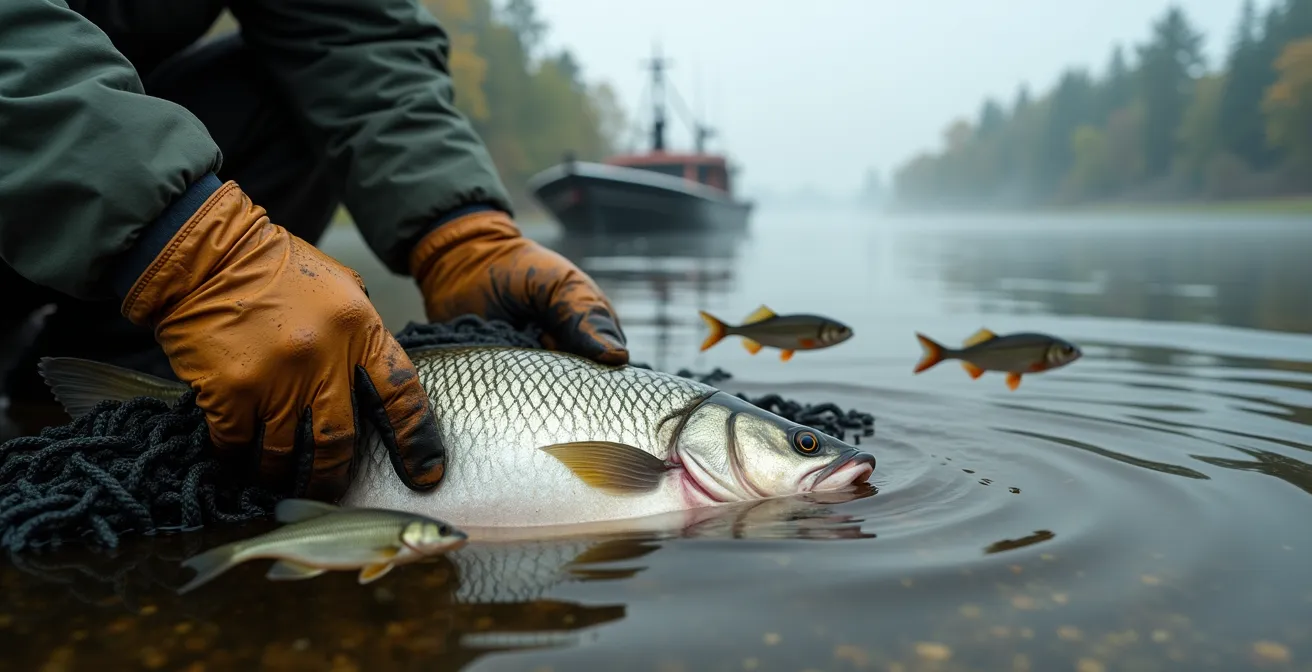
The hands-on work of removing these destructive invaders is a stark example of how consumptive activities are essential for protecting and rebuilding native ecosystems that have been pushed to the brink.
Without these targeted removal efforts, many native fisheries would simply cease to exist, taking with them the rich biodiversity they support.
Trout as Indicator Species: What Their Presence Says About Water Quality?
The connection between angling and conservation runs deeper than just funding or invasive species removal; it is woven into the biology of the fish themselves. Trout are a prime example of an indicator species. Their presence—or absence—provides a direct and reliable measure of the health of an entire aquatic ecosystem. Trout, particularly native species like brook trout, have extremely specific and sensitive habitat requirements. They need cold, clean, and highly oxygenated water to survive and reproduce. This makes them the proverbial “canary in the coal mine” for our rivers and streams.
As the conservation group Clean Wisconsin notes, the requirements are stringent.
Brook trout live and thrive only in very clean and cold water, preferring temperatures less than 66 degrees, especially for spawning when they do best with water between 40 and 50 degrees
– Clean Wisconsin, Bellwether: Brook trout as indicator species
This sensitivity means that any pollution, excessive sediment from erosion, or thermal warming from the removal of streamside vegetation can wipe out a trout population. For instance, rainbow trout require dissolved oxygen levels between 7-9 mg/L for optimal health; levels below 3 mg/L are lethal. Therefore, an angler’s vested interest in maintaining a healthy, fishable trout stream aligns perfectly with the broader public interest in clean water. When groups like Trout Unlimited work to restore streamside vegetation, stabilize eroding banks, or fight against industrial pollution, they are doing so to protect trout. However, the result is cleaner water for downstream communities, healthier habitat for insects, amphibians, and birds, and a more resilient ecosystem for everyone.
This is a perfect example of structural symbiosis: the angler cannot succeed without a healthy environment, and their efforts to create that environment benefit society as a whole.
Wolf Reintroduction: How It Impacts Elk Herds and Hunter Success?
The reintroduction of wolves into ecosystems like the Northern Rockies provides a powerful lesson in trophic cascades—ripple effects that flow through a food web following a change at the top. While often viewed as a conflict between predator conservation and hunting interests, the reality is far more complex and demonstrates how hunters are an integral part of a dynamic system. Before wolf reintroduction, large elk herds often congregated in sensitive riparian areas, over-browsing willows and aspens along stream banks. This prevented the regeneration of these crucial trees, which in turn negatively impacted beavers, songbirds, and water quality.
The return of wolves created an “ecology of fear.” Elk became more vigilant and avoided spending prolonged periods in exposed, open valleys and stream corridors. This behavioral change allowed streamside vegetation to recover. The recovering willows provided food and building material for beavers, whose dams created new wetland habitats. The entire ecosystem began to shift towards a more diverse and resilient state. What, then, is the hunter’s role? Hunters remain the primary tool for managing elk population numbers, ensuring the herd stays within the land’s carrying capacity and doesn’t simply move its over-browsing problem elsewhere. Hunter harvest data is also invaluable for state biologists modeling predator-prey dynamics and making informed management decisions. In this new, more complex ecosystem, the hunter is not replaced by the wolf; rather, they become a complementary management force, helping to maintain balance in a wilder, more complete ecosystem.
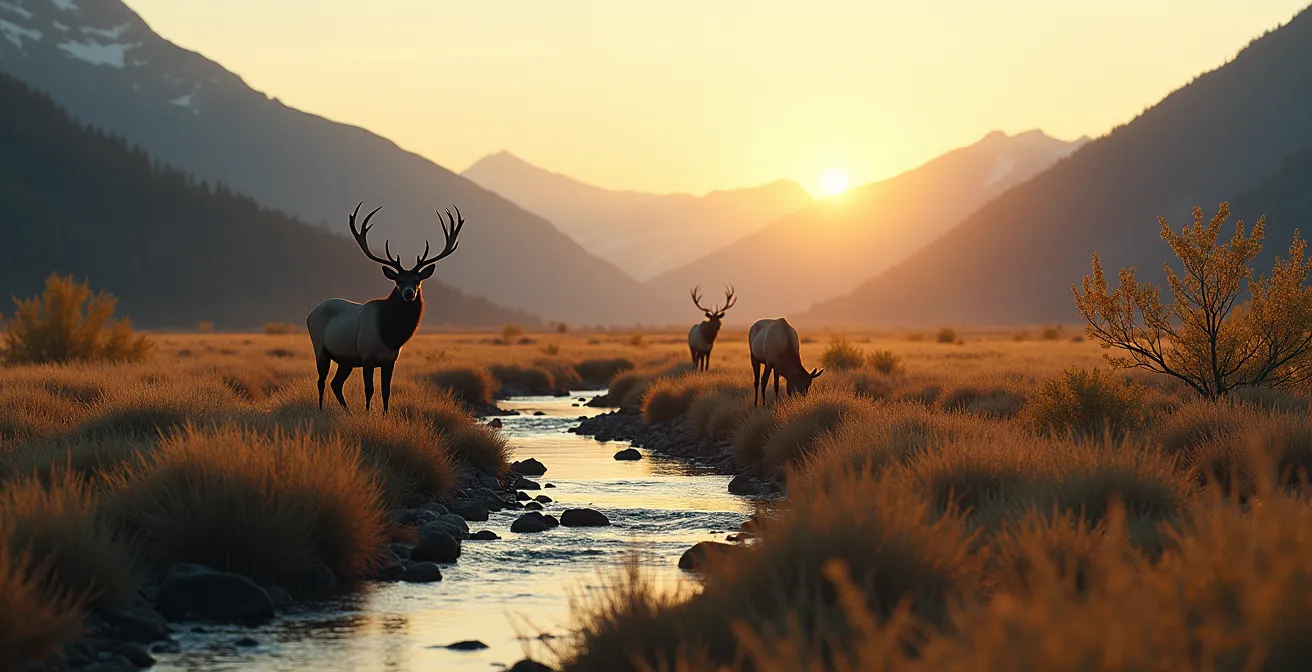
This landscape-level transformation, driven by the reintroduction of a keystone predator, illustrates that hunting is not a static activity but one that adapts to and participates in the ever-changing dynamics of a complete ecosystem.
Hunters, by adapting their methods and continuing their role in population management, contribute to the overall health and complexity that benefits all species, including the wolves themselves.
Why Protecting Beaver Habitats Benefits Ducks and Trout Alike?
Beavers are often called “ecosystem engineers,” and for good reason. Their innate drive to build dams fundamentally reshapes the landscape in ways that create a cascade of benefits for a surprisingly diverse array of wildlife. While trappers (a form of consumptive user) have a direct interest in maintaining healthy beaver populations, the protection of beaver habitats is a cornerstone of conservation that serves species cherished by both hunters and anglers.
The process is a masterclass in ecological synergy. When a beaver builds a dam, it slows the flow of a stream, causing water to pool and spread out. This creates a wetland, an ideal habitat for waterfowl like wood ducks and mallards, which rely on the shallow, food-rich waters and surrounding vegetation for nesting and raising their young. This directly benefits the waterfowl hunter. Simultaneously, the deeper pools that form behind the dam have a profound effect on fish. During the hot summer months, these pools serve as critical thermal refuges for trout, offering cooler, more stable water temperatures than the shallower, faster-flowing sections of the stream. This directly benefits the angler. Furthermore, the dam acts as a natural filter, trapping sediment and pollutants, which improves water quality downstream for all aquatic life. By advocating for policies that protect beaver populations and their habitats, consumptive users create a multi-layered system where the engineering of one species directly enhances the survival and proliferation of many others.
This is not a story of single-species management, but of fostering a process that builds a more complex, resilient, and productive landscape for ducks, trout, and everything in between.
Carrying Capacity: Why Too Many Deer Can Destroy a Forest Ecosystem?
One of the most direct and impactful roles a hunter plays is in managing wildlife populations to keep them in balance with their habitat. This is guided by the ecological principle of carrying capacity—the maximum number of a species that an environment can sustain indefinitely without degrading the ecosystem. When a prey species like white-tailed deer exceeds its carrying capacity, the consequences can be catastrophic, not just for the deer but for the entire forest community.
In the absence of sufficient natural predators or hunting pressure, deer populations can explode. Their feeding habits have a cascading negative effect. They decimate the forest understory, eating native shrubs and saplings before they have a chance to grow. This creates a distinct “browse line” about six feet off the ground, below which almost nothing green survives. This loss of the understory has several devastating impacts. First, it eliminates the habitat required by ground-nesting birds like Ovenbirds and Wood Thrushes, leading to dramatic population declines. Second, it eradicates diverse native wildflowers, such as trilliums and orchids, which cannot withstand the intense browsing pressure. Finally, it prevents the regeneration of the forest itself, as no young trees can survive to replace the old ones. The forest becomes a simplified, aging canopy with an empty, barren floor—a shadow of its former biodiversity.
The following table illustrates the stark contrast between a balanced ecosystem and one suffering from deer overpopulation.
| Ecosystem Component | Managed Deer Density | Overpopulated Deer Density |
|---|---|---|
| Forest Understory | Diverse shrubs and saplings present | Browse line visible, no regeneration below 6 feet |
| Ground-nesting Birds | Healthy populations of Ovenbirds, Wood Thrush | 90% decline in ground-nester abundance |
| Native Wildflowers | Diverse spring ephemerals present | Trilliums and orchids locally extinct |
| Tree Regeneration | Multiple age classes of trees | No saplings surviving to maturity |
Regulated hunting is the most effective and efficient tool available to modern wildlife managers to prevent this scenario. By harvesting a scientifically determined number of animals, hunters act as a proxy for natural predators, ensuring the deer herd remains healthy and in balance with a forest that can support a rich diversity of life.
Key Takeaways
- The Pittman-Robertson Act creates a “user-pays, everyone-benefits” system, where taxes on hunting gear fund conservation for all species.
- Direct action, like removing invasive carp or managing deer populations, is a form of active ecological stewardship that prevents ecosystem collapse.
- The needs of consumptive users (e.g., clean water for trout) are often perfectly aligned with the needs of the broader ecosystem and public.
How to Plant Food Plots That Benefit Non-Game Species Too?
The practice of planting food plots is often narrowly viewed as a method to simply attract game animals like deer and turkey. However, a modern, conservation-minded approach to food plots transforms them from single-species bait stations into hubs of biodiversity that provide significant benefits for a wide range of non-game species. This is a prime example of proactive habitat enhancement, where a hunter’s actions directly build a more resilient and diverse local ecosystem.
A thoughtfully designed food plot is a mosaic of different plant types that offer food and cover throughout the year. Instead of a hard-edged monoculture of a single crop, land managers can create “soft edges” by planting native grasses and shrubs around the plot. These transition zones provide critical escape cover for animals like quail and rabbits. Within the plot itself, planting clover varieties not only provides high-protein forage for deer but also offers a vital nectar source for early-season pollinators like bees and butterflies. Incorporating strips of sunflowers, millet, or sorghum provides seeds that will persist into the winter, offering a crucial food source for dozens of songbird species when other foods are scarce. This multi-species approach turns an investment made for hunting into an investment in the entire local food web. It demonstrates a sophisticated understanding of ecological connections, where the goal is not just to attract one animal, but to enrich the entire habitat.
Your Action Plan: Multi-Species Food Plot Planning
- Create soft edges with native grasses and shrubs instead of hard borders to provide cover for quail and rabbits.
- Plant clover varieties in spring for early-season pollinators and deer nutrition.
- Include sunflower and millet strips that provide winter seeds for songbirds.
- Establish small sacrificial plots near cash crops to concentrate wildlife browsing and reduce agricultural damage.
- Position plots in recently logged areas to accelerate habitat diversity and draw wildlife for forest regeneration.
By implementing these strategies, hunters become active creators of habitat, boosting local biodiversity in ways that extend far beyond their primary game species of interest.
How to Participate in Habitat Restoration Projects on Your Local Public Lands?
The contribution of hunters and anglers extends beyond individual actions and financial inputs; it is a powerful collective force that shapes national conservation policy and drives large-scale habitat restoration. Sportsmen’s organizations are some of the most effective conservation advocates in the country, leveraging their membership’s passion to secure funding and legislation that benefits all public lands and the wildlife they support.
These groups are not just social clubs; they are conservation powerhouses. Organizations like Ducks Unlimited, the Ruffed Grouse Society, the National Wild Turkey Federation, and Trout Unlimited raise millions of dollars for on-the-ground habitat work. They are also highly active politically, lobbying for conservation at state and federal levels. As the Ruffed Grouse Society points out, this influence has a monumental impact on public resources.
In addition to this direct financial investment, hunters and anglers in general – and RGS & AWS members in particular – played a vital role in the past year alone in securing passage of the Great American Outdoors Act and permanent funding for the Land and Water Conservation Fund
– Ruffed Grouse Society, America’s hunters and anglers lead by example in conservation
The Great American Outdoors Act (GAOA) provides billions of dollars to address the maintenance backlog in our national parks and other public lands, benefiting every single visitor. The Land and Water Conservation Fund (LWCF) uses revenues from offshore oil and gas leasing to fund the acquisition of public lands and waters. These are colossal legislative victories that were heavily driven by the hunting and angling community, yet their benefits—more public access, better-maintained trails and facilities, and protected landscapes—are shared by everyone. Participating in this effort is as simple as joining one of these organizations, volunteering for a local habitat project, or contacting elected officials in support of conservation legislation.
By engaging at this level, consumptive users amplify their impact from a personal pursuit to a national legacy of conservation for all Americans.