Adding 20 yards to your cast isn’t about brute force, but mastering a synchronized system of gear and technique.
- Braided line’s thin diameter and a longer rod’s leverage are foundational for maximizing energy transfer.
- A perfectly timed ‘snap’ and correctly filled spool prevent critical energy loss from friction and wind knots.
Recommendation: Focus on making each component—from line choice to release point—work in harmony to achieve maximum, tangle-free distance.
For any shore angler, the sight of schooling fish breaking just beyond casting range is a familiar frustration. You try a harder snap, a different angle, but the lure still falls short. The common advice is a patchwork of isolated tips: use a longer rod, switch to braid, change your lure. While individually useful, these suggestions often miss the fundamental truth of long-distance casting. The secret to consistently adding 20 yards or more isn’t found in a single change, but in understanding the cast as a complete, synchronized system.
Think of it less like a simple throw and more like a finely tuned engine. Every component—the line’s diameter, the rod’s flex, the lure’s shape, and the timing of your release—plays a critical role in managing friction and maximizing energy transfer. A weakness in one part of the system sabotages the power of the others. A thick line creates drag, an overfilled spool causes tangles, and a poorly shaped lure tumbles through the air, robbing you of those precious yards.
This guide moves beyond the basics to explore the physics behind a powerful cast. We will deconstruct this system piece by piece, showing you how each element contributes to or detracts from your goal. By treating your rod, reel, line, and lure as interconnected parts of a whole, you can systematically eliminate inefficiencies and unlock the full distance potential of your gear. It’s time to stop just casting farther and start understanding *why* you’re casting farther.
To achieve this, we will explore the mechanics of everything from line friction to wave dynamics. The following sections break down the key variables you can control to transform your casting from a game of chance into a science of distance.
Summary: A Surf Caster’s Guide to Maximum Distance
- Why Braided Line Casts Farther Than Monofilament of the Same Strength?
- 7-Foot vs 9-Foot Rods: Which Launch Hard Baits Further from Shore?
- How to Time the ‘Snap’ to Maximize Tip Speed During the Cast?
- The Treble Hook Tangle Problem and How to Stop It Mid-Flight
- Crankbait vs Spoon: Which Aerodynamics Require a Smoother Casting Stroke?
- Why Overfilling Your Spool Causes Wind Knots on the First Cast?
- How to Read the Waves to Place Bait in the Trough?
- Why Erratic Lure Action Triggers Reaction Strikes from Lethargic Predators?
Why Braided Line Casts Farther Than Monofilament of the Same Strength?
The foundation of any long-distance casting system is the line. It’s the first point of contact and a major source of friction. While monofilament has its place, when maximum distance is the goal, braided line is unequivocally superior. The reason lies in a simple principle of physics: less diameter equals less friction. For the same pound-test rating, a braided line is significantly thinner than its monofilament counterpart. This reduced surface area means less resistance as it flies through the rod guides and less drag as it cuts through the air.
This isn’t just a theoretical advantage; it’s a measurable one. In fact, as confirmed by recent tests showing up to 30% farther casting distance with braided line versus monofilament when using lighter lures, the difference is substantial. Furthermore, braid has virtually zero stretch. This ensures that nearly 100% of the energy you load into the rod during your cast is transferred directly to the lure, rather than being absorbed and dampened by the line itself. Monofilament, with its inherent stretch, acts like a shock absorber, robbing the cast of critical launch velocity.
To maximize this advantage, consider these factors:
- Diameter is Key: Always compare lines based on diameter, not just strength. A 20lb braid with a 0.2mm diameter will vastly outperform a 20lb mono with a 0.3mm diameter.
- Strand Count: Opt for a high-quality, 8-strand or higher braid. The higher strand count creates a rounder, smoother profile that glides through guides with even less friction than rougher 4-strand braids.
- Line Conditioner: Applying a silicone-based line conditioner can further reduce friction and help the line shed water, making it lighter and more efficient during the cast.
Ultimately, choosing braid is the single most effective gear change for reducing friction and ensuring that the power you generate is not wasted before the lure even leaves the rod tip.
7-Foot vs 9-Foot Rods: Which Launch Hard Baits Further from Shore?
If the line is the foundation, the rod is the engine of your casting system. Its job is to store and release energy, and when it comes to raw distance, length creates leverage. A longer rod travels through a wider arc during the cast, generating significantly more tip speed for the same amount of effort. This is why a 9-foot or even 10-foot surf rod will consistently out-cast a standard 7-foot inshore rod when launching hard baits from the shore.
This increased leverage is not just a matter of a few inches. As one study on casting mechanics revealed, a longer rod can provide more than 10 inches of additional leverage. This translates directly into more stored potential energy during the backcast, which then converts into kinetic energy upon release, sending the lure flying. Professional angler tests confirm this, showing that 10-12 foot rods can achieve distances of 100-150 yards, sending the same 1/2 oz lure 25-30 yards farther than a 7-foot rod.
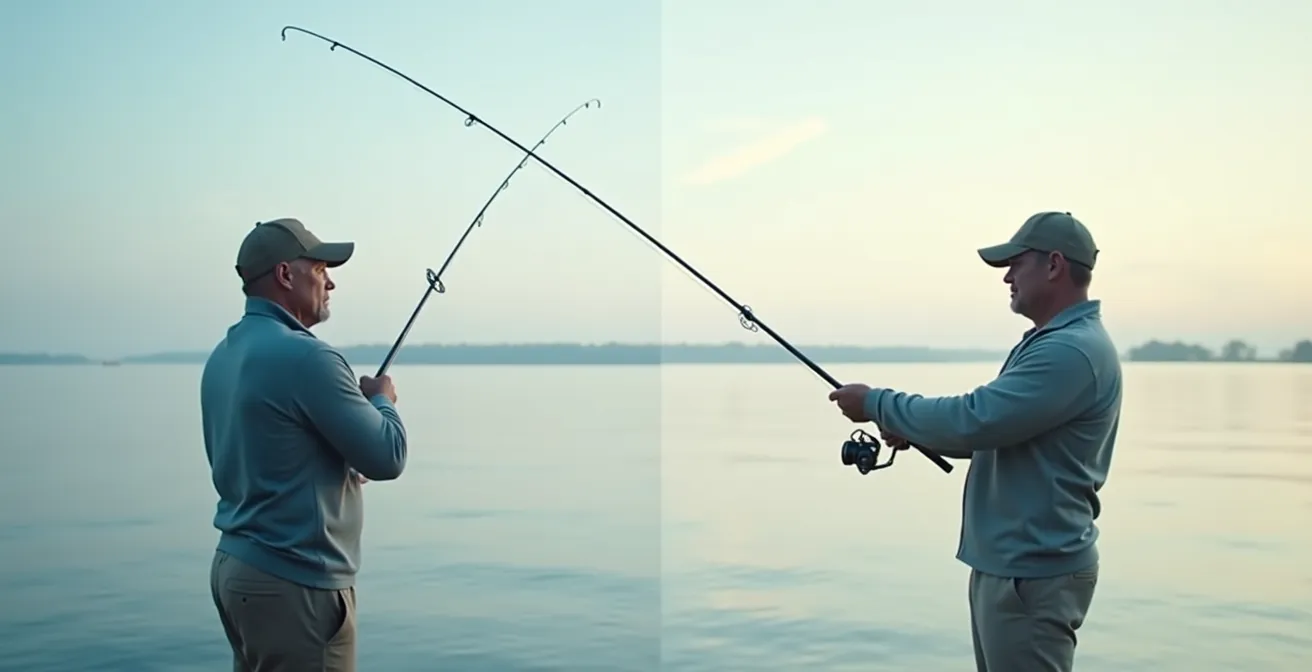
As the visual demonstrates, the wider arc of the longer rod is the key to generating superior momentum. However, distance comes with trade-offs. While longer rods excel at launching lures, they can be less accurate for close-quarters casting and require more physical effort and backcast space to use effectively. Choosing the right length means balancing the need for distance with the practicalities of your fishing environment.
This table breaks down the core differences in performance:
| Factor | 7-Foot Rod | 9-Foot Rod |
|---|---|---|
| Leverage Arc | Shorter arc, less momentum | 10+ inches more leverage |
| Accuracy | Superior for close targets | Reduced at distance |
| Required Space | Minimal backcast room | Needs clear overhead space |
| Angler Fatigue | Less arm strain | Requires more core strength |
| Optimal Lure Weight | 1/4 to 1/2 oz | 1/2 to 1 oz+ |
For the shore angler whose primary goal is reaching distant fish, the choice is clear. The physics of leverage dictates that a longer rod is the superior tool for maximizing the potential energy of your cast.
How to Time the ‘Snap’ to Maximize Tip Speed During the Cast?
With the right line and rod, the final piece of the power puzzle is technique. The “snap” of the cast is the moment of truth where all the stored energy in the rod is transferred to the lure. Perfect timing is what separates a 60-yard cast from a 90-yard one. It’s not about raw power, but about a smooth, accelerating motion that culminates in an abrupt stop, whipping the rod tip forward at maximum velocity. Many anglers make the mistake of trying to “muscle” the cast, using their arms and shoulders. A powerful cast, however, originates from the core and hips, rotating the body to generate momentum.
The goal is to load the rod deeply and then release that energy at the precise moment. Releasing too early sends the lure skyward in a high, inefficient arc. Releasing too late drives it down toward the water. The optimal release point is typically between the 10 and 11 o’clock positions, creating a powerful, flat trajectory that cuts through the wind. As one expert notes, mastering this mechanical consistency is the true path to distance.
It’s all about accuracy, not distance. With bass fishing, particularly, it’s all about accuracy, not distance. So don’t worry about your distance. As a matter of fact, as time goes on, and as you get more and more practice, your distance will get there.
– Glenn May, BassResource.com Casting Tutorial
This wisdom highlights that focusing on smooth, repeatable mechanics naturally leads to greater distance. The power comes from efficient energy transfer, not brute force. By perfecting the timing and sequence of the motion, the distance becomes an automatic byproduct of a well-executed cast.
Your Action Plan: Perfecting the Snap Timing Technique
- Set Your Position: Start with the rod at the 9 o’clock position behind you, with the lure hanging about 12-18 inches from the rod tip.
- Engage Your Core: Begin the forward motion by rotating your hips and torso, using your larger core muscles, not just your arms.
- Accelerate Smoothly: Build speed progressively through the casting arc. The motion should be a fluid acceleration, not a sudden jerk.
- Pinpoint the Release: Release the line as your hand passes the 10-11 o’clock position in front of you for the ideal launch trajectory.
- Stop Abruptly: The key to maximizing tip speed is to bring the rod to a sudden stop at the 1 o’clock position. This sharp stop is what transfers the rod’s stored energy into the lure.
Practice this technique with a medium-weight sinker in an open field. Focus on the feeling of the rod loading and unloading. When you can consistently hit your target with a smooth, effortless motion, you’ll find the extra yards have appeared on their own.
The Treble Hook Tangle Problem and How to Stop It Mid-Flight
You’ve selected the perfect line, a powerful long rod, and honed your casting snap. You unleash a monster cast, only to see your expensive hard bait “helicopter” through the air, tangling the line around its own treble hooks before it even hits the water. This is a common and frustrating failure point in the long-distance casting system. This mid-air tangle is caused by aerodynamic instability. When a lure isn’t perfectly stable in flight, it begins to tumble, allowing the hooks to foul the line.
This problem is especially prevalent with lures that have an uneven weight distribution or a large, wind-catching profile, like deep-diving crankbaits. The force of a powerful cast can exacerbate this instability. The solution lies in controlling the lure during the final phase of its flight. One of the most effective techniques is “feathering” the spool. As the lure approaches its maximum distance, lightly press your index finger against the rim of the spinning reel’s spool. This adds a tiny amount of friction, which gently pulls the lure taut and forces it to fly straight, with the weight-forward end leading the way. This prevents it from tumbling and keeps the hooks away from the line.
In addition to technique, you can make several gear adjustments to minimize the problem:
- Stop the Spool: Just before the lure impacts the water, stop the spool completely with your finger. This snaps the line tight, ensuring the lure enters the water cleanly and is ready for an immediate retrieve.
- Consider Single Hooks: When conditions are particularly challenging or a lure is notoriously prone to tangling, replacing the stock treble hooks with single inline hooks can dramatically reduce the chances of fouling. They offer a much smaller profile for the line to catch on.
- Check for Line Twist: After every 20-30 casts, let out a long length of line and check for twist. A twisted line will try to uncoil in mid-air, which can contribute to tangles.
By implementing these feathering and gear-tweaking techniques, you ensure that the power of your cast isn’t wasted on a tangled mess, allowing the lure to complete its journey to the strike zone effectively.
Crankbait vs Spoon: Which Aerodynamics Require a Smoother Casting Stroke?
Not all lures are created equal when it comes to long-distance casting. The lure’s shape, density, and profile—its aerodynamics—are the final variable in the casting system. A lure that is dense and streamlined will cut through the air with minimal resistance, while a bulky, light, or oddly shaped lure will be slowed by drag and prone to tumbling. This is why a metal spoon or a pencil popper will almost always outcast a deep-diving crankbait of the same weight.
The key difference lies in how they interact with the air. A dense, bullet-like metal spoon has excellent aerodynamic stability and can handle a sharp, powerful “snap” cast. Its momentum easily overcomes air resistance. In contrast, a crankbait, especially one with a large diving lip, is an aerodynamic nightmare. The lip acts like a parachute, creating immense drag and causing the lure to wobble or spin if cast too aggressively. To cast a crankbait for maximum distance, you must use a different technique: a smoother, more progressive casting stroke. Instead of a sharp snap, think of it as a long, sweeping “lob.” This slower acceleration allows the crankbait to remain stable in flight, preventing it from tumbling and losing energy to drag.
This table illustrates how a lure’s profile dictates the required casting motion:
| Lure Type | Aerodynamic Profile | Casting Stroke | Typical Distance |
|---|---|---|---|
| Metal Spoon | Dense, bullet-like | Sharp snap acceptable | 100+ yards |
| Lipless Crankbait | Moderate drag | Smooth acceleration | 80-90 yards |
| Deep-Diving Crankbait | High drag from lip | Very smooth lob | 60-70 yards |
| Pencil Popper | Streamlined | Fast snap works | 90-100 yards |
Therefore, to truly maximize distance, an angler must become a student of aerodynamics, recognizing that a powerful cast is not one-size-fits-all. It requires adapting your energy delivery to the unique flight characteristics of each lure.
Why Overfilling Your Spool Causes Wind Knots on the First Cast?
One of the most common—and entirely preventable—saboteurs of a long cast is the dreaded “wind knot.” This frustrating tangle often occurs on the very first cast with a freshly spooled reel, and the culprit is almost always an overfilled spool. When a spinning reel spool is filled beyond its capacity, the line doesn’t sit securely. Instead, loose coils can slip over the lip of the spool during a cast. But it’s not just one coil that comes off; several loose coils often jump off simultaneously. Once airborne, these coils collide and create an instant, often unsalvageable, knot.
The physics are simple: the line needs a small shoulder on the spool’s lip to contain it under the pressure of a cast. Without this containment, chaos ensues. The optimal fill level is not to the very edge, but just below it. In fact, technical specifications confirm that filling to 1/8 inch (3mm) below the spool lip is the sweet spot that maximizes line capacity while preventing overruns. This small gap is critical for maintaining control as line peels off the reel at high speed.
Field testing has starkly illustrated this principle. A case study on line management practices showed that anglers using overfilled spools experienced wind knots within just two or three casts. In contrast, those with properly filled spools made over 50 casts without a single tangle. The study emphasized that this issue is particularly pronounced with supple, modern 8-strand braids, which have very little memory and are more prone to jumping off the spool in loose loops if not properly managed.
The lesson is clear: resisting the temptation to squeeze on “just a few more yards” of line is paramount. A properly filled spool is a core component of a reliable, tangle-free casting system. The small amount of extra line is not worth the risk of a cast-killing knot that will cost you far more line and valuable fishing time.
By respecting the 1/8-inch rule, you are proactively managing a major source of friction and failure, ensuring that your powerful casts launch smoothly and without interruption, time after time.
How to Read the Waves to Place Bait in the Trough?
Achieving maximum casting distance is only half the battle. A 100-yard cast into unproductive water is useless. The true mark of an expert shore angler is the ability to use that distance to reach the specific zones where predatory fish feed. In a surf environment, this almost always means landing your lure in the “trough”—the deeper channel of water that runs parallel to the shore between sandbars. This is the fish’s highway, where they patrol for bait. The challenge is that these troughs are often located beyond the first or even second set of breaking waves.
This is where raw distance translates into tactical advantage. As one coastal fishing expert notes, the goal is not just distance, but effective distance.
The goal isn’t just distance, but ‘effective distance to target’. The extra 20 yards are needed to reach the second or third trough, which holds bigger, less pressured fish.
– Coastal Fishing Expert, Surf Casting Techniques Guide
Reading the waves is the key to identifying these troughs from shore. Breaking waves indicate a shallow sandbar, while a calm, darker stretch of water indicates the deeper trough. Before you even cast, take a few minutes to observe the wave patterns. Look for a consistent area where waves form, break, and then re-form farther in. The calm area in between is your target.
- Observe the Sets: Watch for 2-3 minutes to identify the pattern of where waves are breaking and where the water is calm.
- Time the Landing: The ideal moment to have your lure land is just as a wave is passing, dropping it into the calm water of the trough behind it.
- Compensate for Wind and Air Time: On a long cast, your lure will be in the air for 3-4 seconds. You must aim slightly upwind and “lead” your target to compensate for drift.
- Use a Low Trajectory: In windy conditions, a low, driving cast is more accurate than a high, looping one, even if it sacrifices a few yards of absolute distance.
Your ability to consistently place a lure in the second or third trough is what turns newfound casting distance into a tangible increase in your catch rate.
Key Takeaways
- True casting distance comes from treating your gear as a synchronized system, not from a single trick.
- The core battle is against friction and for efficient energy transfer, from your body to the rod, line, and lure.
- Effective distance—placing the lure in the right zone—is more important than raw distance alone.
Why Erratic Lure Action Triggers Reaction Strikes from Lethargic Predators?
The perfect cast is a silent, beautiful thing. The lure flies true, lands softly in the target trough 90 yards out, and sinks into the strike zone without a tangle. This clean execution is not just for show; it’s the critical setup for the final, most important part of the process: the retrieve. A perfect cast maximizes the lure’s time in the most productive water and allows you to impart the kind of erratic, triggering action that turns a following fish into a striking one. A tangled line or a lure that lands in a heap is dead in the water and has missed its window of opportunity.
Predatory fish are wired to attack signs of weakness or panic. A steady, monotonous retrieve might as well be invisible to a lethargic fish. But a lure that suddenly darts, pauses, and flutters mimics a stunned or fleeing baitfish, triggering a powerful, instinctual reaction strike. The effectiveness of this is well-documented. For instance, professional guides often report that the most crucial moment is the first few seconds after the lure lands. A long, clean cast allows for a 2-3 second pause right after splashdown. This pause makes the lure look like a stunned baitfish that just fell, often drawing an immediate strike from a predator that watched its descent.
After this initial pause, the entire retrieve should be a sequence of unpredictable movements. Mix in sharp twitches of the rod tip, vary your reeling speed, and incorporate sudden pauses. This erratic action is what convinces a fish that your lure is a real, vulnerable meal. A cast that fell short or tangled robs you of the line and control needed to perform this deadly dance effectively through the entire length of the trough. The added distance you’ve worked for directly translates to more time performing this triggering action in the prime strike zone.
Stop thinking of the cast as finished when the lure hits the water. Instead, see it as the essential first step that enables a dynamic, life-like retrieve. The extra 20 yards you’ve gained are 20 more yards to convince a fish to strike, and that is what ultimately puts more fish on the end of your line.