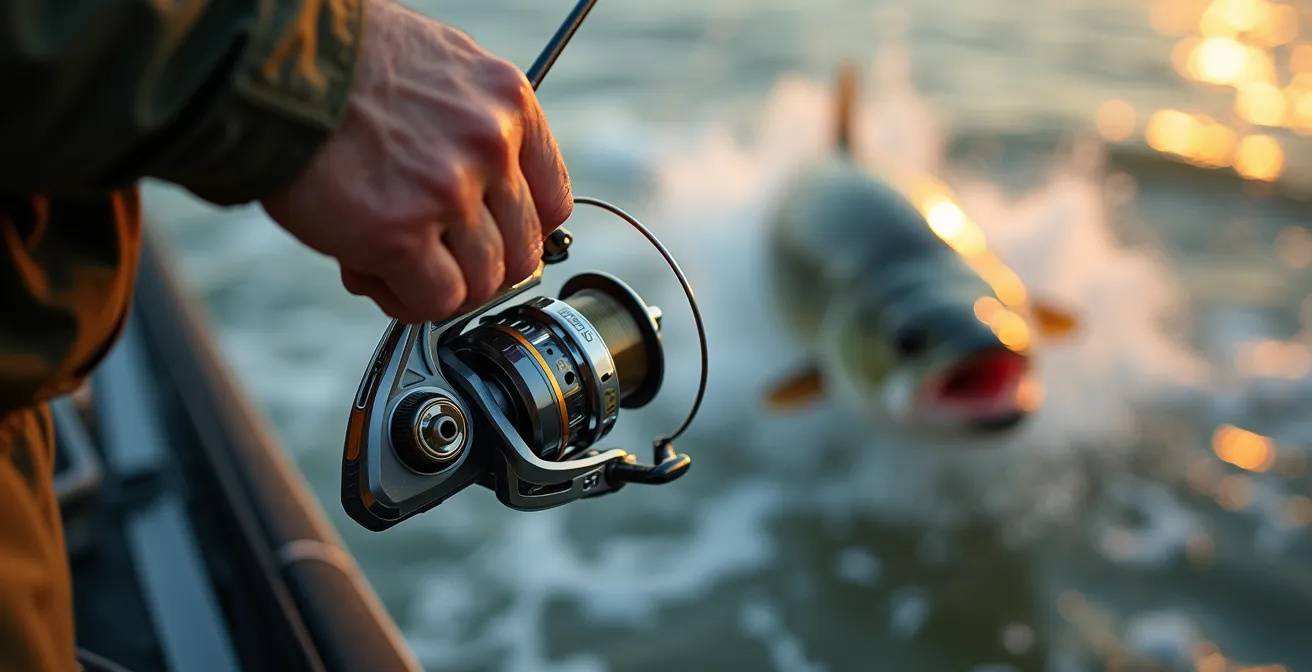
Losing a large fish to a line break isn’t bad luck; it’s a predictable system failure. The key isn’t a single “magic” drag setting, but understanding your reel as a high-performance machine. By mastering the relationship between line type, spool management, and internal mechanics, you can engineer a drag system that protects your line under maximum strain, turning heartbreaking snaps into successful landings.
There’s no worse feeling in angling than the sudden, sickening slack of a broken line after a powerful run from a trophy fish. You did everything right—the perfect cast, the right lure, the solid hookset—only to have it all end in failure at the most critical moment. Many anglers blame a faulty line or simply a fish that was “too big.” The common advice is to set your drag to about 25% of your line’s breaking strength and hope for the best. But this is like telling a race car driver to just press the gas pedal a quarter of the way down.
This approach ignores the complex, dynamic forces at play. What if the real cause of failure wasn’t just the drag setting, but a cascade of small, overlooked mechanical issues? A nearly invisible line twist, a microscopic salt crystal on a drag washer, or an improperly filled spool can create the weak point that a big fish will always find. The secret of elite anglers and reel mechanics isn’t just about setting the drag; it’s about maintaining the entire system for flawless performance under pressure.
This guide moves beyond the simplistic rules. We will deconstruct your spinning reel as a piece of precision engineering. We’ll explore how seemingly unrelated factors like bail closing, gear ratios, and line spooling are intrinsically linked to your drag’s ability to protect your line. By adopting a mechanic’s mindset, you will learn to identify and eliminate the hidden failure points, ensuring your gear is always ready for the fish of a lifetime.
This article provides a complete mechanical breakdown, guiding you through the critical components and practices that ensure your drag system performs flawlessly. Discover the pro-level techniques that separate consistent success from frequent frustration.
Table of Contents: A Mechanic’s Guide to Reel Performance
- Why Closing the Bail Manually Reduces Line Twists by 80%?
- High Speed vs Low Gear Ratio: Which Reel Is Best for Crankbaits?
- How to Spool a Spinning Reel Without Creating Memory Loops?
- The Lubrication Mistake That Gums Up Your Anti-Reverse Bearing
- Why Overfilling Your Spool Causes Wind Knots on the First Cast?
- Why Braided Line Casts Farther Than Monofilament of the Same Strength?
- How to Remove Salt Crystals from Reels Before They Seize Up?
- Spin Casting Accuracy: How to Hit Targets Under Overhanging Branches?
Why Closing the Bail Manually Reduces Line Twists by 80%?
Every time you turn the handle to automatically snap the bail wire shut, you are introducing a small, almost imperceptible twist into your fishing line. As one professional angler noted, this single action, repeated hundreds of times a day, is a primary cause of line twist that can compound into significant problems. The mechanism that closes the bail forces the line to rotate slightly as it settles onto the roller. While one twist is harmless, a hundred twists create a compromised section of line that is prone to tangling and, more critically, breaking under the strain of a heavy drag.
This is a classic example of a systemic failure point. Your drag might be set perfectly, but if the line itself is weakened by accumulated twist, it will fail well below its rated strength. Closing the bail manually with your hand completely bypasses this twisting motion. The line remains straight as it engages the line roller, preserving its integrity. This single change in habit is one of the most significant things you can do to prevent line-related failures.
Adopting this technique is simple and quickly becomes second nature. It’s a hallmark of an experienced angler who understands the mechanics of their equipment. To make it a habit, follow these essential steps:
- After your lure hits the water, pause before starting your retrieve.
- Reach forward with your non-cranking hand and flip the bail closed firmly.
- Just before you begin reeling, give the line a quick tug to remove any slack between the spool and the first guide. This ensures a tight, even line lay from the very start.
Ultimately, this isn’t just about preventing annoying tangles; it’s a fundamental practice in preserving the maximum strength of your line, ensuring it can handle the force your drag system is designed to manage.
High Speed vs Low Gear Ratio: Which Reel Is Best for Crankbaits?
The gear ratio of your reel dictates its winching power, or torque, and is a critical part of the fish-fighting system that works in tandem with your drag. A low gear ratio (e.g., 5.2:1) provides more torque, acting like a low gear in a truck to winch powerful fish away from cover. A high gear ratio (e.g., 7.1:1) retrieves line faster but has less raw power. For deep-diving crankbaits that pull hard, a low gear ratio reel is superior because it reduces fatigue and provides the necessary power to control a big fish’s head.
But how does this connect to drag setting? The two are inseparable. Your drag is the safety clutch; your gear ratio is the transmission. A low-gear reel gives you the power to apply steady pressure, but it’s the drag that must absorb the sudden, violent head shakes and runs. If the drag is too tight, even with a powerful low-gear reel, the shock will snap the line. If it’s too loose, you won’t be able to turn the fish’s head, and it will bury you in the nearest structure. A widely accepted guideline is to set your drag to about 25% of your line’s breaking strength. For a 12-pound test line, this means about 3 pounds of pressure.
This table illustrates how gear ratio selection relates to fighting power, which must be balanced by a correctly set drag.
| Gear Ratio Type | Speed Range | Best For | Fighting Power |
|---|---|---|---|
| Low Gear Ratio | 4.9:1 – 5.4:1 | Largemouth Bass, Grouper | Maximum torque for turning fish heads |
| Medium Gear Ratio | 5.5:1 – 6.3:1 | All-around use | Balanced power and speed |
| High Gear Ratio | 6.4:1 – 7.5:1 | Tuna, Salmon (long runs) | Quick line recovery but less winching power |
Think of it as a complete system: the low-gear reel provides the muscle, while the finely-tuned drag provides the finesse, allowing the line to slip just before its breaking point is reached.
How to Spool a Spinning Reel Without Creating Memory Loops?
Memory loops—the coils that persist in your line after it comes off a filler spool—are more than an annoyance. They are a primary cause of inconsistent line lay, which leads to friction, casting knots, and critical weak points. When a line with memory is spooled onto a reel, it doesn’t lay perfectly flat. Instead, it creates uneven pressure and gaps. As you cast and retrieve, these imperfections can cause the line to dig into itself or, worse, develop nicks and twists. Any such damage is a ticking time bomb. According to some expert analyses, even a small nick or kink can reduce the strength of the line by 50-75%.
When a large fish takes a powerful run, your line will invariably break at this pre-existing weak point, not at a section of healthy line. This is why a perfectly set drag can seem to fail; it was protecting a line that was already compromised. The solution is to spool your reel with consistent tension, ensuring the line lays down tight and smooth, eliminating memory from the start.
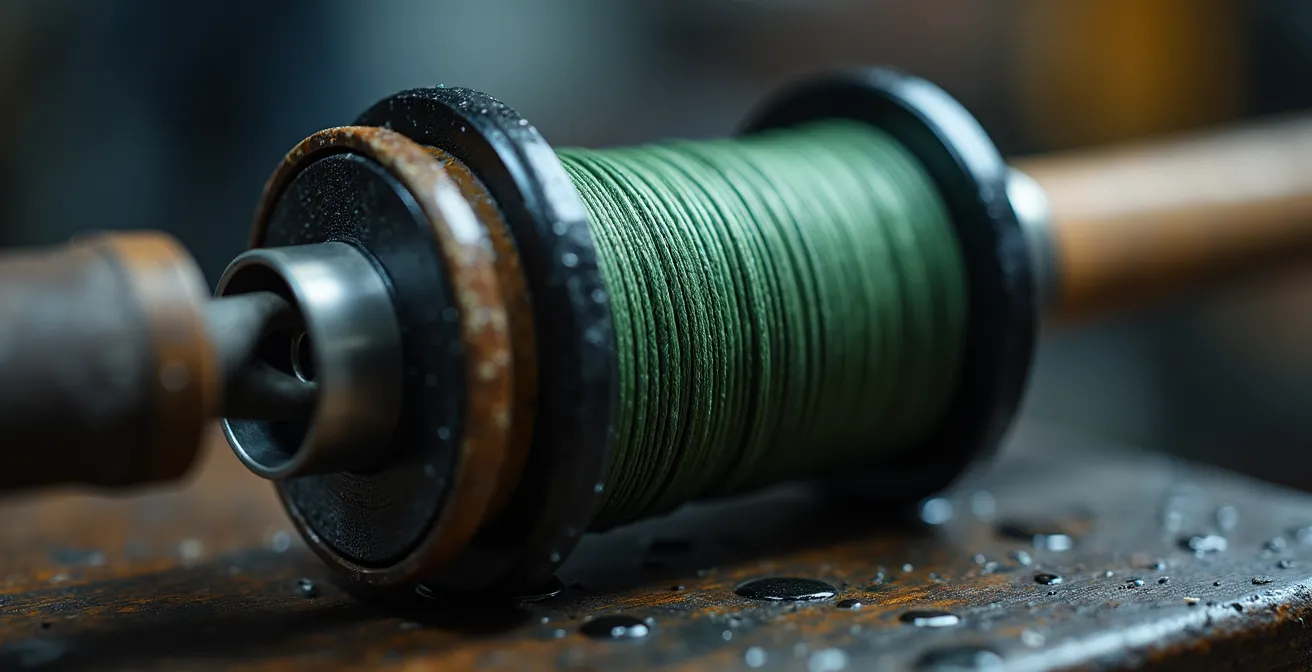
As shown in the image, applying tension is key. A simple and effective method is to run the line through a wet cloth or the pages of a phone book while you wind it onto the reel. The filler spool should be positioned so the line comes off in the same direction the reel’s bail is turning (typically counter-clockwise). After spooling on a few dozen feet, stop and lower your rod tip; if the line starts to twist up, flip the filler spool over and continue. This small bit of diligence ensures your line is at 100% of its potential strength.
Proper spooling is the foundation of a reliable setup. Without it, even the most expensive reel and the most precise drag setting are rendered ineffective.
The Lubrication Mistake That Gums Up Your Anti-Reverse Bearing
While the anti-reverse bearing is critical for solid hooksets, a far more common point of failure related to lubrication is the drag system itself. The number one mistake anglers make is using the wrong type of lubricant—or too much of it—which can migrate into the drag stack. Heavy grease, especially in cold weather, can thicken and cause the drag washers to stick together. This creates a high “inertial start-up” force. Instead of slipping smoothly, the drag will jerk and stutter at the beginning of a fish’s run, causing a shock load that instantly snaps the line.
Conversely, using a very light oil in hot weather can cause it to thin out and seep into the drag washers, reducing their friction coefficient and making the drag feel mushy and inconsistent. As the Handing Fishing Editorial Team notes in their guide, this is especially problematic in saltwater environments. They state, “Salt buildup can make the drag jerky or even freeze up completely.” This happens when saltwater contaminates the lubricant, creating a sticky, crystalline paste that destroys smooth performance.
The key is mechanical sympathy: using the right product for the right component. The anti-reverse is typically a clutch bearing that requires a very light, specialized oil, while drag washers (especially carbon fiber types like Carbontex) are often designed to be run dry or with a very specific, ultra-light drag grease. Applying a heavy, all-purpose grease to your reel’s internals is a recipe for a seized drag. Always back the drag off completely after each use to prevent the washers from compressing and sticking.
A smooth drag is a predictable drag, and predictability is what allows you to trust your gear when fighting a trophy fish. Regular, correct maintenance is non-negotiable.
Why Overfilling Your Spool Causes Wind Knots on the First Cast?
An overfilled spool is the single most common cause of the dreaded “wind knot.” The physics are simple: when there is too much line on the spool, the coils are no longer securely contained by the spool’s lip. During a cast, the line’s momentum causes multiple loose coils to fly off at once. Before they can straighten out and travel through the rod guides, they tangle in mid-air, forming a knot that either jams in the guides or creates a massive weak point in your line.
This directly sabotages your drag system. If a wind knot forms and you don’t notice it, it creates a point of friction and damage. The moment a big fish pulls hard, the line will break at that knot, regardless of how perfectly your drag is set. You might blame the drag for being too tight, but the real culprit was improper line level. The line failed at 50% or less of its rated strength because of the knot’s damage.

As the visual of a cast with an overfilled spool demonstrates, the line comes off in uncontrolled loops rather than a smooth, single strand. In a case study on line management, an expert angler gives a precise guideline: “I will spool my reel up to about an eighth of an inch from the top of the spool. This isn’t too filled where the line will come off too quickly and is still filled up enough to get the best performance.” This 1/8-inch (or ~3mm) gap is the golden rule. It provides the perfect balance, allowing for maximum casting distance while ensuring the spool lip maintains control over the line, preventing the loose loops that cause wind knots.
Check your spool before every trip. It’s a five-second inspection that can save you from the guaranteed failure a wind knot creates.
Why Braided Line Casts Farther Than Monofilament of the Same Strength?
Braided line casts farther than monofilament primarily due to its much smaller diameter for a given strength and its slicker, more supple nature, which creates less friction against the rod guides. However, the most significant difference between the two lines in the context of fighting fish is stretch. Monofilament can stretch 25% or more under load, acting as a crucial shock absorber. Braided line has virtually zero stretch. This fundamental difference completely changes how you must approach your drag setting.
With monofilament, the line’s inherent stretch provides a buffer during sudden head shakes or powerful runs. It forgives a slightly-too-tight drag setting. With braid, there is no forgiveness. The rod and the drag system must absorb 100% of the shock. If your drag sticks or is set too tight, the instantaneous shockwave travels directly to the weakest point—the knot or a nick in the line—and causes it to fail. For this reason, drag settings must be adjusted based on line type. While mono can be set around 30% of its breaking strength, many pros suggest a lighter setting for braid. The consensus is that drag should be set looser when fishing with braided lines that do not stretch.
The goal is to achieve a smooth, immediate release of line at the moment of impact. As expert angler Jason Sealock explains, this is critical:
The drag should slip smoothly. Sometimes, if it’s too tight, it can’t start smoothly, and that is where breaks happen. You want it to feel like the drag is slipping well before you think you are about to break your line from pulling so hard.
– Jason Sealock, Wired2Fish Drag Setting Guide
This concept of smooth “inertial start-up” is ten times more critical with non-stretch braided lines. Your drag is not just a brake; it’s the system’s only shock absorber.
Therefore, when using braid, you are not just setting a drag; you are tuning a shock absorption system where precision is paramount.
How to Remove Salt Crystals from Reels Before They Seize Up?
For saltwater anglers, salt is the ultimate enemy of mechanical performance. When saltwater evaporates on your reel, it leaves behind microscopic salt crystals. Nowhere is this more destructive than inside your drag system. These abrasive crystals work their way between your drag washers, contaminating lubricants and physically scoring the smooth surfaces. This is what causes a once-smooth drag to become “jerky” or “sticky.” A single, tiny crystal can cause a washer to catch for a split second, creating a massive shock load on the line when a fish runs.
This is a mechanical seizure in slow motion. Over time, this buildup of salt and corrosion will completely freeze the drag stack, turning your high-performance reel into a winch with no safety clutch. The key is preventative maintenance, which means removing salt before it has a chance to crystallize and cause damage. A high-pressure blast of freshwater is counter-productive, as it can drive salt and water deeper into the reel’s internals. A gentle, low-pressure mist after every outing is the correct first step.

The visual contrast between a corroded, salt-encrusted drag washer and a clean one highlights the battle being fought at a microscopic level. To win this battle requires a disciplined, multi-tiered maintenance approach. Simply rinsing the outside of your reel is not enough.
Action Plan: Tiered Saltwater Reel Maintenance Schedule
- After Each Use: Perform a light freshwater misting on the reel’s exterior. Never use a high-pressure spray. Wipe down with a dry cloth.
- Weekly (Heavy Use): Remove the spool completely. Use a damp cloth to wipe down the exposed drag components and the inside of the spool.
- Monthly: Conduct a full drag service. This involves disassembling the entire drag stack, cleaning each washer and metal key individually with a soft cloth, and checking for wear.
- Seasonally: A complete teardown is necessary. This includes cleaning and re-lubricating the main gear, pinion gear, and all bearings, especially the anti-reverse bearing, with a high-quality, corrosion-resistant marine grease and oil.
Treating your reel with this level of mechanical care ensures that when you hook the fish of a lifetime, your drag will perform exactly as it was engineered to.
Key Takeaways
- Line breaks are often caused by overlooked mechanical issues, not just an incorrect drag setting.
- Proper line management (manual bail closing, correct spool level) is as crucial as the drag setting itself, as it prevents line-weakening twists and knots.
- Drag performance is a system: it depends on line type (stretch vs. no-stretch), reel maintenance (lubrication, cleanliness), and gear ratio (power).
Spin Casting Accuracy: How to Hit Targets Under Overhanging Branches?
Achieving pin-point casting accuracy, especially when skipping lures under low-hanging branches, relies on a technique called “feathering.” This involves lightly touching the spool’s lip with your index finger during the cast to control the rate at which line comes off the spool. It’s a delicate touch that gives an angler total control over the lure’s trajectory and distance. While this is primarily a casting technique, the mindset behind it—active, dynamic line control—is the final piece of the puzzle for fighting big fish.
Your mechanical drag setting is the foundation. As many professionals recommend, setting it to about 20 to 30 percent of the pound test is the correct starting point. However, no single setting is perfect for every moment of the fight. When a giant fish is about to run into a dock piling or a sharp rock, you may need a split-second of extra pressure to turn its head. Conversely, if a fish makes a sudden, blistering run in open water, you may need to ease the pressure slightly to avoid a break-off from sheer velocity.
This is where pros use manual drag adjustment. Just as you feather the spool to control a cast, you can apply gentle pressure with your fingertips to the spool during a fight to add temporary, incremental drag. This gives you a level of dynamic control that a mechanical system alone cannot. It allows you to momentarily exceed your preset drag to turn a fish, then instantly release that pressure. Most experienced anglers develop a feel for this, making bail closing and line management second nature for superior control. It’s the ultimate expression of working in sync with your equipment.
By combining a perfectly maintained reel and a precisely set base drag with the skill of manual feathering, you move from being a passenger to being the pilot, capable of adjusting to any situation the fish throws at you.