Successfully flushing birds without a dog hinges on shifting from a physical chase to a psychological chess match against the bird’s survival instincts.
- Your movement—pauses, changes in direction, and sound—is your primary tool for creating pressure that forces a bird to flush.
- Understanding the specific cover, time of day, and the bird’s sensory limits gives you a decisive tactical advantage.
Recommendation: Stop trying to “find” birds and start learning how to “unnerve” them by becoming an unpredictable predator in their environment.
The cold reality of hunting without a four-legged partner hits you the first time you walk a perfect line of cover and come up empty-handed, only to hear a cackle explode behind you. It’s a common frustration, but it’s far from a deal-breaker. In fact, learning to hunt solo is one of the most rewarding challenges in the uplands, forcing you to think like a predator, not just a hiker with a shotgun. It’s a skill an increasing number of hunters are embracing; in fact, research from Minnesota shows that 56.3% of people are now bird hunting without a dog.
Most advice for the dogless hunter boils down to simple platitudes: walk slower, pause occasionally, and hunt the edges. While not wrong, this advice misses the fundamental point. It’s not about the walking; it’s about the sensory warfare you wage. It’s not just about pausing; it’s about the calculated use of silence to shatter a bird’s composure—what I call the Predator’s Pause. Flushing birds from dense cattails, thorny briars, or thick woods is a game of psychological pressure. It’s about understanding why a bird feels safe and systematically taking that safety away.
This guide abandons the generic tips and instead focuses on the “why” behind the “how.” We’ll deconstruct the bird’s mindset and environment to build a strategy. We will explore how to read and dismantle a pheasant’s late-season fortress, how to choose the right tool for the split-second shot that follows, and how to use movement as a weapon. We’ll also cover the critical elements of safety, timing, and the specialized gear that allows you to move through the thickest cover with the confidence of an apex predator.
This article provides a complete system for the dogless hunter. Below is a breakdown of the tactics, strategies, and gear insights we will cover to transform your solo hunts from frustrating walks into calculated successes.
Table of Contents: A Solo Hunter’s Guide to Flushing Upland Birds
- Why Pheasants Choose Cattail Sloughs in Late Season Windy Days?
- Modified vs Improved Cylinder: Which Choke Is Best for Flushing Grouse?
- The Zig-Zag Pattern: How to Stop and Start to Unnerve Hiding Birds
- The Line-of-Fire Mistake That Endangers Hunting Partners in Brush
- When to Hunt Upland Birds: Morning Feed vs Evening Roost?
- Why Deer Cannot See Blaze Orange But Turkeys Can?
- Why Genuine Leather Peels While Full-Grain Develops a Protective Patina?
- Kevlar or Cordura: Which Puncture-Resistant Fabric Stops Briars Best?
Why Pheasants Choose Cattail Sloughs in Late Season Windy Days?
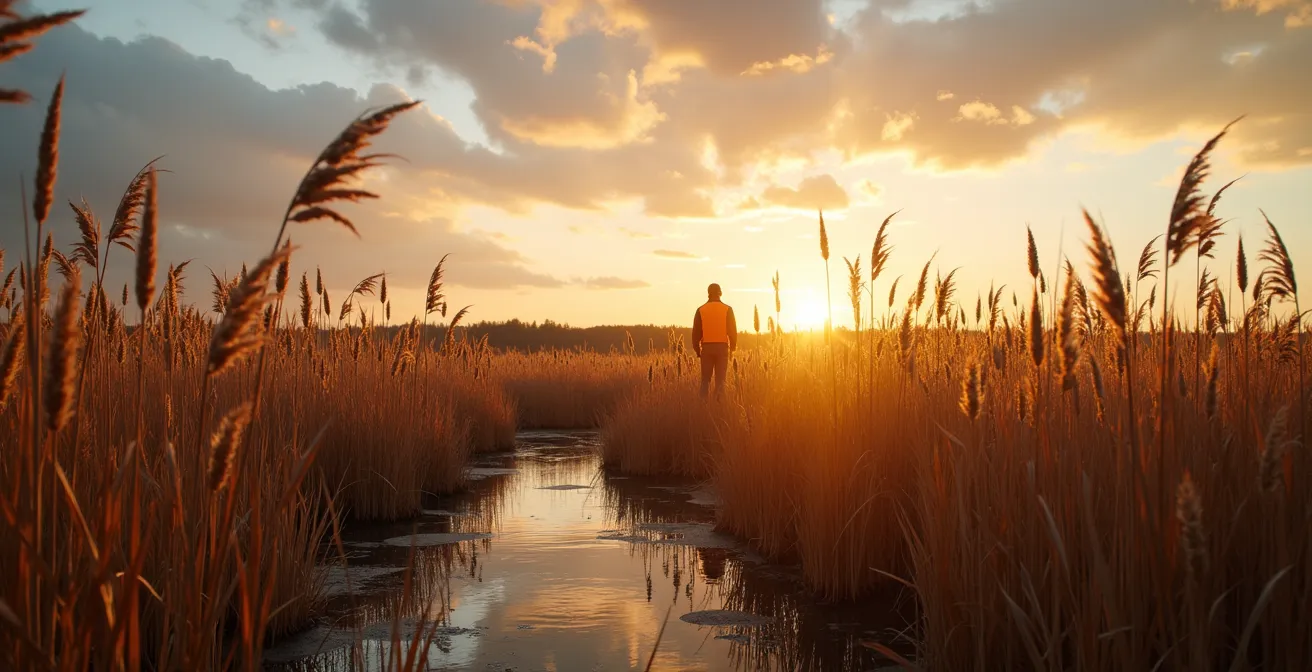
When the wind howls and the temperature drops late in the season, pheasants don’t choose cattail sloughs by accident; they choose them for survival. This isn’t just cover; it’s a fortress. The dense stalks provide crucial thermal insulation against biting winds, saving precious energy. More importantly, from a hunter’s perspective, the dry, rustling cattails act as a massive amplifier for sound. A pheasant can hear your steady, rhythmic footsteps from a hundred yards away, giving it ample time to either run to the far end or hunker down and let you pass.
Your job is to turn this fortress into a trap. Standard tactics of simply walking through won’t work. The birds will use the noise to track you perfectly. Instead, you must become unpredictable. Hunt the edges first. Often, nervous birds will hold on the transition line between the slough and adjacent grass or crop stubble. A quick, quiet pass along this edge can flush skittish birds. If that fails, it’s time to apply direct pressure. A common and effective solo technique is to find a high point overlooking the cattails and throw rocks or large sticks into the thicket. This creates a sound that is not you, forcing birds to choose between staying put with an unknown threat or flushing.
The most effective strategy, however, is the “end run.” Instead of slowly pushing through the cover, move quickly and quietly along the edge to the downwind end of the slough. Birds that have been running ahead of you will be surprised by your sudden appearance at their escape route. They expect pressure from behind, not in front. This move can trigger a flurry of flushes from birds that thought they had you figured out. Always be mindful of your footing and muzzle control during this rapid repositioning, as the action can be fast and furious.
Modified vs Improved Cylinder: Which Choke Is Best for Flushing Grouse?
For the dogless hunter, choke selection isn’t just a technical detail; it’s a strategic calculation of risk and reward. When a grouse thunders from a thicket or a pheasant erupts from under your feet, you don’t have the luxury of a pointing dog giving you a few seconds of warning. The shot is almost always a surprise, close, and fleeting. This reality heavily favors a more open choke. An Improved Cylinder (IC) is often the veteran’s choice for these conditions. It provides a wider, more forgiving pattern at the typical 15-25 yard range where most self-flushed birds are taken. This wider spread can be the difference between a clean kill and a frustrating miss on a rapidly departing bird.
A Modified choke, while excellent for more open country or hunting over pointing dogs where shots are often in the 25-35 yard range, can be a liability in thick cover. Its tighter pattern is less forgiving of a rushed mount and swing, and can excessively damage a bird at very close range. The key is to be honest about your most likely shot distance. Without a dog, that distance is almost always “close and fast.” The IC choke is purpose-built for this exact scenario, balancing pattern density with enough spread to give you a crucial edge.
The material of your shot also plays a role in this decision, especially with the prevalence of non-toxic shot requirements. Steel shot, being less dense than lead, typically produces a tighter pattern. An IC choke with steel shot might perform more like a Modified choke with lead. It’s essential to pattern your gun with the exact load you’ll be hunting with to truly understand what’s happening downrange. This isn’t just gunsmithing; it’s gathering critical intelligence for your hunt.
The following table breaks down the trade-offs, making it clear why understanding your equipment is as important as understanding the terrain. As you can see from the data compiled from a comprehensive guide on upland hunting, the choice is highly situational.
| Choke Type | Best Distance | Pattern Spread | Shot Material Impact | Best Use Case |
|---|---|---|---|---|
| Improved Cylinder | Under 25 yards | Wider, forgiving | Wide open for close shots | Dense cover, dogless hunting |
| Modified | 25-35 yards | Medium spread | Tighter with steel shot | Open fields, line hunting |
| Cylinder/Skeet | Under 20 yards | Very wide | Wide open, like cylinder and skeet | Ruffed grouse in thick woods |
The Zig-Zag Pattern: How to Stop and Start to Unnerve Hiding Birds
The single most powerful tool in the dogless hunter’s arsenal is not the gun, but the pause. Upland birds are masters of camouflage and have nerves of steel. They have evolved to let predators, like coyotes or fox, walk right by. A steady beat of footsteps is a predictable threat they can easily pinpoint and evade. But silence? Silence from a detected predator is unnatural and deeply unsettling. This is the principle behind the stop-and-go or zig-zag hunting pattern. It is pure psychological warfare.
By stopping abruptly, you break the rhythm they are tracking. The bird, which was patiently waiting for you to pass, is now on high alert. Its brain is screaming, “Where did it go? Does it see me?” This is your moment of maximum leverage. The longer you stay still, the more their tension builds, until their nerves break and they explode from the cover. The effectiveness of this is not just anecdotal; some experienced hunters report that stopping often and sitting still for minutes accounts for 40% of their bird flushes. You are preying on their nerves.
The “zig-zag” adds another layer to this. Instead of a straight line, you move unpredictably through the cover, angling towards likely holding spots—a thicket, a fallen log, a small depression. Each time you change direction, you present a new angle of approach, further confusing birds that are trying to keep you in their line of sight. Combine this with the “Predator’s Pause.” Walk 20 yards, stop for 15 seconds, take two steps, stop again for 30 seconds. This erratic pattern convinces the bird that it has been truly seen and that the predator is closing in for the kill, forcing it into the air.
Your Action Plan: The Predator’s Pause and Zig-Zag
- Vary Your Pauses: Mix very short pauses of a few seconds with long, deliberate stops of 30 seconds or more. The unpredictability is key to building psychological pressure.
- Execute the “False Retreat”: After a long pause, take one or two loud, deliberate steps backward. This can trick a bird into thinking the danger has passed, causing it to relax and then flush when you move forward again.
- Hunt Features, Not Lines: As you zig-zag, move from one piece of micro-cover to the next. Target isolated clumps of grass, rock piles, or abandoned machinery where a bird might feel secure.
- Use Your Ears During Pauses: When you stop, remain absolutely silent and listen. You can often hear the faint rustle of a running bird, giving away its position for your next move.
- Stay Ready on the Stop: The flush often comes the second you stop or the second you start moving again. Be at a low-ready position during every pause, prepared for an instant shot.
The Line-of-Fire Mistake That Endangers Hunting Partners in Brush
When hunting solo, safety is a matter of personal discipline. When you add even one more hunter to the equation in dense brush, the complexity and risk multiply exponentially. The most dangerous mistake is a momentary loss of awareness of your partner’s exact location, leading to a swing on a flushing bird that crosses into their line of fire. In thick cover, visibility is measured in feet, not yards. A hunter can disappear completely behind a patch of briars just a few steps away. This makes constant communication not just a courtesy, but a lifeline.
Effective teams talk continuously. Not a full conversation, but a steady stream of “I’m here,” “Moving up on your left,” or simple whistles. This constant auditory contact helps track each other’s position when visual contact is impossible. Before stepping into the cover, establish clear, non-negotiable rules for fields of fire. A common method is the “10 o’clock to 2 o’clock” rule, where each hunter can only shoot in the forward arc in front of them. Any bird that cuts back behind this line is off-limits, no matter how tempting.
Driving birds with a partner and a blocker is a classic dogless tactic, but it requires military-like discipline. The drivers must maintain a straight, even line as they move through the cover. No one gets ahead or falls behind. The most important rule in this scenario is simple: if you can’t see clear sky below the bird’s belly, you cannot shoot. This prevents low shots that travel through the brush at hunter height. As one veteran editor noted, the opportunities for a dogless hunter are precious, making it all the more critical that every decision is safe and deliberate.
Dogless hunters don’t get as many chances as hunters with dogs. That’s a simple truth. You have to make the most of every opportunity.
– Field & Stream Editorial, 10 Tips for Hunting Pheasants Without a Dog
When to Hunt Upland Birds: Morning Feed vs Evening Roost?
Choosing when to hunt is as critical as choosing where. For the solo hunter, timing is a way to stack the odds in your favor by exploiting the bird’s daily routine. The two most productive windows are typically the first few hours after sunrise and the last hour before sunset. Each offers distinct advantages. The morning hunt is about intercepting birds when they are most active and exposed. As temperatures rise, grouse and pheasants leave the security of their roosts to feed in more open areas on insects, seeds, and grit.
This morning activity is your best bet, especially in warmer weather. One proven strategy is to be in the cover at first light, when birds are moving and vocal. Without a dog to scent them in thick midday cover, you need to find them on the move.
Case Study: The Early Bird Strategy
Experienced grouse hunters without dogs often focus exclusively on the morning. By being in the woods before sunrise, they capitalize on the brief window when grouse are on the ground feeding along logging roads and clearings. In early fall, when afternoons can still be warm, this cool-weather activity period is short. The birds will quickly fill their crops and retreat to dense, shady cover to loaf through the heat of the day, making them nearly impossible to flush without a dog.
The evening hunt, or the “golden hour,” presents a different opportunity. This is less about finding birds feeding and more about ambushing them as they travel back to their secure roosting cover for the night. Birds will often congregate in staging areas—lighter cover adjacent to their thick, brushy bedrooms. Some hunters swear by this time, arguing that birds are more predictable as they follow established travel corridors back to roost. According to some experts, this is the prime time, as noted in a guide for beginner upland hunters where it’s stated that the “gold hour,” is your last opportunity. You will find birds moving from food sources to roosts, a pattern you can learn to intercept.
Ultimately, the choice between morning and evening may depend on the species, weather, and specific property. The key is to recognize that birds are not randomly scattered. Their location is dictated by the clock and the temperature, and your strategy should be too.
Why Deer Cannot See Blaze Orange But Turkeys Can?
The blaze orange vest is a staple of hunter safety, but its effectiveness relies on a fascinating quirk of animal biology. Mammals like deer are dichromats; their eyes have two types of cone cells. They see the world primarily in shades of blue and yellow, and they are effectively red-green colorblind. To a deer, a blaze orange vest doesn’t pop as a vibrant, unnatural color. Instead, it appears as a shade of gray or dull yellow, blending in with the autumn landscape. This is why it’s a perfect safety color for deer season: highly visible to other humans, but not to the deer.
Upland birds, however, are a different story entirely. Birds like pheasants, grouse, and especially turkeys, have vastly superior color vision. They possess what is known as tetrachromatic vision with four cone types, allowing them to see reds, greens, and blues, as well as into the ultraviolet (UV) spectrum, which is invisible to humans. To a turkey or a pheasant, your blaze orange vest is a blazing beacon of unnatural color. This doesn’t mean you should abandon it—safety is paramount, especially when hunting with others. But it does mean you must be hyper-aware of your movement.
For a bird, it’s often the sudden movement of that orange block that triggers the flush, not the color itself. A slow, steady pace is less alarming than a jerky, sudden stop or a quick gun mount. Furthermore, many modern detergents contain UV brighteners to make clothes appear “whiter and brighter” to us. To a bird, this makes your clothing glow with an unnatural blue-white light. Using special UV-free hunting detergents can help reduce this effect. For the truly dedicated solo hunter in a safe, isolated area, considering a camouflage pattern on the upper body might provide a slight edge, but this should never come at the expense of being visible to other hunters.
Why Genuine Leather Peels While Full-Grain Develops a Protective Patina?
When you’re pushing through thick briars and climbing over rocky terrain, your boots are not just footwear; they are your foundation. They provide support, protection, and the ability to move quietly. The choice of material is critical, and the world of leather can be deceptive. “Genuine Leather” sounds premium, but it’s often one of the lowest grades. It is made from the inner layers of the hide and is often coated with a synthetic finish. This finish is what gives it a uniform look, but it’s also its greatest weakness. With repeated flexing and exposure to moisture and abrasion, this synthetic layer cracks and peels, exposing the weaker fibers beneath.
Full-grain leather, on the other hand, is the real deal. It is the outermost layer of the hide, containing all the dense, tightly packed fibers that gave the animal its natural protection. It hasn’t been sanded or buffed to remove imperfections. This tough, natural surface doesn’t peel. Instead, as it absorbs oils from your hands, conditioning treatments, and the environment, it develops a patina. This patina is not a sign of wear, but a protective layer that enriches the leather’s character and enhances its water resistance and durability over time. A well-cared-for pair of full-grain leather boots can last for decades, molding to your feet and becoming a trusted piece of gear.
Of course, for certain conditions, other materials excel. As one hunter who primarily hunts flat, muddy fields notes, simple rubber boots can be ideal for their 100% waterproofness and low maintenance. But for the varied and often punishing terrain of the uplands, the durability and support of a high-quality leather boot are unparalleled.
The initial investment in full-grain leather is higher, but the long-term value is undeniable, as the following comparison shows.
| Leather Type | Initial Cost | Durability | Maintenance | Patina Development |
|---|---|---|---|---|
| Full-Grain | High ($200+) | 10+ years | Oil conditioning | Develops protective patina |
| Genuine Leather | Low ($50-100) | 1-2 seasons | Frequent replacement | Peels and cracks |
| Top-Grain | Medium ($100-150) | 3-5 years | Regular treatment | Limited patina |
Key Takeaways
- Flushing birds solo is a game of psychological pressure, not pursuit. Unpredictable movement and strategic pauses are your best tools.
- Your equipment—from choke tubes to boot leather—is a set of calculated choices that must match the specific challenges of close-quarter, dogless hunting.
- Success depends on a holistic strategy that combines an understanding of bird behavior, terrain, timing, and personal concealment.
Kevlar or Cordura: Which Puncture-Resistant Fabric Stops Briars Best?
To effectively execute the stop-and-go tactics required for dogless hunting, you cannot be tentative. You must be able to plunge into the thickest, nastiest cover with confidence, knowing you’re protected. This is where your choice of upland pants or chaps becomes a critical piece of strategic gear. The decision often comes down to two leading materials: Cordura nylon and Kevlar. While both offer excellent protection, they do so with different trade-offs in noise, flexibility, and weight.
Kevlar is famous for its incredible puncture and cut resistance, which is why it’s used in body armor. It will stop nearly any thorn or briar dead in its tracks. However, this extreme protection comes at a cost. Kevlar-faced pants are often stiffer, heavier, and can be noisy as you move through brush. They offer maximum protection but can hinder the stealth required for getting close to wary birds.
Cordura, particularly in a heavy weave like 1000D (denier), offers a more balanced solution. It provides very good puncture resistance—enough to turn aside all but the most determined thorns—while being significantly more flexible and quieter than Kevlar. Lighter versions like 500D Cordura offer even better flexibility and less noise, at the cost of some protection. For most upland conditions, a high-denier Cordura facing provides the sweet spot of protection, durability, and mobility, allowing you to bust brush without sounding like a freight train.
Ultimately, your “armor” must match the battlefield. For a hunt in a sea of multiflora rose, the uncompromising protection of Kevlar might be worth the trade-offs. For mixed woods and grasslands, Cordura is often the more versatile and strategic choice.
| Fabric | Puncture Resistance | Noise Level | Flexibility | Weight | Water Resistance |
|---|---|---|---|---|---|
| Kevlar | Excellent | Medium | Poor | Heavy | Poor when wet |
| 1000D Cordura | Very Good | Low | Good | Medium | DWR-coated options |
| 500D Cordura | Good | Very Low | Excellent | Light | Good with coating |
| Waxed Canvas | Fair | Very Low | Good | Medium | Excellent |
By integrating these tactical movements, environmental reads, and gear choices, you build a complete system. You are no longer simply walking and hoping. You are dictating the terms of the engagement, turning the bird’s strengths into weaknesses and creating your own opportunities. This is the art of the dogless hunter.