
The secret to punching a cast through wind isn’t brute force; it’s mastering the efficient transfer of energy through a sound kinetic chain.
- A tight, aerodynamic loop is the single most critical factor for accuracy and distance in windy conditions.
- Correcting the common ‘broken wrist’ mistake is key to unlocking power and preventing the cast from collapsing.
Recommendation: Stop trying to ‘power through’ the wind and start focusing on creating a mechanically sound casting stroke that generates high line speed with minimal effort.
For many fly fishermen, a stiff headwind on an open river feels like a wall. Your cast, which felt so smooth in the backyard, collapses. The large streamer you need to throw turns into a tangled mess, and the frustration builds. Many anglers believe the solution is to apply more power, to ‘muscle’ the line through the gust. They focus on the haul, the rod, or the line, but rarely on the system as a whole. This often leads to common errors like a ‘broken’ wrist, poor timing, and wide, inefficient loops that are easily slapped down by the wind.
But what if the key wasn’t about adding more force, but about maximizing efficiency? The truth is, mastering the double haul is less about raw strength and more about understanding physics and biomechanics. It’s about learning to be your own casting diagnostician on the water. This guide moves beyond the simple ’10 and 2 o’clock’ advice. We will deconstruct the cast into its core components: the physics of the loop, the biomechanics of your arm, the sensory feedback from your line, and the strategic choices that separate a struggling angler from a confident caster.
To help you see these principles in action, the following video offers a foundational look at the single haul, which is the building block for the more advanced double haul we will be dissecting. It’s an excellent starting point to visualize the core pulling motion.
In the following sections, we will build a complete understanding of the double haul. We will explore each critical element, from forming a wind-cutting loop to managing your line and adapting your technique for any situation you might face on the river.
Summary: Mastering the Wind with the Double Haul
- Why a Tight Loop Is Critical for Accuracy and How to Form It?
- The ‘Broken Wrist’ Mistake That Kills Your Backcast Power
- How to Listen to Your Line to Time the Forward Stroke Perfectly?
- Stripping Basket vs Hand Coils: Which Manages Running Line Better?
- Thumb-On-Top vs Index Finger: Which Grip Offers Better Precision?
- Upstream vs Downstream Casting: Which Presentation Looks More Natural?
- High-Sticking: How to Keep Line Off the Water to Fish Small Pockets?
- Floating vs Sinking Lines: Which Is Necessary for Nymphing in Deep Pools?
Why a Tight Loop Is Critical for Accuracy and How to Form It?
In the battle against wind, the shape of your loop is your primary weapon. A wide, lazy loop presents a large surface area, acting like a sail that the wind can easily grab and push off target. Conversely, a tight, narrow loop is aerodynamic. It cuts through the air with minimal resistance, transferring the energy from your rod directly into forward momentum. Think of it as the difference between throwing a sheet of paper and a paper airplane into the wind. The shape dictates its ability to travel. For fly casting, research on loop aerodynamics shows that an optimal loop of 3 to 4 feet wide maintains energy and accuracy far better than wider ones.
So, how do you form one? A tight loop is not something you ‘create’ on its own; it is the natural result of a mechanically sound casting stroke. The single most important factor is the path of the rod tip. To form a tight loop, the rod tip must travel in a straight line between its start and stop points. Any deviation—a curve, a dip, or a circle—introduces slack and widens the loop. The “10 and 2 o’clock” rule is a simplification of this principle. The key is to accelerate the rod smoothly to an abrupt stop, ensuring all the energy is transferred efficiently into the line.
A mechanically sound stroke, applied over the correct length, will automatically produce tight loops. It’s a direct reflection of your casting form. If your loops are wide, you know there is an inefficiency in your stroke that needs to be diagnosed and corrected. It is the first and most important piece of feedback the line gives you.
Action Plan: Achieve Consistent Tight Loops
- Keep the rod tip just above eye level during the cast to promote a flatter, more direct path.
- Lock the line under your index finger and cast with the line hand in your pocket to isolate and focus on pure rod movement.
- Move the rod tip smoothly between two focus points in a straight line path, both on the backcast and forward cast.
- Practice varying trajectories at different line lengths while consciously maintaining tight, smooth loops.
- Perform the ‘Picking Leaves’ drill, aiming to ‘pick’ a specific leaf off a tree with your leader to improve accuracy and loop control.
The ‘Broken Wrist’ Mistake That Kills Your Backcast Power
One of the most common and destructive habits in fly casting is the ‘broken wrist’. This occurs when the angler allows their wrist to bend excessively backward during the backcast, causing the rod tip to dip dramatically. This curved path kills the straight-line trajectory needed for a tight loop, introduces slack, and robs the cast of its power. A powerful, efficient cast relies on a strong kinetic chain, where energy flows from the shoulder, through the elbow, to the wrist, and finally to the rod. Breaking the wrist disrupts this chain, forcing the arm and shoulder to overcompensate with wasted, jerky movements.
A proper cast uses a firm but not rigid wrist, acting as a hinge that stops abruptly to load the rod. To avoid the ‘broken wrist,’ focus on keeping your thumb pointing toward your shoulder on the backcast. This helps keep the rod and forearm in alignment. The legendary “First Lady of Fly Fishing,” Joan Wulff, offered timeless advice on grip pressure:
Grip the rod as though you were holding a small bird. Firmly enough so it won’t fly away, but gently enough so you don’t crush it.
– Joan Wulff, First Lady of Fly Fishing
An overly tight grip, or ‘death grip,’ is often a symptom of trying to generate power incorrectly and can lead to fatigue and injury. In fact, a 2021 systematic review in the Journal of Hand Therapy confirms that excessive grip force is a known contributor to musculoskeletal issues. A relaxed grip allows for better feel and prevents the wrist from locking up or breaking down.
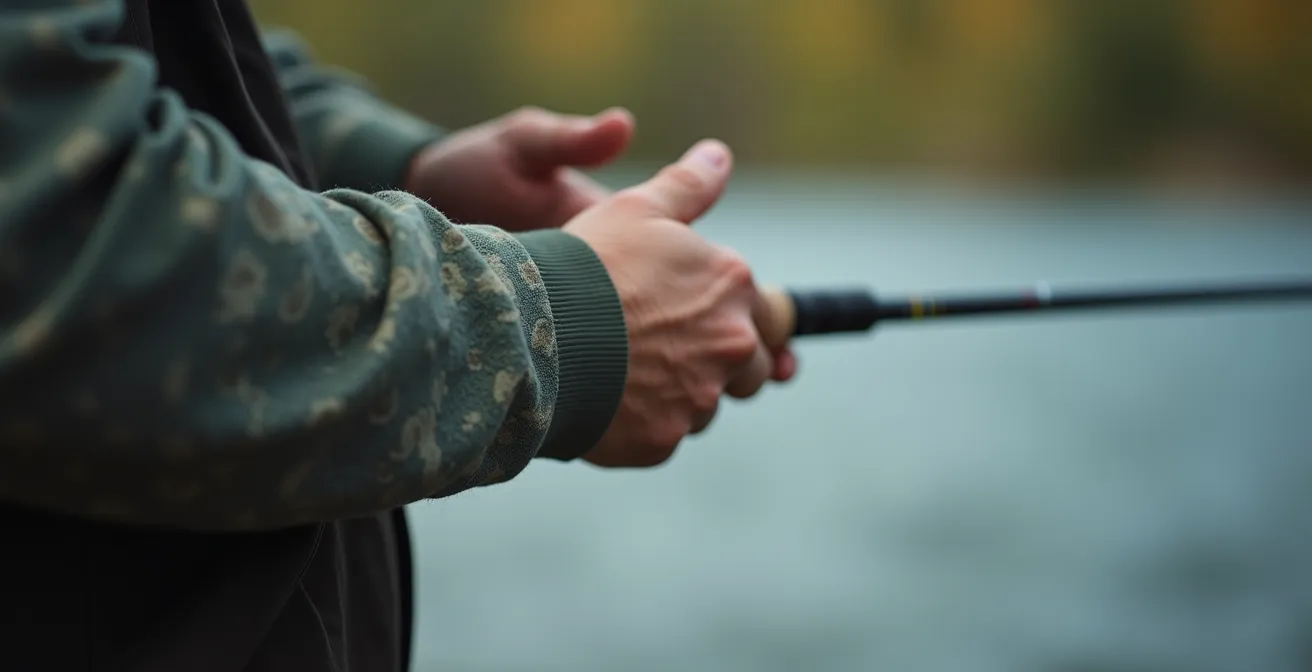
The image above illustrates the proper alignment. Notice how the wrist remains relatively straight, allowing the forearm muscles to do the work of stopping the rod. The power is not generated *by* the wrist, but is rather transferred *through* it in a final, crisp movement. Correcting this single mistake can be the most significant improvement an intermediate caster can make.
How to Listen to Your Line to Time the Forward Stroke Perfectly?
Perfect timing is the soul of a great cast. Launching the forward stroke too early, before the backcast has fully unrolled, will cause a ‘snap’ or ‘tick’ as the leader breaks the sound barrier—a clear sign of a tailing loop and lost energy. Conversely, waiting too long allows the line to lose momentum and sag, forcing you to use extra power to lift it again. While many instructors advise watching your backcast unroll, a more advanced technique is to develop a sensory feedback loop that relies on sound and feel, not just sight.
You can learn to *listen* to your cast. If you move into the forward stroke too quickly, the loud, sharp ‘crack’ of your fly whipping around is an unmistakable auditory cue to pause just a little longer. A well-timed cast is almost silent, with only the gentle ‘whoosh’ of the line cutting through the air. This auditory feedback is immediate and allows you to make micro-adjustments on the very next cast without having to turn your head.
Another powerful sensory tool is rhythm. Think of your cast as having a four-four time signature: backstroke on ‘one’, pause and unroll on ‘two’, forward stroke on ‘three’, and pause for the line to land on ‘four’. As you increase the length of line outside the rod tip, the duration of the pause on beat ‘two’ must get longer. The line needs more time to travel and straighten. By practicing counting these beats while you cast, you can internalize the rhythm. The silence between the strokes becomes your most reliable indicator, telling you precisely when your line is fully extended and ready to be driven forward with maximum efficiency.
Stripping Basket vs Hand Coils: Which Manages Running Line Better?
A perfect double haul is useless if the running line you’ve stripped in becomes a tangled mess at your feet. Efficient line management is the crucial, often-overlooked component of distance casting, especially in wind or from a boat. The two primary methods are using a stripping basket and coiling the line in your hand. Each has distinct advantages and disadvantages depending on the situation.
A stripping basket is a container worn at the waist that holds the stripped line. Its primary benefit is containment. It prevents the line from tangling on rocks, vegetation, or your own feet, and it keeps it out of strong currents. For distance casting, it is superior because it allows the line to shoot out with minimal friction. However, it can limit mobility when wading and can fill with water if you’re deep in the river.
The alternative is coiling the line in your hand. The most effective technique is the figure-eight coil. This method involves creating overlapping, reversed loops in your line hand, which prevents the line from twisting and creating tangles when it shoots. This method offers high mobility and works at any wading depth. However, it requires significant practice to master and is less effective in strong winds, as a gust can easily blow the coils apart.
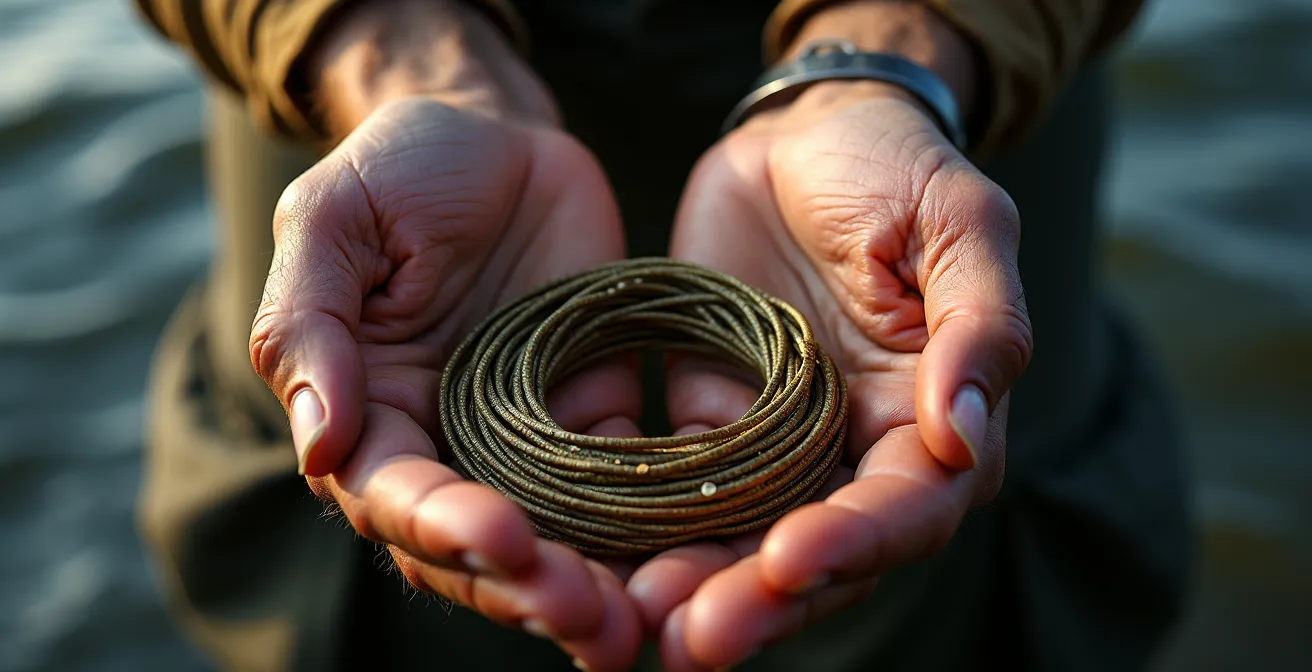
The following table, based on insights from experienced anglers, breaks down the key differences to help you decide which method is best for your needs.
| Aspect | Stripping Basket | Hand Coils |
|---|---|---|
| Mobility | Limited – fixed to waist | High – hands free movement |
| Line Control | Excellent – prevents tangles | Moderate – requires practice |
| Distance Casting | Superior – up to 100ft capability | Limited – 30-50ft practical |
| Wind Performance | Good with deep baskets | Poor – coils blow apart |
| Wading Depth | Can fill with water | Works at any depth |
Thumb-On-Top vs Index Finger: Which Grip Offers Better Precision?
The way you hold the rod might seem like a minor detail, but your grip is the primary interface between your body and the casting system. The two most common grips, thumb-on-top and index-finger-on-top, offer distinct biomechanical advantages and should be chosen strategically based on the casting situation.
The thumb-on-top grip is the workhorse. Placing your thumb directly on top of the cork handle aligns it with the rod blank, allowing you to apply power directly along the axis of the cast. This makes it the superior choice for power casts, long-distance casting, and driving a line through the wind. It naturally encourages the use of the larger muscles in the arm and shoulder, making it ideal for heavier rod weights and casting large, air-resistant flies. It provides stability and a clear sense of when the rod is loaded.
The index-finger-on-top grip, sometimes called the “delicate presentation” grip, is all about finesse. Extending your index finger along the top of the cork shifts the control to a more sensitive digit. Our fingers have far more sensory-motor connections than our thumbs, allowing for finer motor control. This makes the index finger grip ideal for short, precise casts under 30 feet, where subtlety and accuracy are more important than power. It’s perfect for delicate dry fly presentations where you need to aim with pinpoint accuracy. Smart anglers don’t just pick one grip; they alternate between them as a strategy. Switching grips during a long day of casting can also help prevent repetitive strain injuries by distributing the load across different muscle groups.
Upstream vs Downstream Casting: Which Presentation Looks More Natural?
Mastering the double haul isn’t just for bombing casts across the river; it’s a critical tool for line control in complex currents. The direction you cast relative to the current—upstream, downstream, or across—dramatically affects your presentation, and the double haul is key to managing it. A natural presentation requires achieving a drag-free drift, and that starts with the cast itself.
Casting upstream is often favored for stealth, as you approach the fish from behind. The challenge is that the current immediately begins pushing your line back toward you, creating slack. A crisp double haul can help by generating high line speed, allowing you to shoot the line and leader so they land in a straighter configuration. You can then use reach mends and other line management techniques to control the slack as the fly drifts back toward you. This is where a double haul is a utility, not just a distance tool.
Casting downstream or across-and-down presents the opposite problem: the current pulls on the belly of the line, causing the fly to drag unnaturally fast. This is especially problematic when your line sticks to the water’s surface. In fact, field observations demonstrate that surface tension reduces casting distance by 30-40% and, more importantly, creates significant drag. A powerful double haul helps here by enabling aerial mends. By executing the haul, you can power an “S” curve or a reach mend into the line *before* it lands, proactively building in slack that the current can pull out before it drags the fly. A crisp double-haul will open more fly angling ‘doors’ than any other casting skill, and this is a prime example.
High-Sticking: How to Keep Line Off the Water to Fish Small Pockets?
While the double haul is synonymous with distance, its principles of line speed and control are equally valuable for short-line nymphing techniques like high-sticking. High-sticking involves holding the rod high to keep as much fly line off the water as possible, allowing for direct contact with the nymphs and a perfect, drag-free drift through small, complex pockets of water. Integrating a haul into this technique might seem counterintuitive, but it provides an advanced level of control.
Instead of a full power haul, you can use a mini ‘check haul’ during the forward cast. This small, crisp pull on the line just before the stop creates a burst of line speed that helps turn over a heavy nymph rig and allows you to perform an aerial mend. For instance, a late haul, performed just as the loop is unrolling, can ‘tuck’ the nymphs under the indicator at the end of the cast, getting them into the strike zone faster. It’s a subtle application of the same principle: using the haul to control the line’s behavior.
Throughout the drift, you can maintain controlled tension by holding the hauled line, which enhances strike detection. The slightest tick or pause is transmitted more directly up the line when there is no slack. This transforms the haul from a casting-only tool into a drift management tool. As the experts at Jackson Hole Fly Company note in their guide, even the preliminary movements have a purpose.
False casting has a purpose—it dries out your fly, helps you reposition your line, and allows you to measure distance.
– Jackson Hole Fly Company, Cast Like a Pro Guide
In the same way, integrating small hauls into your short-game allows you to reposition your rig with more precision and efficiency before you transition from the cast directly into the high-stick position.
Key Takeaways
- Mastering the double haul is about understanding the physics of efficient energy transfer, not applying brute force.
- A tight, aerodynamic loop is the single most important element for defeating wind and achieving accuracy.
- Your casting stroke is a kinetic chain; a ‘broken wrist’ is the most common fault that disrupts this chain and kills power.
Floating vs Sinking Lines: Which Is Necessary for Nymphing in Deep Pools?
The final piece of the casting puzzle is understanding how your equipment, specifically your fly line, interacts with your technique. When nymphing in deep pools, the choice between a floating and a sinking line dictates not only your fishing strategy but also how you must execute your double haul. Each line type has a different mass and density, which requires adjustments to your casting stroke and timing.
With a standard floating line, the double haul is straightforward. The line is relatively light and sits on the surface, making it easy to pick up and cast. You can execute a standard double haul to power a long leader and heavy nymphs to your target. Mending is easy, as the line is visible and responsive on the surface. This is the default setup for nymphing at depths up to about six feet.
When you move to intermediate or full sinking lines to reach depths of 10-20 feet or more, the game changes. These lines are much denser and heavier. Lifting a sunken line directly from the water with a standard backcast is nearly impossible and puts immense strain on the rod. Here, the double haul must be preceded by a roll cast. You must first perform a dynamic roll cast to lift the sinking line to the surface. ONLY when the line is on or near the surface can you transition into your double haul backcast. The timing of the haul also needs to be slower and more powerful to handle the increased mass of the line. Mending becomes very limited, so the accuracy of your initial cast is paramount.
The following table outlines the key considerations when choosing a line for deep nymphing and how it impacts your casting approach.
| Line Type | Depth Range | Mending Capability | Double Haul Difficulty |
|---|---|---|---|
| Floating | 0-6 feet | Excellent | Easy |
| Intermediate | 2-10 feet | Moderate | Moderate |
| Full Sink | 8-20+ feet | Very Limited | Requires roll cast setup |
Now that you have deconstructed the double haul and understand how to adapt it to your line and the conditions, you have the tools to be your own diagnostician. You can analyze your loops, feel the kinetic chain in your arm, and listen for the timing of your stroke. Mastering the double haul isn’t about achieving one perfect cast; it’s about gaining the knowledge to make every cast better, no matter what the river throws at you.