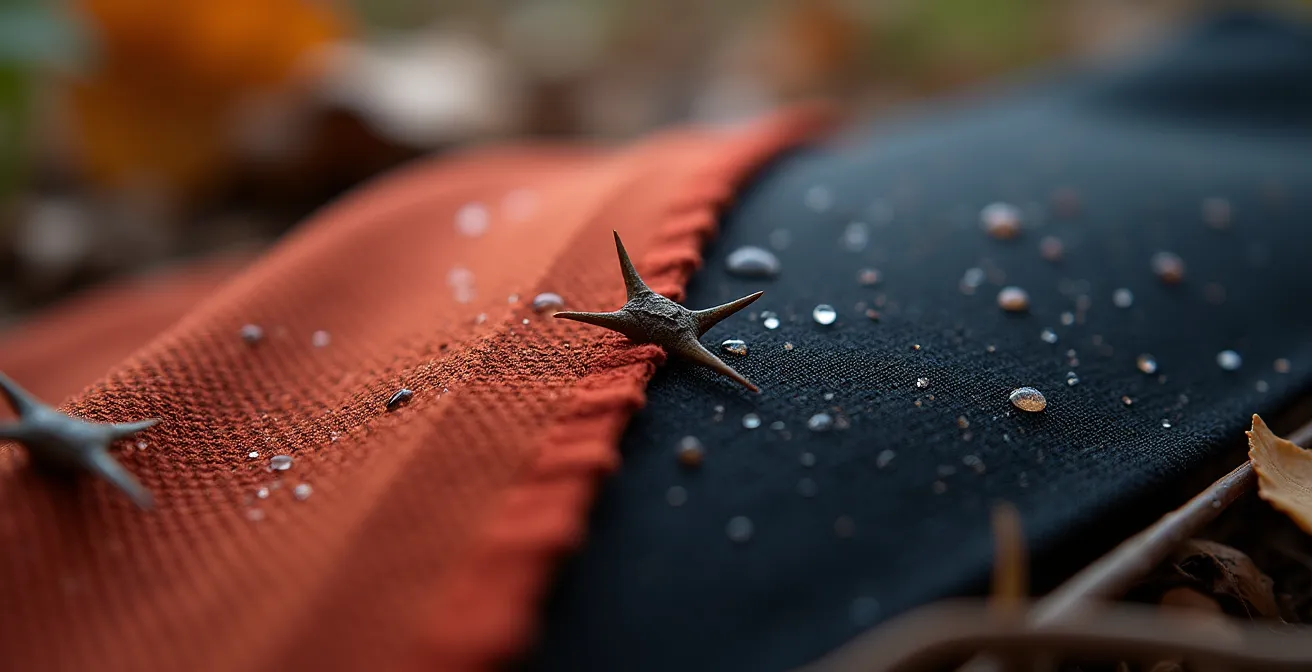
Contrary to popular belief, no single fabric—not even Kevlar—offers a perfect solution for briar protection; true durability comes from a complete system.
- Cordura offers superior, more practical performance for briar resistance due to its weave and availability, while Kevlar’s strengths lie elsewhere.
- Garment construction, fit, and features like ventilation are just as critical as the material itself for all-day effectiveness and comfort.
- Field viability, including noise, wet-weather performance, and repairability, ultimately determines a pant’s true worth in the scrub.
Recommendation: Stop searching for a single “miracle fabric” and start evaluating your brush pants as a complete performance system based on fabric, fit, and features.
For any hunter or hiker who has pushed through a dense thicket of blackberry or multiflora rose, the sound of fabric tearing is a painful, expensive reality. The debate over the best protective material often circles around two titans of textile technology: Kevlar and Cordura. Kevlar, famed for its use in ballistic vests, carries an almost mythical reputation for toughness. Cordura, a high-tenacity nylon, is the established workhorse in rugged outdoor and military gear. Most discussions end with a simple declaration that one is “stronger” than the other, but this oversimplifies a complex engineering problem.
The common approach is to look for the highest denier or the most impressive brand name. However, this misses the crucial point. Effective protection from thorns and environmental hazards is not about a single material. It’s about a systemic approach that considers the physics of puncture mechanics, the construction of the garment, and its performance in a dynamic, real-world environment. A fabric’s ability to shed a thorn is only one part of the equation; its capacity to manage heat, its performance when wet, and its repairability in the field are equally vital metrics for a textile durability tester.
This analysis moves beyond the simple “Kevlar vs. Cordura” question. We will deconstruct the factors that truly create a briar-proof garment, from the science of ventilation and the geometry of fit to the critical differences in protection needed for various threats, be they thorns, sharp rocks, or even snake fangs. By understanding the complete system, you can make an informed decision that keeps you protected, comfortable, and moving efficiently through the toughest terrain.
This guide breaks down the critical components of puncture-resistant gear. Explore the sections below to understand how each element contributes to a complete protection system.
Summary: Kevlar vs. Cordura: Deconstructing the Briar-Proof System
- Why Double-Front Pants Cause Overheating and How to Vent Them?
- How to Patch a Puncture in Cordura Pants in the Field?
- Waxed Cotton vs Synthetics: Which Sheds Thorns Better?
- The Baggy Pant Error That Catches More Thorns Than Tight Fits
- Snake Gaiters vs Puncture Pants: Which Is Safer in Rattlesnake Country?
- Leather vs Cordura: Which Material Survives Sharp Limestone Rocks?
- Why Pheasants Choose Cattail Sloughs in Late Season Windy Days?
- How to Meet Hunter Orange Requirements Without Spooking Game Animals?
Why Double-Front Pants Cause Overheating and How to Vent Them?
The fundamental trade-off with any double-front or briar-faced pant is protection versus breathability. The very same tight weave and heavy material that block thorns also trap heat and moisture. During high-exertion activities like busting through brush or climbing steep grades, your body generates significant thermal energy. Without an escape route, this heat builds up, leading to excessive sweating, discomfort, and potentially even unsafe core temperature fluctuations. The assumption that durable pants must lead to overheating is, however, a misconception. The issue isn’t the fabric itself, but the lack of an effective ventilation system.
Modern textile engineering has proven that with proper design, you can maintain thermal comfort even with heavy-duty gear. In fact, one study on outdoor workers found no significant differences in core temperature between those wearing shorts and those in full-length pants, provided the pants allowed for adequate airflow. The key is mechanical venting—purpose-built openings that allow for active air exchange. These can include zippered thigh vents, mesh-backed knee gussets, or even simple roll-up cuffs. These features transform a pair of pants from a static sweat-trap into a dynamic climate control system.
To maximize this effect, venting should be paired with a smart layering strategy. A moisture-wicking base layer made of merino wool or a high-quality synthetic is essential. This layer pulls sweat away from your skin, while the open vents allow that moisture to evaporate from the space between the base layer and the outer pant. This systematic approach—wicking plus venting—is the only way to stay comfortable and dry while wearing the heavy armor required for thick-country travel.
How to Patch a Puncture in Cordura Pants in the Field?
No fabric is indestructible. Even 1000D Cordura, the gold standard for abrasion and puncture resistance, can be compromised by a particularly sharp thorn, a piece of barbed wire, or a jagged rock. In a lab, this is a data point; in the field, it’s a critical failure that can let in moisture, catch on more brush, and compromise your hunt. The true measure of a fabric’s field viability is not just its initial strength, but its repairability. A small puncture shouldn’t end the life of a $200 pair of pants, and you need a reliable method to fix it miles from a sewing machine.
The most effective solution for field repairs on synthetic fabrics like Cordura is specialized repair tape. Products like Tenacious Tape have proven their worth time and again. One user on a gear forum reported patching multiple tears in Cordura panniers, noting the patches held without peeling through cold, wet, and dirty conditions. The key is proper application: the area must be clean and dry, and the patch corners should be rounded to prevent snagging and lifting. This simple piece of gear, weighing mere grams in your pack, provides an instant, durable, and nearly invisible fix.
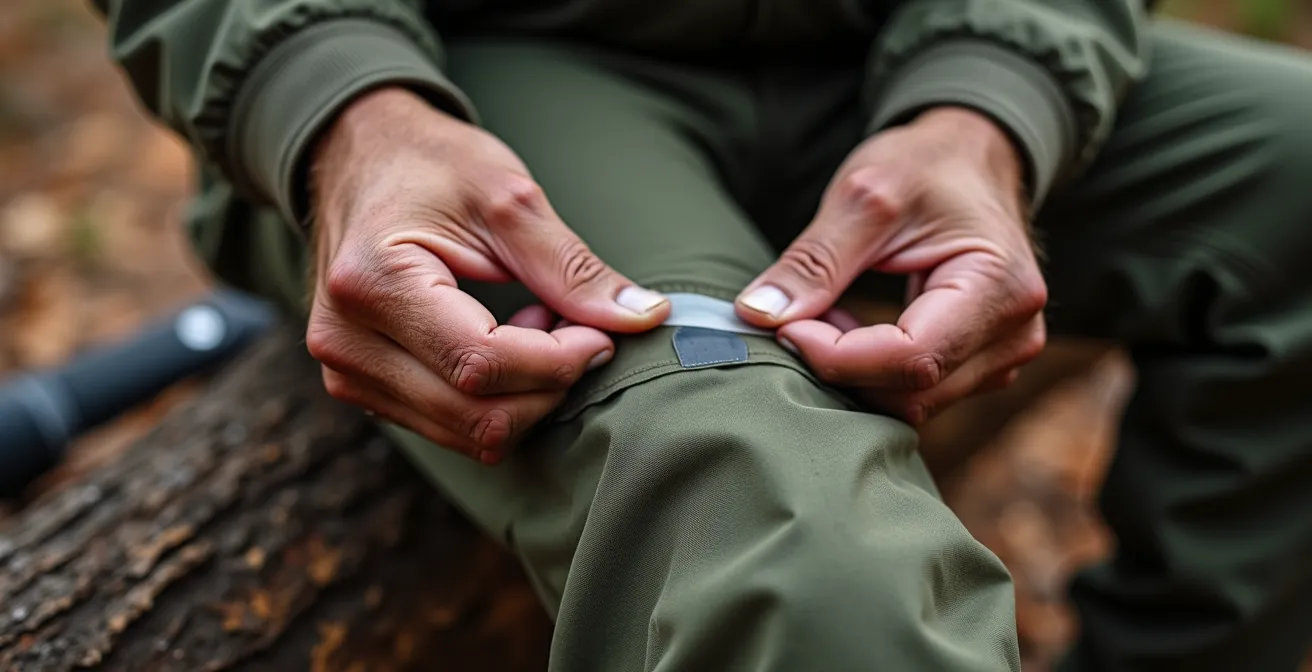
For a truly robust repair kit, you need a tiered approach that can handle anything from a pinhole to a major gash. A small puncture is easily sealed with a single patch. Larger tears require a more methodical process, often involving cleaning the area with an alcohol wipe and applying patches to both the inside and outside of the fabric for a stronger bond. In a worst-case scenario with a major tear, a few passes with a needle and dental floss can stitch the fabric together before being sealed and reinforced with tape.
Your Action Plan: Field Repairing Cordura
- Instant Fix (Small punctures < 1 inch): Apply a piece of Tenacious Tape directly over the hole. Crucially, use scissors or a knife to round the corners of the patch before application; this dramatically reduces the chances of the corners catching and peeling over time.
- Medium Repair (1-3 inch tears): Clean the area around the tear thoroughly with an alcohol wipe to remove dirt and oils. Apply a patch to the exterior. For maximum strength, apply a second, slightly larger patch to the interior of the pants, creating a fabric-and-adhesive sandwich.
- Major Tears (> 3 inches): For large, gaping tears, a simple patch may not hold. First, use a small needle and a strong thread (dental floss is an excellent, packable option) to loosely stitch the edges of the tear together. This provides structural integrity. Then, seal the entire stitched area with a large patch of repair tape.
- Post-Repair Check: After applying any patch, press it down firmly for at least 30 seconds, especially around the edges. If possible, gently warm the area (e.g., with your hands) to help the adhesive bond more securely to the Cordura fibers.
- Kit Integration: Don’t just own the materials—integrate them. Create a small, dedicated repair kit in a waterproof bag containing a small roll of repair tape, a few alcohol wipes, and a pre-threaded needle with dental floss. Store it in your pack’s “always” pocket.
Waxed Cotton vs Synthetics: Which Sheds Thorns Better?
Before the advent of modern synthetics, waxed cotton was the undisputed king of brush protection. Its tightly woven canvas, impregnated with wax, creates a stiff, slick surface that encourages thorns to slide off rather than dig in. For many traditionalists, it remains a popular choice. However, from a pure performance testing standpoint, its dominance is challenged by high-denier synthetics like 1000D Cordura, especially when considering a wider range of field conditions.
The primary advantage of freshly waxed cotton is its low surface friction. The waxy coating acts as a lubricant, preventing the fine, needle-like tips of many briars from gaining purchase. Cordura, with its textured weave, can sometimes catch these fine tips. However, this initial advantage of waxed cotton is conditional and temporary. The wax wears off with use and requires periodic re-application. More importantly, its performance plummets in wet weather. Once saturated, waxed cotton becomes incredibly heavy, loses its stiffness, and its now-softened fibers are far more susceptible to grabbing and holding thorns. A quality 1000D Cordura, by contrast, sheds water, maintains its structural integrity, and provides consistent protection regardless of the weather.
The following table, based on material properties and field testing, breaks down the key performance differences:
| Property | Waxed Cotton | 1000D Cordura |
|---|---|---|
| Initial Thorn Deflection | Excellent (slick surface) | Good (may catch fine tips) |
| Long-term Performance | Degrades without re-waxing | Consistent protection |
| Wet Weather Performance | Poor (heavy, grabs thorns) | Excellent (sheds water, maintains structure) |
| Weight When Wet | Increases 40-60% | Minimal increase |
| Maintenance Required | Annual re-waxing | None |
While synthetics like Cordura often win on a technical scorecard, lighter-weight synthetics also perform admirably. Testing shows that even a well-constructed 420D fabric provides good protection against most briars and thorns while offering a significant advantage in weight and flexibility. The final choice depends on the specific conditions and user preference, but for all-around, low-maintenance durability, modern synthetics have a clear edge.
The Baggy Pant Error That Catches More Thorns Than Tight Fits
There’s a common but mistaken belief that a baggy or loose fit in brush pants provides better protection, perhaps by keeping thorns further from the skin. In reality, the opposite is true. From a textile tester’s perspective, this is a simple matter of physics and geometry: excess material creates more surface area and more snag points. Every fold, bunch, and billow of fabric is an opportunity for a thorn to catch and hold on.
Baggy pants work against you in several ways. First, the loose material can easily get hooked on a briar, and as you move forward, the fabric is pulled taut, allowing the thorn to puncture deeply. Second, the movement of the excess fabric creates a “whipping” action that can cause it to wrap around thorny canes. This is why you often find your lower legs entangled in briars when wearing ill-fitting pants. A proper fit, often described as an “athletic” or “tapered” fit, eliminates this problem. These designs use just enough material to allow for a full range of motion without any restrictive binding, but remove all the unnecessary, snag-prone excess.
Modern athletic fit pants achieve this through smart construction. They often feature articulated knees (pre-bent sections that mimic the leg’s natural shape) and a gusseted crotch (a diamond-shaped piece of fabric that allows for greater movement). Furthermore, many designs incorporate stretch panels in key areas like the seat and knees, providing flexibility precisely where needed, while using the tougher, non-stretch briar-proof fabric on the fronts and lower legs. This hybrid construction results in pants that move with your body like a second skin, presenting a smooth, streamlined profile to the brush that is far less likely to get hung up.
To further minimize snags, sealing the interface between your pants and boots is critical. Using built-in boot gaiters or simple blousing straps prevents the pant cuffs from catching on low-lying brush and ensures debris and ticks stay out. By choosing a pant with a tapered leg and actively securing the cuff, you create a seamless, snag-free line from your knee to your foot.
Snake Gaiters vs Puncture Pants: Which Is Safer in Rattlesnake Country?
A dangerous point of confusion for many outdoorspeople is equating “puncture-resistant” with “snake-proof.” The forces and mechanics involved in a snakebite are vastly different from those of a thorn. A briar exerts slow, tearing pressure, whereas a snake strikes with rapid, piercing force. Puncture-resistant pants, typically made of Cordura or similar fabrics, are designed to stop the former. They are not designed, tested, or certified to stop the latter. Relying on them for snake protection is a critical and potentially life-threatening mistake.
True snake protection, found in dedicated snake gaiters or snake boots, works on a different principle. It’s not about fabric resistance; it’s about hard deflection. These products use layers of tightly woven material combined with rigid polycarbonate or acrylic plates. The goal is not just to slow the fang, but to deflect its path or even break it, preventing it from penetrating to the skin and injecting venom. Puncture-resistant pants may slow a fang, but they are unlikely to stop it, and they do nothing to prevent venom injection even if the fang doesn’t reach the skin.
The testing standards for these materials reflect this difference. General protective clothing is often tested using methods like the ASTM F1342 standard, which evaluates puncture resistance using a specified probe. However, the standard itself notes it is not intended to measure resistance against all types of punctures. Snake gaiters, in contrast, are often subjected to live testing or specialized tests that simulate the speed and force of a snakebite. There is no recognized industry standard that certifies a flexible fabric pant as “snake-proof.”
This table clarifies the critical differences in protection:
| Protection Type | Snake Gaiters | Puncture-Resistant Pants |
|---|---|---|
| Protection Method | Hard deflection plates | Fabric resistance only |
| Strike Zone Coverage | Ankle to knee (critical zone) | Full leg (but less effective) |
| Fang Penetration Defense | Designed to break/deflect fangs | May slow but not stop injection |
| Certification | Snake-bite specific testing | General puncture standards only |
| Recommended Use | Primary protection in snake country | Briar protection only |
The conclusion is unequivocal: in rattlesnake country, snake gaiters or snake boots are the primary, non-negotiable line of defense for the lower legs. Puncture-resistant pants offer excellent protection against brush but should be considered purely supplemental. They can be worn under gaiters for full-leg briar protection, but never as a substitute for dedicated snake armor.
Leather vs Cordura: Which Material Survives Sharp Limestone Rocks?
While thorns test a fabric’s puncture resistance, rocky terrain introduces a different challenge: abrasion. Sliding down a scree field, kneeling on sharp limestone, or scrambling over granite puts immense stress on a fabric’s surface. In this arena, the classic matchup is between traditional leather facings and modern synthetic Cordura. Both perform exceptionally well, but they fail in different ways and require different considerations.
Leather, particularly top-grain hide, has outstanding abrasion resistance. Its dense, fibrous structure is naturally tough and can withstand being scraped against sharp, uneven surfaces. This is why it has been the material of choice for chaps and work pants for centuries. However, leather’s weaknesses are well-known: it is heavy, absorbs water, becomes even heavier when wet, and loses flexibility in cold temperatures. It also requires maintenance (cleaning and conditioning) to prevent it from drying out and cracking.
Cordura, on the other hand, offers a more modern balance of properties. High-denier Cordura (like 1000D) has abrasion resistance that rivals or even exceeds that of many types of leather, but at a fraction of the weight. It does not absorb water and dries quickly, maintaining its performance characteristics in all weather. The experience of hunters in extremely rugged terrain supports this; one user testing Kutana pants in rocky, briar-filled country was surprised by how well the synthetic material withstood abuse without tearing or pulling. From a lab testing perspective, fabrics are rated for puncture resistance on a scale. For instance, laboratory testing shows that needle-resistant materials are rated under the EN 388 test, with ratings from 0 to 4, where even the highest rating corresponds to resisting forces over 150 Newtons. Cordura consistently scores well in such tests for both puncture and abrasion.
The choice between them often comes down to the mode of failure. When leather is pushed past its limit, it tends to gouge or tear. Cordura, under extreme abrasion, can “fuzz up” as its surface fibers are frayed, and eventually, the heat from friction can cause it to melt and form a hole. For most hunting and hiking applications, Cordura’s lightweight, all-weather performance makes it the more practical and versatile choice for protection against both rocks and briars.
Why Pheasants Choose Cattail Sloughs in Late Season Windy Days?
In the late season, when the wind howls and the temperature drops, pheasants seek the densest thermal cover available—and that often means diving into frozen cattail sloughs. For the hunter, this presents a unique and brutal gear challenge. Frozen cattails are no longer soft and pliable; they become rigid, sharp, and highly abrasive stalks. Pushing through this environment is like wading through a field of fiberglass spears. This specific context demands a re-evaluation of your protective gear, prioritizing maximum abrasion resistance and waterproofing.
This is one of the few scenarios where only the heaviest-duty materials will suffice. A minimum of 1000D Cordura is recommended for the pant facings. The constant friction against the frozen stalks will shred lesser fabrics. Furthermore, cattail sloughs are inherently wet environments, whether from melting snow, hidden pockets of water, or the moisture released from crushed stalks. Therefore, a reliable waterproof/breathable membrane like Gore-Tex is not a luxury, but a necessity to prevent getting soaked and dangerously cold.
However, there are two critical, often-overlooked properties of gear in freezing conditions: noise and flexibility. As one experienced hunter noted in a forum discussion:
The nature of briar clothes makes them stiff and less breathable, but when you need them, you really need them. They have to have a super tight heavy weave to keep thorns out, which means stiffer material. Cordura is pretty abrasive and even broken in well it’s still ‘zippy’ brushing against stuff. I haven’t found clothing that stops thorns that isn’t loud and stiff.
– Experienced hunter, Sniper’s Hide Forum discussion
New Cordura can be particularly noisy, and this effect is amplified when the material is frozen and stiff. The “zippy” sound of branches scraping against it can alert birds long before you’re in range. It’s crucial to pre-break in any new gear and to test its flexibility at freezing temperatures. Some materials become excessively rigid in the cold, restricting movement and making it difficult to navigate the uneven ground of a slough. Your gear must be tough enough to withstand the cattails, but quiet and flexible enough to allow you to hunt effectively.
Key Takeaways
- Protection is a System: Effective briar protection relies on a system of fabric, fit, and features—not a single “magic” material.
- Threat-Specific Gear: The best material changes with the threat; briar protection (Cordura), snake protection (gaiters), and abrasion resistance (leather/Cordura) are not interchangeable.
- Fit Over Fabric: An athletic, tapered fit that eliminates excess material prevents more snags than simply choosing a heavier, baggier fabric.
How to Meet Hunter Orange Requirements Without Spooking Game Animals?
The requirement to wear blaze orange is a cornerstone of hunter safety, but it creates an apparent paradox: how can one remain concealed from game while wearing a fluorescent color? The answer lies in understanding the visual capabilities of the animals being hunted, particularly ungulates like deer and elk. The fear that blaze orange “glows” in the woods is both true and false, and the key to solving the paradox is found in the science of animal vision and the chemistry of modern dyes.
The critical scientific fact is that deer and other related game animals have dichromatic vision. They possess only two types of color-receptive cone cells in their eyes (blue and green-yellow), unlike humans, who have three (trichromatic: blue, green, and red). This means they are effectively red-green colorblind. As a result, they cannot distinguish between green, yellow, orange, and red. To a deer, these all appear as varying shades of yellow or brown. Scientific research confirms that elk vision is dichromatic, and oranges simply appear yellowish against a green background. On this basis alone, blaze orange should not be a problem.
However, there’s a catch: UV brighteners. Many modern detergents and dyes contain ultraviolet (UV) brightening agents that absorb invisible UV light and re-emit it as visible blue light, making fabrics appear “whiter” or “brighter” to the human eye. Because deer have a blue cone that is highly sensitive to the UV spectrum, these brighteners cause blaze orange to glow with an intense, unnatural blue-white light. This is a dead giveaway. As one analysis on game vision points out, this powerful stimulation of a deer’s blue cones transforms the garment into a bright warning signal. The solution is simple: wash all hunting clothes, including blaze orange items, in a special detergent that eliminates UV brighteners. This renders the orange invisible to deer, appearing as just another shade of yellow or gray.
The final piece of the puzzle is breaking up your silhouette. A solid block of any color is easier to spot than a patterned one. A quiet outer layer, such as a fleece or brushed tricot vest in a blaze orange camouflage pattern (like Mossy Oak Blaze or Realtree AP Blaze), provides the best of all worlds. It meets legal orange requirements, its pattern disrupts your human form, and its soft material minimizes noise when moving through brush. This three-part system—UV-free fabric, a disruptive pattern, and a quiet material—allows a hunter to be safely visible to other humans while remaining effectively camouflaged to game.
By shifting your perspective from searching for a single best fabric to building a complete performance system, you can select gear that not only protects you from the harshest environments but also enhances your comfort, safety, and effectiveness in the field. Evaluate your current pants and outerwear against these principles to identify any weak points in your system.