
The key to gaining that critical half-second on moving game isn’t in your gear; it’s in re-engineering your body as an integrated shooting system.
- Your gun’s fit (Length of Pull) dictates your mount speed more than any other factor.
- Training your eyes to work together provides a wider field of view, allowing you to see and process targets faster.
- A dynamic, athletic stance is the foundation for fluid movement and instant shot readiness.
Recommendation: Begin by auditing your gun fit and stance biomechanics. These two foundational elements unlock the greatest and fastest improvements in target acquisition speed.
That fleeting moment—the trophy buck breaking cover, the bird flushing from the brush—is often decided in less than a second. For many hunters and shooters, the frustration of a missed opportunity isn’t a failure of aiming, but a failure of speed. The common advice is to practice more or buy a faster optic, but this often overlooks the root cause. We treat the firearm as a tool separate from ourselves, when in reality, elite performance comes from merging the body, eyes, and weapon into a single, cohesive unit.
The truth is, shaving 0.5 seconds off your target acquisition time has less to do with the gear you hold and more to do with how you hold it, how you see the world through it, and how your body is programmed to react. It’s not about magic; it’s about mechanics. This is the difference between simply shooting and becoming a true performance shooter. It’s about optimizing the entire neuromuscular pathway from the moment your brain detects a target to the instant the shot breaks.
But what if the secret to reflexive speed wasn’t in endless live-fire drills, but in a systematic deconstruction of your own biomechanics? Instead of focusing on the target, we’re going to focus on the system: you. This guide will walk you through the critical mechanical and neurological components of rapid target engagement. We will analyze how your gun fits you, how your eyes process information, how your stance enables movement, and how you can program your brain to eliminate hesitation and flinching, transforming your reaction into a reflex.
This article provides a structured path to building that reflexive speed. In the following sections, we will break down each component of your personal shooting system, from the physical interface with your firearm to the ethical principles that govern its use.
Summary: A Coach’s Guide to Faster Target Acquisition
- Why Length of Pull Affects Your Ability to Mount the Gun Quickly?
- How to Shoot with Both Eyes Open to Widen Your Field of View?
- Low Power Variable Optics: Are They Faster Than Red Dots for Hunting?
- The Stance Mistake That Delays Your First Shot on Target
- How Dry Fire Drills Can Fix Your Flinch Response at Home?
- How to Hold 10x Binoculars Steady Without a Tripod?
- How Fast Must Electronic Muffs Compress Sound to Stop Gunshot Damage?
- Why Fair Chase Principles Are Critical for the Future of Public Hunting?
Why Length of Pull Affects Your Ability to Mount the Gun Quickly?
Before we discuss optics or stance, we must address the absolute foundation of speed: gun fit. The Length of Pull (LOP)—the distance from the face of the trigger to the back of the buttstock—is the most critical interface between you and your firearm. If it’s wrong, your gun mount will be inconsistent, slow, and clumsy. An LOP that is too long forces you to mount the gun on your bicep instead of your shoulder pocket, causing you to adjust your head position after the mount, costing precious time. An LOP that is too short can lead to your thumb hitting your nose under recoil. This is a critical error, as gun fitting experts estimate that 60-70% of shooters experience mounting issues because their firearm is simply too long.
A correct LOP allows for a perfectly fluid and repeatable gun mount. The stock should find the pocket of your shoulder naturally, and your eye should align perfectly with the sights or optic without any conscious head movement. This is the bedrock of a fast, reflexive shot. The goal is for the gun to become an extension of your line of sight. When the LOP is correct, the mount is a single, efficient motion. When it’s wrong, it becomes a multi-step, herky-jerky process that sabotages your speed before you’ve even acquired the target. Correcting this single variable can yield more improvement than any other gear change.
Don’t rely on old, static measurements. Your LOP can change based on the thickness of your clothing from early to late season. A dynamic self-test is the best way to ensure your fit is optimized for real-world conditions. Perform the following check regularly, especially when changing your hunting attire.
Your Action Plan: Dynamic LOP Self-Test
- Initial Measurement: As a starting point, bend your arm at a right angle and measure from the inside of your elbow to the pad of your trigger finger. This is a rough estimate.
- The Eyes-Closed Mount: With the gun unloaded, close your eyes and mount it as you naturally would, pointing at an imaginary target.
- Alignment Check: Open your eyes. Your dominant eye should be perfectly aligned with your sights. Now, check the distance from your nose to your shooting hand’s thumb. It should be about 1 to 1.5 inches (or two finger-widths).
- Consistency Test: Test your gun mount speed 10 times. A consistent, smooth mount that lands in the same spot every time indicates a correct LOP.
- Seasonal Variation: Repeat this entire test while wearing your actual hunting jacket and layers. You may need a shorter stock or adjustable LOP for cold-weather gear.
Ultimately, a personalized LOP transforms the firearm from a cumbersome object into a responsive tool. It is the first and most important step in building an integrated shooting system that is fast by design.
How to Shoot with Both Eyes Open to Widen Your Field of View?
Many shooters are taught to close one eye to aim, believing it improves focus. This is a significant mistake for hunting moving targets. By closing your non-dominant eye, you discard up to 50% of your horizontal field of view and eliminate your brain’s ability to perceive depth and track motion effectively. Your two eyes are a powerful binocular system designed to work together. Using both allows you to see the target enter your field of view sooner, track its movement more naturally, and maintain complete situational awareness. This is not just a preference; it is a neurological advantage.
The technique involves training your brain to focus with your dominant eye through the optic while allowing your non-dominant eye to feed peripheral information. At first, you might see two images or find it distracting, but with practice, your brain learns to prioritize the clear, magnified image from the dominant eye while still processing the wide-angle view from the other. This binocular vision is what allows you to see a second deer following the first or to notice a change in the terrain, all without breaking your focus on the primary target. It’s a skill that directly translates to faster processing and reaction times.
This isn’t just theory; it’s a proven technique used by the world’s best. Their performance under pressure demonstrates the undeniable speed advantage of maintaining full field awareness.

Case Study: The Competitive Edge of Binocular Vision
Top competitive shooters like Doug Koenig, a 19-time Bianchi Cup champion, rely on shooting with both eyes open to achieve world-class speed. In multi-target scenarios, keeping both eyes open is non-negotiable. His training demonstrates how the peripheral vision from the non-dominant eye is crucial for planning transitions to the next target before the first shot is even complete. This technique shaves tenths of a second off split times by allowing the brain to maintain a continuous, uninterrupted flow of spatial information.
Start practicing this during dry fire. Focus on a point across the room, mount your rifle, and keep both eyes open. Over time, your brain will adapt, and you’ll unlock a level of awareness and speed that is simply impossible with one eye closed.
Low Power Variable Optics: Are They Faster Than Red Dots for Hunting?
The debate between red dot sights and Low Power Variable Optics (LPVOs) for speed is often oversimplified. Red dots are champions of close-range, parallax-free speed, making them incredibly fast for scenarios under 50 yards. However, hunting is rarely that predictable. A moving target might appear at 20 yards one moment and 120 yards the next. This is where the LPVO demonstrates its superior versatility and, in many cases, its overall speed advantage for the hunter.
An LPVO, set to its true 1x magnification, operates nearly identically to a red dot for close-quarters speed. In fact, an analysis of modern optics shows that modern low power variable optics can achieve 95-100% of a red dot’s field of view at 1x magnification. Where the LPVO pulls ahead is its ability to instantly magnify for positive target identification. Is that a buck or a doe? Is it a legal animal? A red dot provides no help here, forcing you to lower your rifle and use binoculars, wasting critical seconds. With an LPVO, a flick of a lever provides the magnification needed for instant identification and a precise, ethical shot at distance. This ability to identify, decide, and act within a single motion makes the LPVO a faster *system* for the variable distances encountered in hunting.
The choice depends entirely on the hunting scenario. For a dedicated brush gun where shots are always close and fast, a red dot excels. But for the all-around hunter facing unpredictable encounters, the LPVO’s blend of speed and certainty is hard to beat.
The following table, based on common field scenarios, breaks down the performance differences to help you decide which optic best serves your integrated shooting system.
| Scenario | LPVO Performance | Red Dot Performance | Winner |
|---|---|---|---|
| Close range (<50 yards) | 0.3-0.4 sec acquisition | 0.2-0.3 sec acquisition | Red Dot |
| Target ID at 100+ yards | Instant magnification for legal verification | No magnification – slower ID | LPVO |
| Moving targets | 1x setting comparable speed | Slightly faster tracking | Red Dot |
| Variable distances | Quick zoom adjustment | Fixed 1x only | LPVO |
| Low light conditions | Illuminated reticle + light gathering | Bright dot only | LPVO |
Ultimately, the “fastest” optic is the one that allows you to solve the entire problem—from spotting to ethical shot placement—in the shortest amount of time. For the dynamic nature of hunting, that honor increasingly goes to the versatile LPVO.
The Stance Mistake That Delays Your First Shot on Target
Your gear can be perfect and your eyes well-trained, but if your body is not positioned to move, you will always be slow. The most common stance mistake is standing flat-footed or with weight evenly distributed, like you’re waiting in line. This static posture is stable but inert. It requires a conscious thought and weight shift to initiate any movement—a delay you cannot afford. To be fast, you must adopt a dynamic, athletic stance that is pre-loaded for movement in any direction. Think like a boxer, not a statue.
A proper athletic shooting stance positions your body for explosive and fluid motion. Your feet should be in a boxer’s stance, shoulder-width apart with your non-dominant foot slightly forward. Crucially, your weight should be biased forward, with about 60% on the balls of your front foot. This pre-loads your body to drive towards the target or pivot smoothly. Your knees are bent, hips are loose, and your core is engaged. This allows your torso and the firearm to move as a single, unified block, driven by the powerful muscles in your hips and legs, not the small, slow muscles in your arms. This stance doesn’t just make you faster to mount the gun; it makes you faster to swing on a moving target.
This athletic readiness should be your default state when you are actively hunting. It means you are 90% of the way to a perfect shot before you even see the target. The mount becomes the final 10%—a small, efficient action rather than a large, clumsy scramble. The image below illustrates the core principles of this powerful, movement-ready foundation.
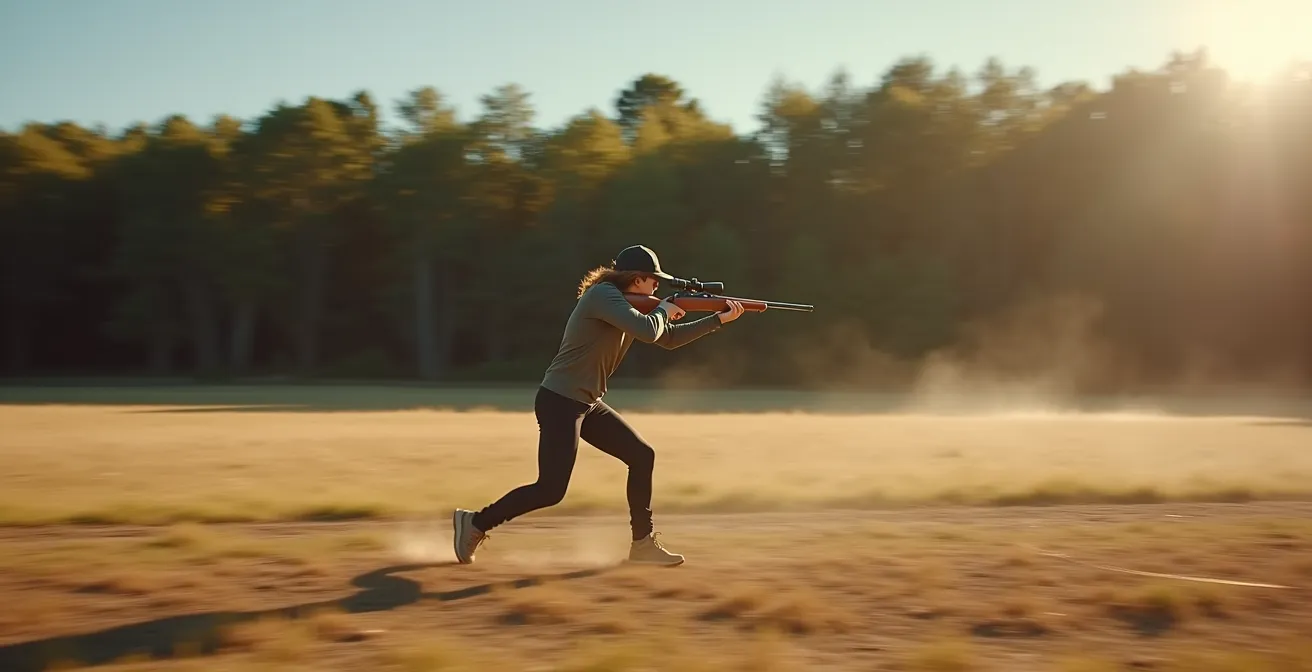
To build this into your muscle memory, treat it like a fundamental athletic skill. Your stance should allow you to:
- Position your feet for a 360-degree pivot without losing balance.
- Keep your hips loose, as this is where the power for your swing originates.
- Relax your shoulders to avoid the “Tense-Shoulder Shrug” that slows down your mount.
- Extend your support hand far enough to drive the gun, with your shooting elbow slightly raised.
- Maintain this state of readiness even while walking, so you are always prepared for an instant mount.
By making this athletic posture your default, you eliminate the initial delay in your reaction chain. You are no longer reacting to the target; you are simply completing a movement you were already prepared to make.
How Dry Fire Drills Can Fix Your Flinch Response at Home?
Flinching—the anticipatory muscle contraction just before a shot—is the ultimate speed killer. It derails your aim at the last millisecond and destroys confidence. It’s a subconscious response to expected recoil and noise, and you cannot fix it with live fire alone. The answer lies in decoupling the action of pressing the trigger from the expectation of a bang. This is the domain of consistent, focused dry-fire practice. At home, in a safe and controlled environment, you can execute hundreds of perfect trigger presses without any recoil, re-wiring the neuromuscular pathways in your brain.
Dry fire works by allowing you to focus with 100% of your attention on a single element: the trigger press. The goal is to press the trigger so smoothly that the sights do not move. A classic drill is to balance a coin on your barrel or scope; if it falls, you’re flinching or jerking the trigger. By repeating this process, you are programming your trigger finger to move independently of the rest of your body. You are teaching your brain that a trigger press does not equal a violent explosion. This builds a clean, surprise shot break that is fundamental to both accuracy and speed on a moving target, as it allows you to keep swinging through the shot without interruption.
Modern tools have made this practice more effective than ever. While not required, they can accelerate progress by providing immediate feedback.
Case Study: Measurable Gains with Laser Training Systems
Systems like the Strikeman Laser Training System provide real-time, data-driven feedback on your dry-fire practice. The laser cartridge fires a beam of light at a target, and a smartphone app records the “shot” placement. This allows shooters to see precisely how much their aim is disturbed during the trigger press. Users consistently report measurable improvements in accuracy and a reduction in split times after implementing daily 15-minute dry-fire sessions. This practice directly identifies and corrects the anticipatory movements of a flinch, all without the cost or stress of live ammunition.
A structured program is the best way to eradicate a flinch. Follow this progressive plan to rebuild your trigger control from the ground up. Remember to always ensure your firearm is unloaded and all ammunition is removed from the room before beginning any dry-fire practice.
- Week 1: Focus only on a smooth, consistent gun mount. Perform 50 repetitions daily with no trigger press.
- Week 2: Integrate a slow, deliberate trigger press. Use the coin balance drill for 30 perfect reps per day.
- Week 3: Vary the speed of the entire mount-aim-trigger sequence. Perform 40 reps, introducing random delays to break any rhythm.
- Week 4: Add movement. Practice 50 reps that incorporate pivots and transitions between two imaginary targets.
- Daily Habit: Practice box breathing (4 seconds in, 4 hold, 4 out, 4 hold) before and during each session to manage stress and improve focus.
By investing time in dry fire, you are not just practicing; you are performing targeted neurological maintenance. You are building a trigger press that is so clean and reflexive it can be executed perfectly while your brain is focused on tracking a moving target.
How to Hold 10x Binoculars Steady Without a Tripod?
Target acquisition doesn’t start when you mount your rifle; it starts when you spot the game. For hunters using powerful 10x binoculars, the slightest hand shake can obscure a distant target or make it impossible to identify. While a tripod is the gold standard for stability, it’s often too slow and cumbersome for dynamic hunting situations. The key is to use your own body and gear to create a stable, bone-supported platform, allowing you to glass for extended periods and transition to a shot seamlessly.
Forget trying to hold your binoculars with just your arms. This relies on small, easily-fatigued muscles. Instead, you need to create a stable triangle of support. The most effective method is the “Rifleman’s Bino Hold.” This technique involves bracing your elbows firmly against your chest or ribcage, creating a solid bone-on-bone connection. To add a third point of contact, pull the binocular neck strap taut against the back of your neck. This tension removes the micro-jitters from your hands and creates a surprisingly steady viewing platform. This technique is most effective when you are in a supported position, such as sitting with your back against a tree.
Crucially, this stability must not come at the cost of readiness. Your rifle should always be within immediate reach. The goal is a fluid transition from glassing to shooting. You must practice the motion of dropping your binoculars with one hand while your other hand acquires the rifle grip. The entire process should be one smooth, practiced movement. You are not “stopping to glass”; you are “glassing while ready to shoot.” This mindset is a core part of an integrated, high-speed system.
To master this tripod-free stability and ensure a lightning-fast transition to your rifle, incorporate these steps into your practice:
- Create a bone-supported triangle by bracing both elbows firmly against your chest.
- Pull your binocular neck strap taut against the back of your neck to create a third, stabilizing point of contact.
- Always assume a shooting-ready position (seated, braced against a tree) before you start glassing.
- Keep your rifle within arm’s reach, ideally in a position that facilitates a quick mount.
- Practice a one-handed binocular drop while your other hand moves to the rifle, making the transition seamless.
- Maintain a 90% shooting-ready posture while glassing, minimizing the movement required to get on target.
By mastering this skill, you turn your binoculars from a separate, slow tool into an integrated part of your rapid target acquisition process. You can spot, identify, and transition to a shot without wasted movement or time.
How Fast Must Electronic Muffs Compress Sound to Stop Gunshot Damage?
Hearing protection is a non-negotiable aspect of shooting safety, but traditional passive earmuffs create a dangerous problem for hunters: they isolate you from your environment. You can’t hear a twig snap, the rustle of leaves, or the direction of an animal’s call. Electronic hearing protection solves this by amplifying ambient sounds to a safe level while instantly compressing loud, harmful noises like a gunshot. But for this technology to enhance—not hinder—your acquisition speed, its performance must be nearly instantaneous. The key metric is “attack time,” the speed at which the circuitry detects a loud noise and compresses it.
To prevent hearing damage from a gunshot, the attack time must be incredibly fast. For high-quality muffs designed for shooters, you should look for specifications showing a sub-0.5ms attack time with a 50ms recovery. This means the circuit clamps down on the dangerous sound wave in less than half a millisecond. The “recovery time” is equally important; it’s how quickly the amplification returns after the loud noise, ensuring you don’t miss the sound of a follow-up animal or other environmental cues. This level of performance makes the protection effectively seamless to the user.
However, the true advantage for target acquisition isn’t just protection; it’s enhancement. Quality electronic muffs with directional microphones act like super-hearing, allowing you to pinpoint the location of sounds with uncanny accuracy. This acoustic situational awareness can give you a critical head start, allowing you to orient your body towards a target before you can even see it.
Case Study: Acoustic Awareness in Military Operations
Military sniper training places a heavy emphasis on situational awareness. Field studies show that snipers using quality electronic muffs with clear, directional audio can detect and identify subtle environmental cues, like a snapping twig or a quiet vocalization, up to 0.5 seconds sooner than those using passive protection. This enhanced acoustic awareness directly contributes to faster target acquisition by enabling pre-visual detection. The sniper begins to orient towards the threat based on sound alone, so when the target becomes visible, they are already halfway through the acquisition process.
Investing in high-performance electronic muffs is not just about protecting your hearing for the long term. It’s about sharpening your most vital sense for the short term, turning your ears into a primary tool for faster target acquisition.
Key Takeaways
- Fit is the Foundation: A firearm with the correct Length of Pull enables a fast, repeatable mount, which is the cornerstone of a rapid shot.
- Vision is Your Primary Sensor: Shooting with both eyes open maximizes your field of view and depth perception, allowing your brain to process moving targets faster.
- Stance Enables Motion: A dynamic, athletic stance, with weight forward, pre-loads your body for fluid movement, eliminating the delay of a static posture.
Why Fair Chase Principles Are Critical for the Future of Public Hunting?
In our pursuit of a half-second advantage, it’s easy to focus solely on the mechanics of speed. However, as a performance coach, my ultimate goal is not just to make you faster, but to make you better. The true measure of a hunter is not speed, but effectiveness and ethics. This is where the principles of Fair Chase become the ultimate governor on our system. Fair Chase dictates that the hunter must not have an improper or unfair advantage over the game animal. It’s the ethical framework that separates hunting from mere killing.
How does this relate to speed? It forces us to define “speed” correctly. Speed without accuracy is reckless. Speed that leads to low-percentage, marginal shots is unethical. The principles of Fair Chase demand that we pair our speed with judgment. It encourages us to use our skills—stalking, reading terrain, understanding animal behavior—to get closer, turning a difficult, long-range running shot into a high-percentage, closer-range opportunity. The goal is to be decisively effective, not just fast. This mindset shifts the focus from a “success-at-all-costs” mentality to one of mastery and respect.
The principle of not taking unethical, low-percentage shots forces a hunter to master core skills like stalking and reading terrain to get closer. Fair Chase fosters a ‘Mastery Mindset’ over a ‘Success-at-all-Costs Mindset.’
– Rod Harrison, JAGER PRO, Shooting Moving Targets – Ethical Considerations
Integrating this ethical filter simplifies your decision-making process under pressure. When a target appears, your highly practiced skills give you the *ability* to make the shot quickly, but your commitment to Fair Chase gives you the *wisdom* to know if you *should*. This is the final and most important component of an elite shooting system.
- Practice until making a clean, ethical kill within your effective range is a reflex.
- Use an “Ethical Filter” to simplify your shoot/don’t shoot decision under pressure.
- Focus on mastering stalking skills to reduce the distances at which you need to shoot.
- Train exclusively for high-percentage shots; speed without the guarantee of accuracy is unacceptable.
- Develop the judgment to pass on a marginal shot, no matter the time pressure or the quality of the animal.
By building your skills on a foundation of ethical principles, you ensure that your speed serves the highest ideals of hunting. You become not just a faster shooter, but a more complete and responsible hunter, securing the future of our shared public trust.