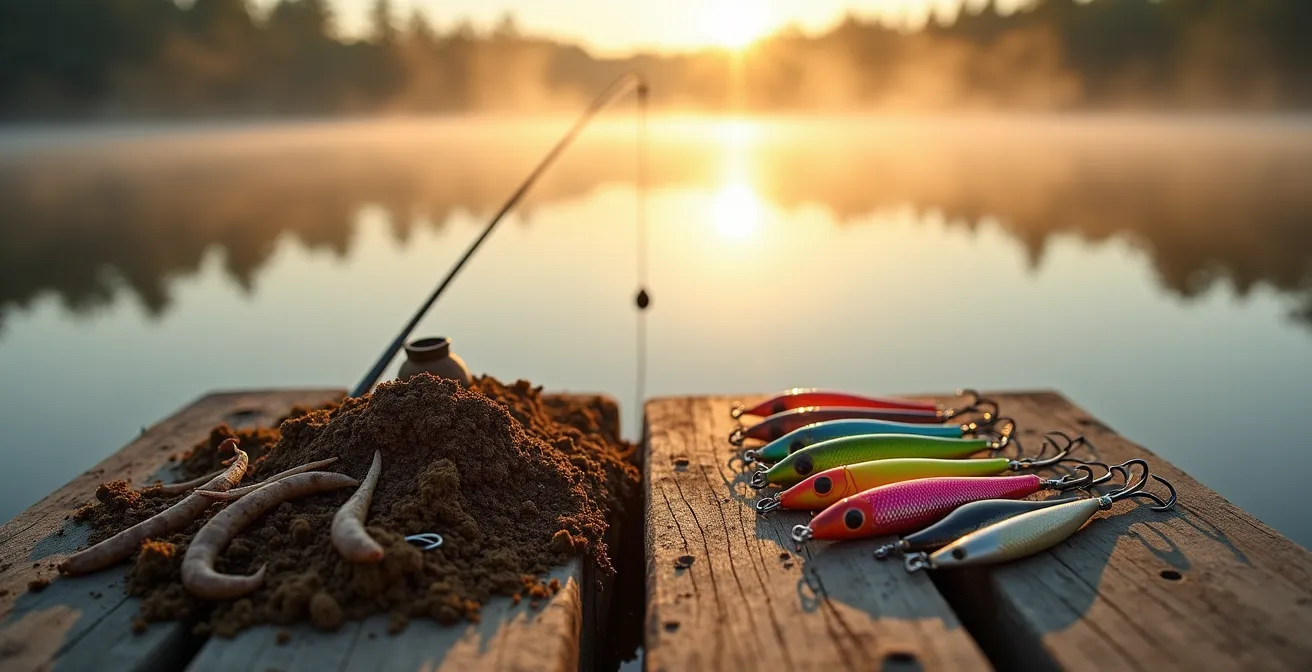
Catching your first fish isn’t about having the fanciest lure; it’s about learning to see the world through the fish’s eyes.
- Simple bait fishing forces you to develop patience and observation, turning waiting into an active learning process.
- Understanding and finding natural bait teaches you where fish live, what they eat, and when they are most active.
Recommendation: Start with a worm on a hook to build a fishing foundation that will make every other technique you learn far more successful.
Walk into any tackle shop, and you’re met with a wall of shimmering, colourful lures. They promise to wiggle, dart, and flash in ways that are supposedly irresistible to fish. For a newcomer, it’s an overwhelming and expensive sight. The common wisdom often suggests thatこれらの modern lures are for “serious” anglers, while a simple worm on a hook is for kids. This thinking, while well-intentioned, misses a fundamental truth about learning the craft of fishing.
The real question isn’t which method is “better” in a vacuum, but which one builds a better angler from the ground up. While lures demand active casting and retrieving, simple bait fishing offers something far more valuable to the novice: time. It creates a quiet space for learning, an aquatic classroom where the most important lessons are taught not by a flashy piece of plastic, but by the subtle movements of the water, the line, and the life within it.
This guide takes a different approach. We will explore why embracing the patient, traditional art of bait fishing isn’t a step back, but a crucial first step forward. It’s about building a deep, intuitive understanding of the underwater world. This foundation of observation and patience is the very thing that will make you a more effective angler, whether you have a simple nightcrawler or a hundred-dollar swimbait on the end of your line.
In the sections that follow, we’ll delve into the specific skills that bait fishing cultivates. From the ethical importance of hook selection to reading the almost invisible signs of a bite, you’ll discover how this timeless method connects you directly to the ecosystem and sets you on the path to a lifetime of successful fishing.
Summary: An Old Timer’s Guide to Your First Catch
- Circle Hook vs J-Hook: Which Reduces Gut-Hooking Mortality Rates?
- How to Adjust Bobber Depth to Present Bait Exactly in the Strike Zone?
- Why Waiting for the Bite Builds Better Observation Skills Than Casting Lures?
- The Line Movement Mistake That Causes You to Miss 50% of Worm Bites
- Where to Find Worms and Crickets Naturally Instead of Buying Them?
- Shiners or Nightcrawlers: Which Works Best in Muddy Spring Water?
- What Happens When a Bass Swallows a Traditional PVC Worm?
- How to Read Lake Topography Maps to Find Summer Bass Hotspots?
Circle Hook vs J-Hook: Which Reduces Gut-Hooking Mortality Rates?
Before you even think about what bait to use, the first decision you make—the hook—is one of the most important for the health of the fish. As a beginner, you’re going to be learning, and part of that learning is how to handle fish responsibly. The two most common hooks are the traditional J-hook and the more modern circle hook. A J-hook looks just like its name suggests and requires a sharp, quick jerk to set it in the fish’s mouth. The problem for a novice is timing. Set it too late, and the fish has swallowed the bait, leading to a dangerous “gut-hook” that can be fatal.
A circle hook, on the other hand, is a beginner’s best friend for catch-and-release. Its point curves back in toward the shank. When a fish takes the bait and swims away, the hook slides to the corner of the fish’s mouth and sets itself with just a steady pressure from reeling. There’s no need for a dramatic, hard hookset. This design drastically reduces the chances of gut-hooking, making it the most ethical choice when you plan to release your catch. Learning to let the circle hook do its job teaches you a smooth, controlled technique that is invaluable.
Your Action Plan: Hook Selection for Beginners
- Choose circle hooks as your ethical default for catch-and-release fishing. It’s the responsible starting point.
- Practice the ‘reel-set’ technique with circle hooks: when you get a bite, simply start reeling steadily instead of jerking the rod.
- Start with J-hooks only when you are confident in your ability to detect a bite instantly and set the hook precisely.
- Use circle hooks for passive bait fishing where fish have time to take the bait and hook themselves.
- Select hook size based on the size of your bait, not the size of the fish you hope to catch. A smaller hook presents the bait more naturally.
Ultimately, starting with circle hooks isn’t just about being kind to the fish; it’s about building good habits from day one. It teaches a patient and effective hook-setting method that will serve you well for your entire fishing life.
How to Adjust Bobber Depth to Present Bait Exactly in the Strike Zone?
A bobber does more than just tell you when you have a bite. Its most important job is to suspend your bait at a precise depth, right where the fish are feeding. This area is called the strike zone. Fish often hold at very specific depths depending on water temperature, light, and structure. Simply guessing and clipping your bobber on a random spot on the line is a recipe for a long, fishless day. The key is to find the bottom first, then work your way up.
A simple, old-timer’s trick is to use a heavy sinker to find the depth before you even bait your hook. The Indiana DNR recommends a method called “plumb-bobbing,” a technique that provides an exact measurement of the water’s depth right where you cast. You can read about their step-by-step process of using a heavy sinker to find the exact bottom depth first before adjusting your bait. Once you know the bottom, you can set your bobber to hold your bait just above it, say a foot or two, which is a classic starting point for many species like bluegill or catfish.
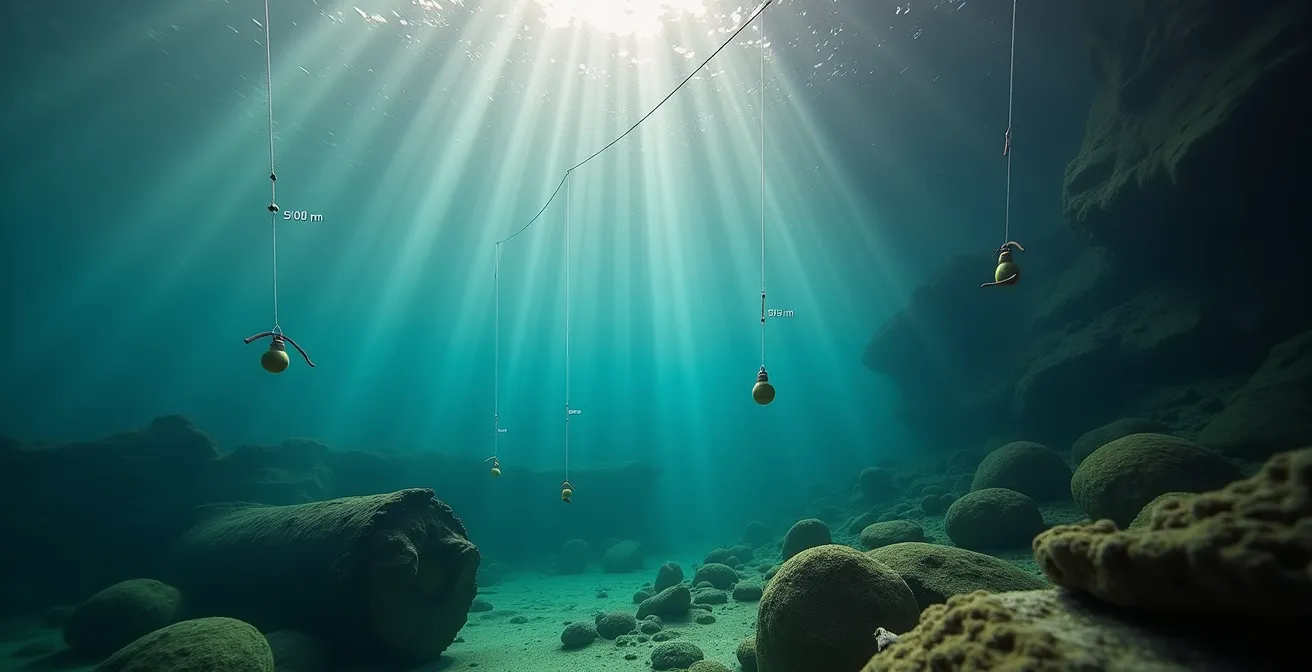
As this visualization shows, fish might be suspended near the surface, holding tight to the bottom, or somewhere in between near submerged structure. If you’re not getting bites near the bottom, don’t be afraid to adjust. Raise your bobber in one-foot increments every 15-20 minutes. This methodical approach allows you to systematically search the entire water column until you find where the fish are actively feeding. This isn’t just fishing; it’s a form of active investigation.
This process of finding and adjusting depth teaches you to think three-dimensionally about the water, a skill that lure anglers spend years trying to develop by feel alone.
Why Waiting for the Bite Builds Better Observation Skills Than Casting Lures?
Lure fishing is an active pursuit: cast, retrieve, cast, retrieve. Your focus is narrow, locked onto your lure’s action and the feel of your line. Bait fishing, in contrast, is an exercise in patient observation. That time spent “waiting” is not empty time; it is your classroom. As one Northland Tackle Expert puts it in their guide, this method teaches you the absolute basics. They explain that through bait fishing, newcomers learn what fish eat, where they expect to find it, and how they prey upon it.
Bait fishing teaches new chums the absolute basics of the sport, including what food items fish prefer to eat, where fish expect to find those food items, and how and when fish prey upon them.
– Northland Tackle Expert, Northland Tackle Guide
While you wait, you begin to notice things. You see a dragonfly dip to the water’s surface, followed by a small ripple. You notice that the minnows are schooling near a shady, sunken log. You hear the “plop” of a frog jumping in along the far bank. These are not random events; they are clues about the lake’s ecosystem. You are learning to read the water, a skill far more valuable than knowing which colour crankbait is “hot” this week.
This difference in the learning experience is profound. Lure fishing can provide quick thrills, but bait fishing builds a deeper, more lasting knowledge of the environment. The following comparison highlights the different skill trajectories.
| Skill Aspect | Bait Fishing | Lure Fishing |
|---|---|---|
| Initial Success Rate | High – fish naturally attracted | Lower – requires technique |
| Observation Time | Extended – passive watching | Limited – active casting |
| Environmental Awareness | High – time to scan surroundings | Moderate – focused on retrieval |
| Learning Curve | Gentle – bait does the work | Steep – requires practice |
By slowing down, you give your brain time to connect the dots. You start to think like a predator, anticipating where the food—and therefore the fish—will be. This is the true art of angling, and it begins with the simple act of waiting.
The Line Movement Mistake That Causes You to Miss 50% of Worm Bites
For a beginner, the bobber is the star of the show. You stare at it, waiting for it to plunge dramatically beneath the surface. But here’s a secret that separates good anglers from great ones: many of the most subtle bites, especially from cautious fish like bluegill or crappie, will never move your bobber at all. The first sign of a bite often appears on the fishing line itself. If you’re only watching the bobber, you’re likely missing half your opportunities.
The key is to maintain a slight, gentle curve or “belly” in the line between your rod tip and the bobber. This slack is your most sensitive bite indicator. A fish might pick up the worm and swim slowly sideways, causing the line to straighten or move across the water. It might gently nibble, creating a tiny, almost imperceptible twitch in the line. These are the tells—the subtle language of the bite—that you only see if you’re watching the line.
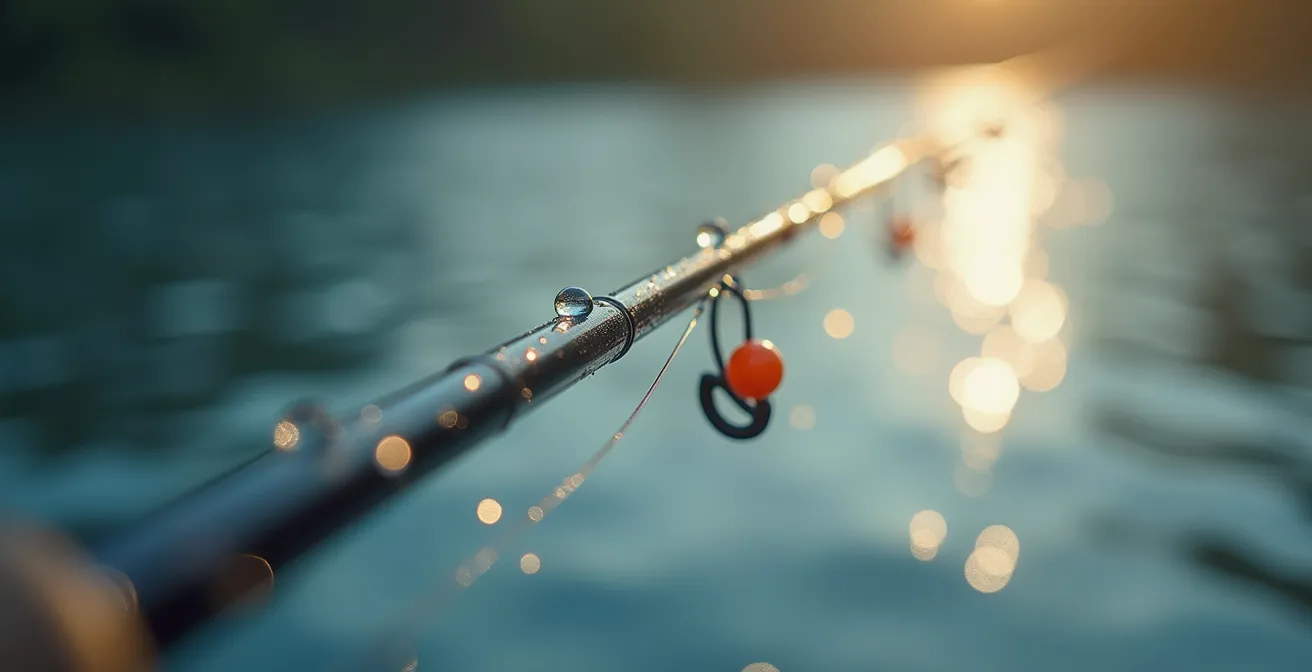
Look at how the line rests on the water’s surface tension. The slightest disturbance from below will register here long before the inertia of the bobber is overcome. When you see that line twitch or start to move, that is your signal to act. By learning to watch your line as intently as your bobber, you develop a heightened sense of awareness. You are no longer just waiting for a big signal; you are reading the quiet whispers from the underwater world.
This skill, honed through the patience of bait fishing, directly translates to lure fishing, where detecting subtle “ticks” or changes in line tension is the difference between catching a fish and thinking you just bumped a rock.
Where to Find Worms and Crickets Naturally Instead of Buying Them?
Buying a container of worms or crickets from a bait shop is convenient, but it disconnects you from a vital part of the fishing process. The act of collecting your own bait is a lesson in itself; it forces you to understand the local food chain from the ground up. Instead of just using “bait,” you start to think in terms of what the fish in your specific lake or river are actually eating on a daily basis.
Finding your own bait is simpler than you think. Nightcrawlers, a favorite of many fish, are easy to find. After a good rain, walk through your lawn or a garden at night with a flashlight; they’ll often be right on the surface. For crickets and grasshoppers, a slow walk through a field or tall grass in the late afternoon is all it takes. Listen for their chirping and watch for movement. This process isn’t just about saving money, though fishing experts confirm that this is a significant benefit. It’s about education.
Case Study: Natural Bait Collection as Ecosystem Education
Experienced anglers often report that collecting your own bait provides invaluable insights. Finding nightcrawlers in damp soil after a spring rain, listening for crickets in the tall grass during a warm evening, or observing grasshoppers in a meadow in the morning sun gives you direct knowledge. You learn what’s available for fish to eat and, just as importantly, *when* it’s most active and available. This firsthand observation is far more powerful than any fishing report.
When you turn over a rock and find hellgrammites, or catch grasshoppers in a field, you’re not just gathering bait; you’re conducting fieldwork. You are building an ecosystem connection. You begin to understand that a windy day might blow terrestrial insects like ants and beetles into the water, making them a prime food source. This knowledge allows you to “match the hatch,” a principle that is the absolute pinnacle of advanced fly fishing, yet its roots are here, in the simple act of finding a worm.
This hands-on experience gives you a predictive power that no lure can replicate. You’ll know what the fish are looking for because you found it yourself.
Shiners or Nightcrawlers: Which Works Best in Muddy Spring Water?
Spring often brings rain, which can turn your favorite clear pond into a murky, muddy environment. When visibility is low, fish change how they hunt. They can no longer rely on their sight to find food. Instead, they switch to their other powerful senses: their sense of smell and their lateral line, an organ that runs along their sides and detects vibration and pressure changes in the water. As an angler, you must adapt your bait choice to appeal to these senses.
In these conditions, the choice between a live minnow, like a shiner, and a nightcrawler becomes a strategic one. According to one fishing biology expert, “In murky water, sight is limited, so fish rely on vibration and smell.” This is the core principle to guide your decision.
In murky water, sight is limited, so fish rely on vibration and smell.
– Fishing Biology Expert, Bait Selection Guide
A lively shiner struggling on a hook sends out powerful vibrations that a predatory fish like a largemouth bass can detect from a distance with its lateral line. A big, juicy nightcrawler, on the other hand, leaches a strong scent into the water, creating a trail that a bottom-feeder like a catfish or carp can follow. The best choice depends on what you’re trying to catch.
This table breaks down how each bait type leverages a different sense to attract fish in low-visibility conditions.
| Bait Type | Primary Attraction | Best Target Species | Effectiveness Rating |
|---|---|---|---|
| Shiners | Vibration via lateral line | Largemouth Bass, Pike | Excellent for predators |
| Nightcrawlers | Powerful scent trail | Catfish, Carp | Superior for bottom feeders |
| Hybrid Rig | Scent + Vibration | All species | Maximum effectiveness |
Learning to make this strategic choice is a perfect example of how bait fishing teaches you to think critically about the environment and the biology of your target species, turning a challenge like muddy water into a solvable puzzle.
What Happens When a Bass Swallows a Traditional PVC Worm?
As you progress, you’ll inevitably be tempted by soft plastic lures, like the classic plastic worm. They are effective, but a legitimate concern arises: what happens if a fish swallows one? Traditional soft plastics were made from PVC, a material that is not digestible and can potentially harm a fish if ingested deeply. This has led many conscientious anglers to worry about their impact.
The good news is that the industry has responded to these concerns. Today, a growing number of soft plastics are designed with fish safety in mind. As some manufacturers now report that, modern soft plastics are increasingly made from biodegradable materials or are infused with high concentrations of salt, which helps them break down faster if ingested. This doesn’t mean you should be careless, but it does alleviate some of the worst-case scenarios.
The most important factor, however, is not the material of the lure but the skill of the angler. The real solution to preventing a fish from swallowing a lure is a quick and proper hookset. This is a skill you began honing from day one by watching your line while bait fishing. By setting the hook the moment you detect the bite, you ensure the hook lodges in the fish’s mouth, not its throat or stomach. This makes proper disposal of used and damaged plastics far more of an environmental concern than a lost lure that was swallowed. Never leave torn plastics in the water or on the bank.
Ultimately, the responsibility lies with us. By focusing on technique, choosing more modern materials when possible, and disposing of our gear properly, we can enjoy the effectiveness of plastic lures while minimizing our environmental footprint.
Key Takeaways
- Patience is a Tactic: Bait fishing teaches that waiting isn’t passive; it’s an active period of observation where you learn to read the water and your line.
- Conservation Starts with the Hook: Choosing a circle hook as a beginner is the most effective way to prevent fish mortality and build good catch-and-release habits from day one.
- The Environment is Your Guide: Learning to find natural bait and adjusting your presentation to water conditions connects you directly to the ecosystem, making you a more intuitive and successful angler.
How to Read Lake Topography Maps to Find Summer Bass Hotspots?
As you gain confidence, you’ll want to move from fishing the obvious spots to actively hunting for fish. This is where a lake map becomes one of your most powerful tools. A topographic map of a lake shows you the underwater landscape: the points, the drop-offs, the flats, and the old creek channels. It’s like having X-ray vision. For both bait and lure anglers, learning to read these maps is the key to consistently finding fish, especially during the summer when they often move to deeper, cooler structures.
You don’t need expensive electronics to get started. Free tools like the Navionics web app or even Google Earth can provide incredibly detailed contour maps. The skill is in interpreting what you see. According to the U.S. Fish and Wildlife Service, successful anglers often use what’s called the “3 Cs” rule when analyzing a map.
Case Study: The 3 Cs Rule for Map Reading Success
A guide from the U.S. Fish and Wildlife Service highlights a simple rule for finding fish on a map. Look for the “3 Cs”: Channels (underwater riverbeds that fish use as highways), Contours that are close together (indicating steep drop-offs where fish hold to ambush prey), and Coves that have a creek channel running into them (offering structure, current, and a food source). Identifying these three features on a map will consistently put you in high-percentage areas.
This is where the observation skills you learned while bait fishing pay huge dividends. You’re not just looking at lines on a map; you’re visualizing the underwater world. You can imagine how a fish would use that steep drop-off for cover or travel along that submerged channel. You can then take your boat, or even just walk the bank, to these pre-identified spots and present your bait or lure with confidence, knowing that you’re fishing in a place where fish are likely to be, not just casting randomly.
Mastering a map is the bridge between being a novice who hopes to get lucky and an angler who makes their own luck. It’s a skill that elevates every cast you’ll ever make, proving that the greatest tool in your tackle box is your knowledge.