In summary:
- Stop using your whole arm; pinpoint accuracy comes from mastering a crisp, explosive wrist snap that controls the entire kinetic chain.
- Learn to load your rod’s tip like a catapult, using its flex to generate high tip velocity for a flat, powerful trajectory.
- Mastering trajectory control is not just about casting low; it’s about a silent lure entry that prevents spooking fish in shallow water.
- True precision combines flawless mechanics with environmental awareness, from reading current seams to managing your own shadow.
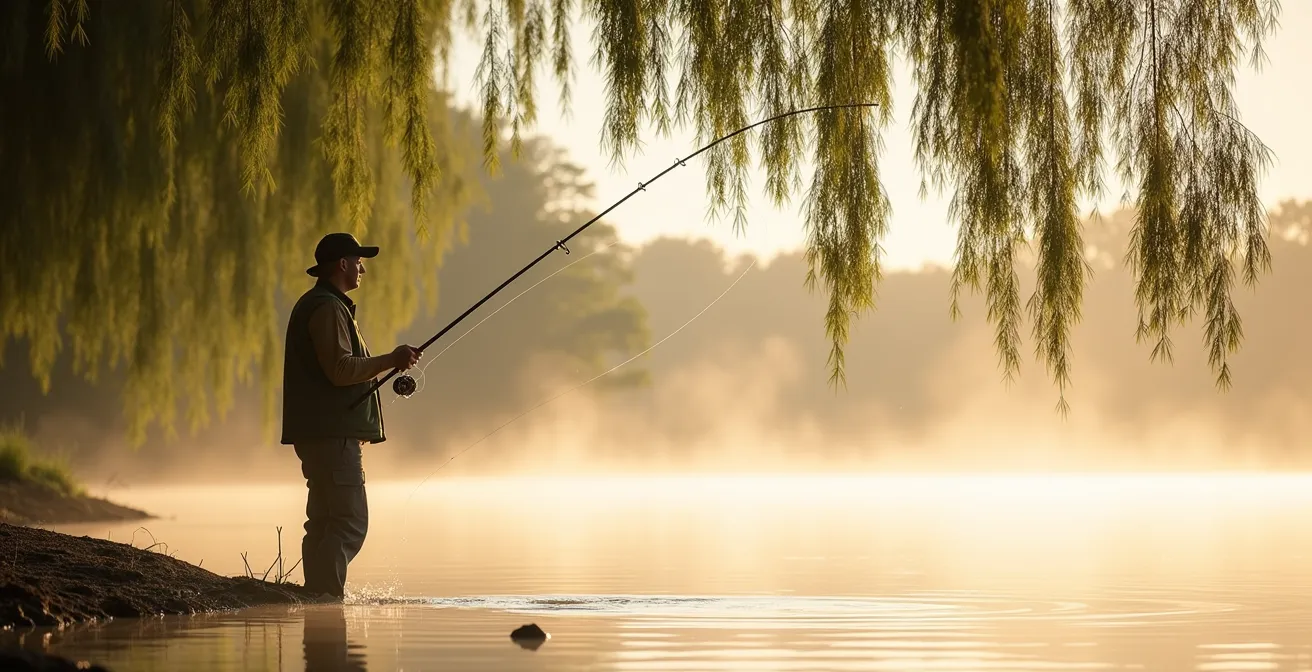
The image is a familiar one for any angler who fishes tight cover: a perfect-looking pocket of water, guarded by a lattice of overhanging branches just inches above the surface. The common advice is to switch to a sidearm cast or simply “practice more.” But these generic tips fail to address the core problem. You can practice a flawed technique for a thousand hours and only get better at snagging lures. The standard overhead cast is built for distance in open water, not for the surgical precision required in cramped quarters.
This isn’t a game of brute force or wide, sweeping motions. It’s a game of millimeters and milliseconds. The secret to consistently hitting those impossible targets isn’t found in a bigger swing or a different rod. It’s found in understanding the internal physics of the cast—the subtle, almost invisible mechanics that separate the amateur from the specialist. We often focus on the arm, but the real engine of accuracy is the wrist. We think about the lure, but the true weapon is the stored energy in the rod’s tip.
Forget what you know about power casting. This guide will deconstruct the cast into its fundamental components. We will abandon the arm in favor of the wrist, learn to transform the rod into a high-velocity catapult, and master the art of trajectory control. This is about shifting your focus from the big, visible movements to the small, critical details that produce flawless accuracy. It’s time to learn how to thread the needle, every single time.
This article provides a complete breakdown of the mechanics needed for trick-casting. The following sections will guide you through mastering each element, from body mechanics to environmental awareness.
Contents: Mastering Pinpoint Spin Casting Accuracy
- Why Using Your Wrist Instead of Your Arm Increases Casting Accuracy?
- How to Use Rod Flex to Catapult Lures into Tight Spaces?
- How to Time the ‘Snap’ to Maximize Tip Speed During the Cast?
- How to Keep Your Cast Low to Punch Through Headwinds?
- Heavier vs Lighter: Which Is Easier to Cast Accurate at Short Range?
- The Splash Entry Mistake That Scares Shallow Water Fish Instantly
- How to Identify the ‘Seam’ Where Fast and Slow Water Meet?
- The Casting Shadow Mistake That Spooks Fish in Clear Water
Why Using Your Wrist Instead of Your Arm Increases Casting Accuracy?
Most anglers instinctively use their entire arm to cast, believing a larger motion generates more power. This is a critical error when precision is the goal. A full-arm cast introduces multiple, hard-to-control variables: shoulder rotation, elbow bend, and body sway. Each of these moving parts can deviate slightly, sending your lure off-target. The key to accuracy is to minimize these variables and isolate the movement to the most efficient and controllable joint: the wrist. The arm’s role is simply to position the wrist; the wrist’s role is to power the cast.
This approach creates a more efficient kinetic chain. Energy should transfer from a stable body, through a quiet arm, and culminate in an explosive, crisp snap of the wrist. By eliminating unnecessary body and arm motion, you create a consistent, repeatable casting stroke that is far easier to aim. As trick-casting expert Glenn May notes in a tutorial for BassResource.com, ” Ninety percent of all casts you make whether bait casting or spinning is wrist, that’s it.” Mastering this wrist-centric motion is the absolute foundation of hitting tight targets under branches or next to structure.
To build this muscle memory, you must actively train your body to be still and let the wrist do the work. The following drill is designed to completely remove the arm from the equation, forcing you to learn the feel of a pure, wrist-powered cast.
Action Plan: The Wrist-Only Casting Drill
- Sit down in a chair to completely eliminate body and arm movement, forcing pure wrist action.
- Hold a piece of paper between your elbow and your torso to ensure your elbow stays locked in place during practice.
- Start with the rod tip pointing down, then snap upward using only your wrist motion to load the rod.
- Practice feathering the line with your index finger on the spool lip for controlled deceleration and pinpoint accuracy.
- Aim to keep 90% of all casts within a wrist-only motion, gradually increasing distance while maintaining the same precise form.
Ultimately, transitioning to a wrist-dominant cast transforms your approach from one of hopeful aiming to one of confident execution. It is the first and most critical step toward becoming a true precision caster.
How to Use Rod Flex to Catapult Lures into Tight Spaces?
Once you’ve isolated the wrist as the engine, the next step is to understand your primary tool: the rod. An accurate cast is not about “throwing” the lure; it’s about efficiently loading and unloading the rod tip to “launch” the lure. Think of the rod not as a lever, but as a spring or a catapult. The goal is to store the maximum amount of potential energy in the rod’s blank during the backswing and release it in a controlled explosion during the forward snap. This is what generates incredible tip velocity with minimal physical effort.
To achieve this, you must feel the rod “load.” This happens when the lure’s weight and the casting motion bend the rod, primarily in its upper third. A fast-action rod, which is stiffer in the lower two-thirds and flexible at the tip, excels at this. It loads and unloads very quickly, creating a crisp, high-velocity cast ideal for shooting lures on a flat trajectory. A technique like the pendulum cast is a perfect example of this principle in action.
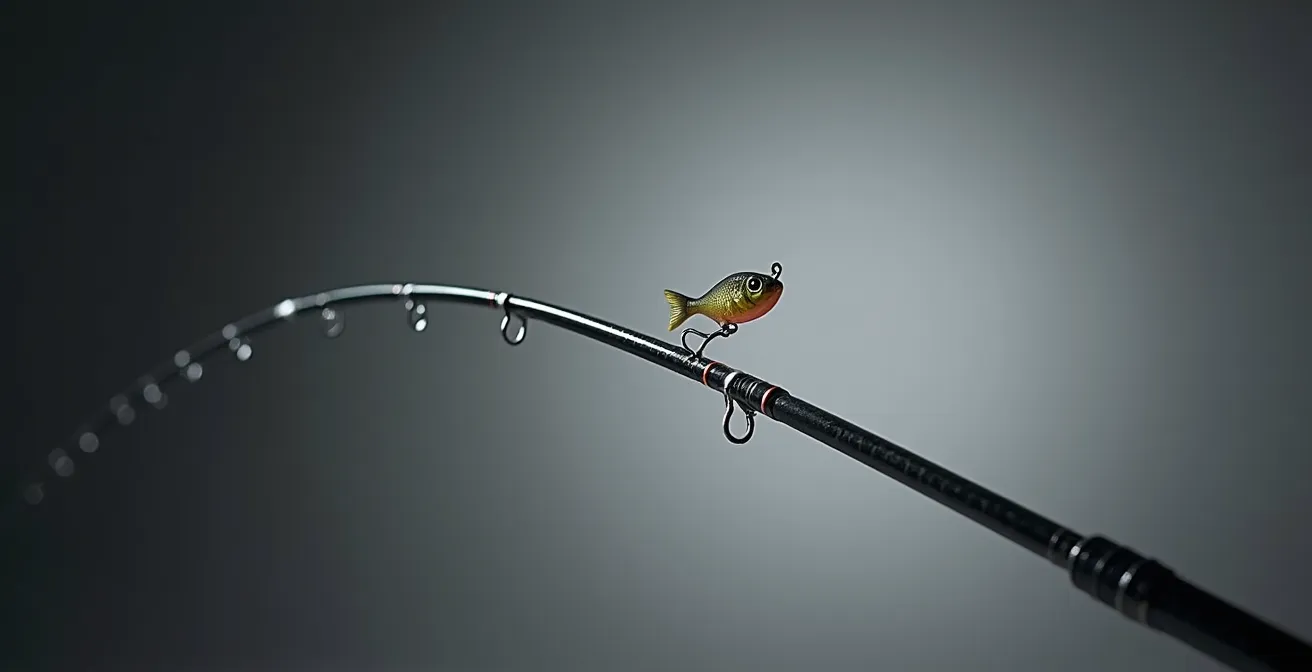
As demonstrated in the image, the rod’s bend is where the energy is stored. The professional angler C.A. Richardson has perfected this with a pendulum cast for tight cover. He creates a low-to-high swing that pre-loads the rod tip before the forward snap. This generates an explosive catapult effect, shooting the lure with pinpoint accuracy into tight spaces. The technique relies entirely on the rod’s fast recovery speed to create a flat, powerful trajectory needed to get under docks and branches.
By shifting your mindset from “throwing” to “loading,” you begin to work *with* your equipment instead of against it. This harmony between wrist action and rod physics is what allows for effortless and repeatable accuracy.
How to Time the ‘Snap’ to Maximize Tip Speed During the Cast?
You have a powerful engine (the wrist) and an efficient catapult (the rod flex). The final piece of the mechanical puzzle is timing. Maximum tip speed isn’t achieved through raw power, but through a perfectly timed “snap” at the precise moment of peak rod load. This is the “crack of the whip” moment where all the stored energy in the rod blank is transferred directly into the lure, launching it forward with astonishing velocity and a flat trajectory.
Renowned angler Adam Royter describes a key sensory cue for this: a properly timed, powerful snap will create a distinct ‘swoosh’ sound as the rod tip cuts through the air. This sound is your auditory confirmation that you’ve achieved maximum tip velocity. The motion is less of a long push and more of a short, sharp, and abrupt stop. This sudden stop is what forces the rod to unload its energy explosively.
An excellent way to understand this concept comes from an unlikely source: fly fishing. The “double haul” technique in fly casting is designed to achieve maximum line speed by loading the rod on both the back and forward cast. As demonstrated by Salt Strong, applying this principle to spinning gear involves a sharp stop at the end of the backcast to fully load the rod, immediately followed by the forward snap. This pre-loading action ensures the rod is already storing significant energy before you even begin the forward motion, leading to a much more powerful release. Mastering this timing transforms a good cast into a great one, adding both distance and precision.
Timing the snap is where feel and mechanics merge. It’s an intuitive skill built on a mechanical foundation, and it’s what gives a specialist the ability to change cast speed and trajectory on demand.
How to Keep Your Cast Low to Punch Through Headwinds?
Once you’ve mastered the core mechanics, you can begin to apply them to solve specific problems, like casting into a headwind. A standard overhead cast creates a high, looping arc that acts like a sail, getting caught by the wind and killing both accuracy and distance. To punch through wind, you need to master trajectory control and keep the lure’s flight path as low and flat as possible. This is achieved by adjusting your release point and casting style.
The two most effective low-trajectory casts are the dart cast and the sidearm cast. * The Dart Cast: This is essentially a modified overhead cast with a much earlier release point. Instead of releasing at a 45-degree angle, you stop the rod abruptly around the 11 o’clock position. This forces the lure out on a low, direct line, like throwing a dart. It’s perfect for moderate headwinds and medium distances. * The Sidearm Cast: This provides the lowest possible trajectory. The rod is brought back horizontally and snapped forward. The key is to keep the motion compact and wrist-driven. This cast keeps the lure just above the water’s surface, almost completely immune to headwinds.
Your equipment also plays a role. A thinner line creates less drag in the air. For instance, braided line has a 38-83% smaller diameter than monofilament of the same strength, making it vastly superior for cutting through wind. Combining a low-trajectory cast with a thin braided line gives you the ultimate advantage against the elements.
The following table, adapted from pro casting tips, summarizes how to choose your cast based on conditions.
| Cast Type | Release Point | Trajectory | Best For |
|---|---|---|---|
| Dart Cast | 11 o’clock stop | Low, flat | Headwinds, medium distance |
| Sidearm Cast | Horizontal release | Very low | Strong crosswinds |
| Standard Overhead | 45-degree angle | High arc | Calm conditions |
Mastering these casts gives you a toolkit to maintain accuracy no matter the weather, ensuring a gust of wind doesn’t ruin a perfect opportunity.
Heavier vs Lighter: Which Is Easier to Cast Accurate at Short Range?
The question of lure weight and its effect on short-range accuracy is a common one. Intuitively, a lighter lure seems like it would be better for delicate presentations, but for pure mechanical accuracy at close quarters (15-20 feet), a heavier lure is often easier to cast precisely. The reason lies in tactile feedback. As experts from Sport Fishing Magazine note, ” A heavier lure provides more tangible feedback during the pendulum swing of a pitch cast, making it easier for the angler to time the release for accuracy.”
A heavier lure (in the 1/2 oz+ range) does a better job of loading the rod tip with minimal motion. You can physically feel the weight of the lure pull against the rod, which provides a clear signal for when the rod is loaded and ready to be snapped forward. This enhanced feedback makes it much easier to develop the consistent timing needed for pitching and flipping into tight pockets. Lighter lures require a more aggressive snap to load the rod, which can introduce more variables and reduce accuracy at very short distances.
However, this doesn’t mean heavier is always better. The key is to match the lure weight not only to the technique but also to the rod’s power rating. A heavy lure on a light-power rod will create a sluggish, unresponsive cast. Conversely, a light lure on a medium-heavy rod will fail to load the tip at all. Finding the “sweet spot” where the lure properly loads the rod without overpowering it is critical. The goal is to build muscle memory for specific lure weights and techniques.
By practicing with consistent lure weights, you train your wrist and hand to recognize the exact moment of optimal rod load, turning short-range casting into an act of pure reflex.
The Splash Entry Mistake That Scares Shallow Water Fish Instantly
Hitting your target is only half the battle. If your lure crash-lands with a loud “plop,” you’ve likely just spooked every fish within a 10-foot radius, especially in shallow, clear water. The pinnacle of casting accuracy is not just hitting a spot the size of a dinner plate, but doing so with a silent entry. This is a higher-level skill that separates good casters from elite anglers.
The primary mistake is allowing the lure to complete its arc and fall vertically into the water from a height. This maximizes surface impact. As the guides at AnyCreek advise, “The goal is a low, shallow angle, like skipping a stone.” A low trajectory is the first step, but the final secret is a technique called “feathering the line.” As your lure approaches the target, you gently apply pressure with your index finger against the lip of the spinning reel’s spool. This acts as a brake, slowing the lure’s momentum just before it touches down.
Professional captain C.A. Richardson has demonstrated that this feathering technique dramatically reduces surface impact. It allows you to control the final few feet of the cast with incredible precision, causing the lure to glide into the water rather than crash into it. This is not just about being quiet; it’s about being stealthy. In high-pressure fishing situations, a silent entry is often the difference between getting a bite and watching a fish flee in panic.
By combining a low-trajectory cast with expert feathering, you complete the trifecta of precision casting: hitting the target, at the right angle, with minimal disturbance.
How to Identify the ‘Seam’ Where Fast and Slow Water Meet?
Perfect casting mechanics are useless if you’re not aiming at the right spot. Predatory fish are experts at energy conservation. They will not hold in fast-moving water where they have to constantly fight the current. Instead, they position themselves in an area of slack water immediately adjacent to a fast current, waiting to ambush baitfish that get swept by. This meeting point is called a current seam, and it is the single most productive type of structure in any moving water system.
Identifying these seams is a crucial angling skill. You are looking for visual cues on the water’s surface that indicate a change in current speed. These can include: * A “bubble line” or a line of foam and small debris on the surface. * A change in water texture, from riffled (fast) to glassy (slow). * A visible color or clarity difference between two bodies of water. * The downstream side of any structure that breaks the current, such as a large rock, a logjam, or a bridge piling.
The reason these spots are so effective is pure physics. According to studies on predator behavior, fish can conserve up to 50% of their energy by holding in the slow water of a seam while having immediate access to the “conveyor belt” of food passing by in the fast current. Your goal as a precision caster is to land your lure just inside the fast water and have it drift naturally past the ambush point in the slack water.
By accurately casting to these subtle, high-percentage zones, you stop fishing random water and start targeting fish where they are actively feeding.
Key Takeaways
- True accuracy originates from a compact, explosive wrist snap, not a large arm movement. Isolate the wrist to eliminate variables.
- Master the feeling of the rod “loading” and “unloading.” Use its flex as a catapult to generate maximum tip velocity for flat, fast casts.
- Control the end of the cast by “feathering” the line with your index finger to achieve a silent, stealthy lure entry that won’t spook fish.
The Casting Shadow Mistake That Spooks Fish in Clear Water
You have perfected your wrist snap, mastered the rod flex, and can land a lure silently on a dime. You’ve identified a perfect current seam and see a large fish holding in it. You make the perfect cast… and watch the fish bolt just before your lure lands. What went wrong? The final layer of stealth, and one of the most overlooked mistakes, is managing your own presence—specifically, your shadow.
In clear, shallow water, fish are acutely aware of overhead threats. A shadow from a predator like a bird is a primary danger signal. Your own body, your moving rod, and even the fishing line arcing through the air can cast a shadow over the water that is just as terrifying to a wary fish. This is why your position relative to the sun is critical. Whenever possible, you want the sun at your face, which casts your shadow behind you and away from the fish you are targeting.
This awareness extends beyond just your shadow. In clear water conditions, bright, unnatural colors can be just as startling. As experts at Florida Sport Fishing magazine point out, “In clear water, a bright yellow shirt is as startling as a shadow.” Neutral, earth-toned clothing (like olive, gray, or tan) helps you blend into the background and become less of a threatening presence to sensitive fish. Think like a hunter: your goal is to be invisible.
By integrating this awareness of your own shadow and visibility into your approach, you complete the transition from a person who is simply fishing to a true predator who understands every element of the hunt.