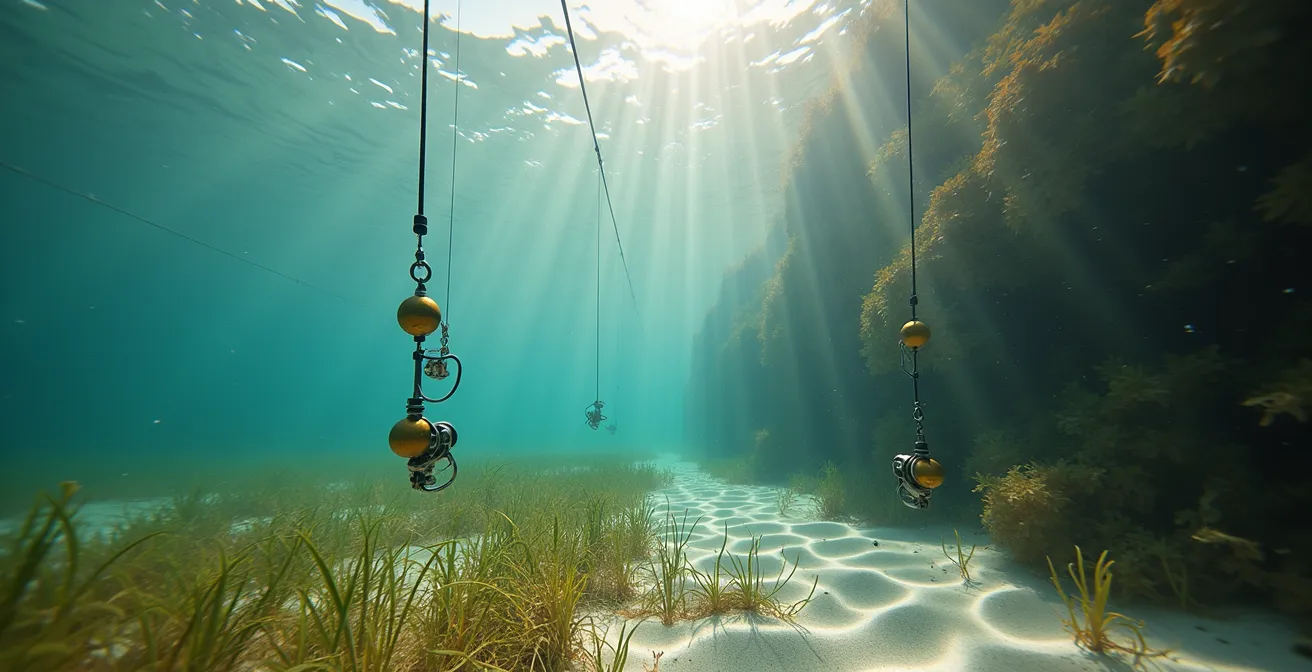
Mastering weedy bottoms isn’t about choosing Texas or Carolina; it’s about understanding that each rig demands a completely different fishing philosophy.
- The Texas rig is a surgical tool for direct contact and punching through dense cover, requiring an instant, powerful hookset.
- The Carolina rig is a search bait for covering ground, where sensitivity and a delayed, sweeping hookset are critical to success.
Recommendation: Use the Texas rig as a close-quarters weapon to dissect specific targets in heavy cover, and deploy the Carolina rig to methodically mop up scattered fish on adjacent flats and weed edges.
Every bass angler knows the feeling: you make a perfect cast toward a promising weed line, feel a subtle ‘tick,’ and swing for the fences… only to reel in a giant ball of salad. The frustration of fishing weedy bottoms can make you question your tackle, your technique, and sometimes your sanity. The two workhorses for this job are, without a doubt, the Texas rig and the Carolina rig. Most articles will give you a simple pro/con list: one is weedless, the other has more action. But that’s entry-level thinking. In the heat of a tournament, when every bite counts, that simplistic view costs you fish and money.
The truth is, these aren’t just two rigs; they are two entirely different systems. Choosing between them isn’t the most important decision. The real key to dominating weedy environments is mastering the subtle tactical adjustments that each system requires. It’s about understanding the “why” behind the rig. Why does a C-rig demand a different hookset? Why does scent become more critical when a fish has a few extra seconds to inspect the bait? This isn’t just about avoiding snags; it’s about maximizing your presentation efficiency and, most importantly, improving your bite-to-hookup ratio.
This guide breaks down those critical, pro-level details. We’ll move beyond the basics and dissect the mechanics of hooksets, color theory in stained water, and the often-overlooked details like line management and bait sustainability. By the end, you won’t just know *which* rig to throw; you’ll know *how* to fish it with the precision of an angler who’s cashing checks.
To navigate this deep dive into advanced rigging tactics, this article is structured to address the most critical questions anglers face when fishing soft plastics in and around vegetation. Explore the sections below to fine-tune your approach.
Summary: Advanced Rigging for Weedy Conditions
- How to Set the Hook Through Plastic Without Missing the Fish?
- Green Pumpkin or Black/Blue: Which Color Works in Stained Water?
- Why Scent Impregnation Matters More When Fish Hold onto Plastics Longer?
- How to Repair Torn Soft Plastics to Save Money on Tackle?
- When to Peg Your Sinker to Keep the Bait Compact in Heavy Cover?
- How to Fish Heavy Vegetation Without Fouling Your Hook Every Cast?
- 2 Years vs 200 Years: How Fast Do Bio-Baits Actually Break Down?
- Why Closing the Bail Manually Reduces Line Twists by 80%?
How to Set the Hook Through Plastic Without Missing the Fish?
The single biggest difference between a Texas rig and a Carolina rig isn’t the leader; it’s the hookset. Treating them the same is the fastest way to a zero in the livewell. The mechanics are fundamentally different because the point of contact and the amount of slack in the system are worlds apart. With a Texas rig, the weight and bait are one unit. When a fish bites, you feel it directly. This demands an immediate, powerful, vertical “snap set.” You’re driving the hook point through the plastic and into the fish’s jaw in one explosive motion.
The Carolina rig is a game of finesse. The weight is separated from the bait by a leader, creating intentional slack. When a fish picks up the lure, it can move off without feeling the heavy tungsten sinker. This requires a completely different response from the angler. Instead of an instant snap, you must first reel down to remove the slack in the leader, feel the weight of the fish, and then execute a long, sweeping horizontal hookset. Think of it like a golf swing—a powerful, fluid motion, not a sharp jab. Trying to snap-set a C-rig will almost always result in either pulling the bait away from the fish or failing to get a solid hookup due to the slack.
Your gear choice is an extension of this principle. A fast-action rod with no-stretch braid is ideal for Texas rigs, providing the power to drive the hook home in heavy cover. For a Carolina rig, a more forgiving moderate-fast action rod paired with fluorocarbon (which has some stretch) helps prevent tearing the hook out of the fish’s mouth during that long, sweeping set. Mastering this distinction in your hookset is the first step to dramatically increasing your landing ratio with both presentations.
Your Action Plan: Perfecting the Hookset for Each Rig
- For Texas rig hooksets, keep your rod at the 10 o’clock position to maintain readiness for quick strikes.
- Execute a direct ‘snap set’ with immediate upward force when feeling resistance on a Texas rig.
- For Carolina rigs, reel down first to eliminate slack in the leader before setting the hook.
- Perform a long, sweeping horizontal hookset for Carolina rigs instead of a vertical lift to ensure solid connection.
- Use fast-action rods with no-stretch braid for Texas rigs in heavy cover for maximum power.
- Choose moderate-fast rods with fluorocarbon for Carolina rigs to prevent hook tear-outs during the sweeping set.
Ultimately, the goal is to build muscle memory for each rig. When you pick up a rod, you should instantly know which type of hookset it’s built for. This automatic response is what separates the pros from everyone else when the money is on the line.
Green Pumpkin or Black/Blue: Which Color Works in Stained Water?
In stained or murky water, your bait’s color isn’t about perfectly matching the hatch; it’s about creating the right level of visibility. Bass in low-light conditions are primarily ambush predators that react to movement and contrast. The choice between a natural pattern like green pumpkin and a dark, bold color like black/blue comes down to controlling your bait’s silhouette against the ambient light. This is a crucial tactical decision that can dramatically affect your bite count on any given day.
On dark, overcast days or in heavily stained “chocolate milk” water, a black/blue combination is king. It creates a stark, solid silhouette that stands out against the gray, muted background. A bass doesn’t need to see the fine details; it just needs to see a clear, defined shape moving through its kill zone. This high-contrast profile is easy for the fish to track and attack. Conversely, in moderately stained water with some sunlight penetration, a green pumpkin bait with some flake can be more effective. The translucent quality of the plastic allows ambient light to pass through it, while the metallic flakes catch that light and create subtle flashes, mimicking the scales of a bluegill or perch.
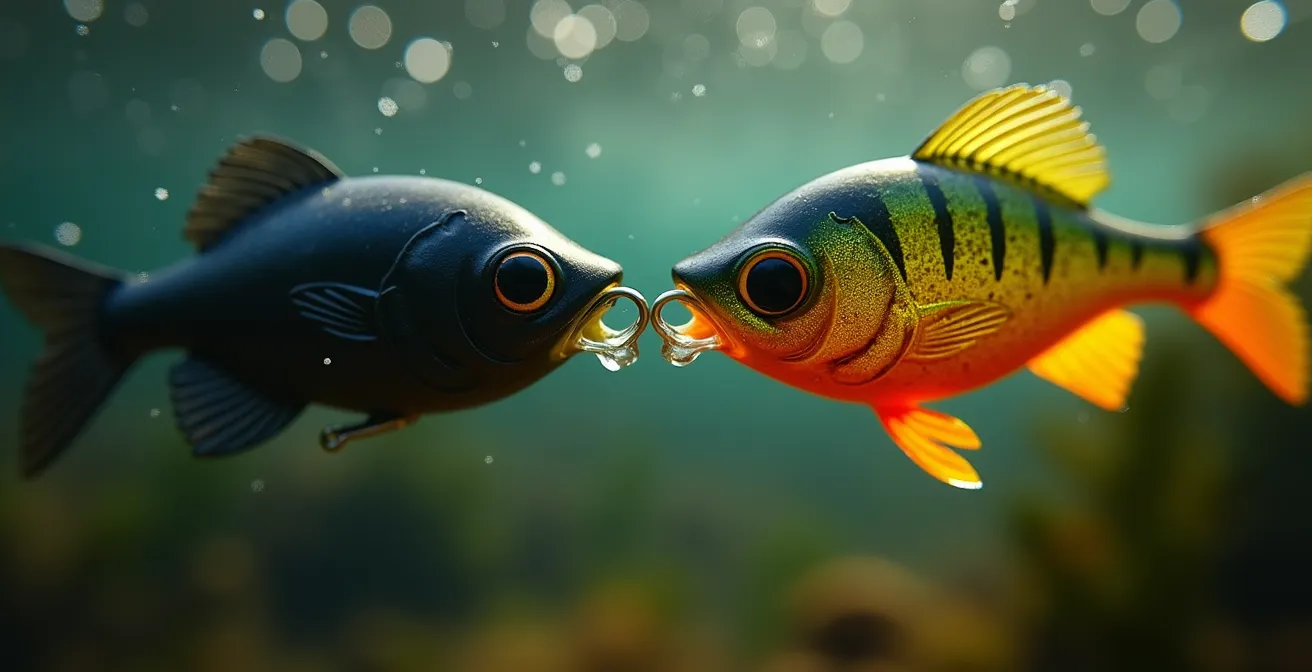
The image above perfectly illustrates this principle. The dark bait on the left presents a hard, unmistakable outline, while the green pumpkin bait on the right interacts with the light, offering a more natural and subtle flash. This isn’t just about color; it’s about light interaction. A common mistake is to think “dark water, dark bait,” but the real rule is “dark conditions, high-contrast silhouette.”
Understanding this will help you select the right tool for the job. This comparative table, based on common wisdom from professional circuits, breaks down the ideal scenarios for each color pattern.
| Color Pattern | Best Conditions | Target Forage | Light Interaction |
|---|---|---|---|
| Black/Blue | Heavy stain, overcast | Crawfish, leeches | Strong silhouette visibility |
| Green Pumpkin | Moderate stain, sunny | Bluegill, perch | Reflects ambient light with flakes |
| Dark Natural Colors | Early spring transition | General bottom dwellers | Subtle natural appearance |
Don’t be afraid to experiment throughout the day. As cloud cover moves in or the sun angle changes, the optimal color can shift. A savvy angler is always observing the conditions and willing to adapt their presentation to maintain that perfect level of visibility.
Why Scent Impregnation Matters More When Fish Hold onto Plastics Longer?
While color is a key visual trigger, scent plays a powerful role in closing the deal, especially with slower presentations. Scent impregnation isn’t just a marketing gimmick; it’s a tool that exploits a bass’s chemoreception—its sense of taste and smell. This becomes exponentially more important with a Carolina rig, where the entire design of the rig is meant to give the fish more time to commit to the bait before it ever feels the angler.
Think about the mechanics. A Texas-rigged bait is in direct contact with the weight and line. When a bass grabs it, the sensation is immediate and often unnatural. The fish has a split second to decide if the bait is food. With a Carolina rig, the leader provides a buffer. The fish can pick up the free-floating plastic, swim with it, and mouth it without feeling the heavy sinker or the main line. This extended “inspection period” is where scent becomes a make-or-break factor. If the bait tastes and smells like food (or at least, not like human hands and petroleum), the bass is far more likely to hold on, swallow the bait deeper, and give you the precious extra seconds needed to reel up slack and make a solid hookset.
This is why salt and scent-impregnated plastics dominate the Carolina rig game. The salt not only adds a taste bass seem to prefer but also increases the bait’s density, affecting its fall rate on the leader. As one expert from the Lake Fork area notes, the very nature of the C-rig encourages fish to be less cautious.
With the Carolina rig, the fish can pick up the bait without feeling the rod making them more likely to hang on longer than they would a Texas rig.
– Lake Fork Fishing Guide, BassLog Database Analysis
This extended hold time is your window of opportunity. A non-scented plastic might be spit out in a second, often before you even realize you had a bite. A heavily scented one might be held for five, ten, or even fifteen seconds—more than enough time to prepare for a perfect, sweeping hookset and put that fish in the boat. It transforms a subtle “tick” into a confident, heavy weight on the end of your line.
Therefore, when you’re fishing a C-rig, don’t treat scent as an option. Consider it a non-negotiable part of your system’s integrity, as crucial as your hook point or line strength.
How to Repair Torn Soft Plastics to Save Money on Tackle?
Fishing soft plastics, especially in heavy cover, is a surefire way to tear through baits. The head of the worm gets ripped by the hook keeper, a tail gets nipped off by a curious bluegill, and before you know it, a $7 bag of plastics is depleted. For a tournament angler, this isn’t just an annoyance; it’s an operating cost. Learning how to effectively repair torn soft plastics is a simple skill that saves a significant amount of money over a season and reduces plastic waste in our waterways.
The repair method depends entirely on the type of plastic you’re using. For standard plastisol baits (the vast majority of worms, craws, and creature baits), a simple lighter is your best friend. By carefully melting the torn edges and pressing them together for a few seconds as they cool, you can create a surprisingly strong weld that’s often durable enough for several more fish. The key is to apply just enough heat to make the plastic molten without scorching it. For more advanced repairs, you can even create “Franken-baits” by welding the tail of one broken bait onto the body of another, creating unique color combinations that fish haven’t seen before.
However, this heat method is a disaster for modern TPE or ElaZtech materials. These hyper-durable, stretchy plastics will simply burn and char if exposed to a flame. For these, a drop of cyanoacrylate glue (super glue) is the only answer. It creates a chemical bond that is incredibly strong and flexible. It’s also crucial to store these different plastic types separately, as the chemical compositions can react and melt each other in your tackle box. As one angler noted, the savings add up quickly.
If you can an extra fish or three per worm, the savings add up fast and we end up with less lost worms falling in the water as litter.
– Angler’s Money-Saving Success Story, Rich Lindgren’s Blog
Your Action Plan: The Tackle-Saving Repair Checklist
- Use screw-lock hooks or plastic bait keepers like the ‘Hitch Hiker’ to prevent initial tears at the head.
- For standard plastisol baits, carefully melt torn edges with a lighter and press them together while warm to create a weld.
- For TPE/ElaZtech materials, apply cyanoacrylate glue (super glue); never use heat as it will destroy the material.
- Create ‘Franken-Baits’ by combining parts from different broken baits using the appropriate adhesive or heat method.
- Store repaired baits separately to prevent chemical reactions between different plastic types.
- Consider using a dedicated plastic welder tool for cleaner, professional-grade repairs on expensive swimbaits.
By extending the life of your plastics, you not only pad your wallet but also become a more resourceful and environmentally conscious angler, keeping more plastic out of the lake and in your tackle box.
When to Peg Your Sinker to Keep the Bait Compact in Heavy Cover?
The decision to peg your sinker on a Texas rig is one of the most fundamental adjustments in bass fishing, yet many anglers treat it as an afterthought. This single choice dictates how your bait enters, navigates, and exits cover. Pegging your sinker—using a bobber stop or specialized peg—locks the weight against the head of the bait. This creates a single, compact unit that is the ultimate tool for penetrating dense vegetation. When you’re trying to punch through matted grass, thick lily pads, or submerged brush, a pegged sinker is non-negotiable. It ensures the weight and the bait go through the same hole at the same time, maximizing your presentation efficiency.
An un-pegged sinker, on the other hand, allows the weight to slide freely on the line. When you pitch this into cover, the heavy tungsten sinker falls first, followed by the weightless, slow-drifting soft plastic. In sparser cover or on clean bottoms, this separation can create a more natural, subtle presentation that entices wary bass. However, in heavy vegetation, this is a recipe for disaster. The sinker will often pass through a small gap in the weeds, but the hook and bait will get hung up on the surface or a different branch, leaving your lure dangling uselessly and completely separated from the weight. You lose all contact and control.
So, the rule is simple: the thicker the cover, the more critical it is to peg your sinker. If your primary goal is to get your bait through a dense canopy to the fish hiding below, you must peg it. This creates a streamlined projectile that goes exactly where you aim it. If you’re fishing the edges of the cover or more scattered grass, leaving the sinker un-pegged can give you a more natural fall. It’s a constant trade-off between penetration power and natural action. A pro angler will often have two Texas rig setups on the deck: one pegged for punching the thick stuff, and one un-pegged for working the edges.
Understanding this trade-off allows you to adapt on the fly, ensuring your bait is always presented in the most effective way possible for the specific piece of cover you’re targeting.
How to Fish Heavy Vegetation Without Fouling Your Hook Every Cast?
Fishing heavy vegetation is a high-risk, high-reward game. The biggest bass in the lake often live in the thickest, nastiest cover, but getting a bait to them cleanly is a major challenge. The key to success is not just being “weedless,” but optimizing your entire system for penetration and extraction. This starts with weight selection. While it seems counterintuitive, going with a heavier weight is often the best way to reduce snags. A light weight will try to navigate around weed stalks, getting tangled and caught. A heavy, compact tungsten weight (3/4 oz or more) acts like a punch, blasting a clean hole through the vegetation for your bait to follow.
According to tackle performance studies, the difference is significant. Analysis has shown that using 3/4 to 1 ounce tungsten weights can reduce vegetation fouling by up to 60% compared to lighter lead options. Tungsten’s higher density means a smaller profile for the same weight, which is critical for slipping through tight spaces. The principles of a Tokyo rig, where the weight is positioned below the bait, are based on this same concept of clean entry. While not a classic Texas rig, its design teaches a valuable lesson: lead with a compact, heavy weight to clear a path.
Your bait selection is just as important. In heavy grass, leave the baits with lots of flapping appendages in the box. Those arms, legs, and oversized craw pinchers are snag magnets. Instead, opt for streamlined, compact baits like stick worms, beavers, or flukes. Their smooth profiles slide through cover with minimal resistance. Finally, your line is your lifeline. Trying to pull a 5-pound bass out of a thick hydrilla mat with 15lb fluorocarbon is a losing battle. You need heavy braided line, typically 50-65 lb test. The thin diameter of braid cuts through vegetation, and its zero-stretch property gives you the raw power needed to horse a fish out of the jungle before it can bury itself and break you off.
By combining a heavy tungsten weight, a streamlined bait, and heavy braid, you create a system that maximizes penetration and gives you the power to land fish that other anglers can’t even reach.
Key Takeaways
- The Texas rig is a direct-contact tool for specific targets, while the Carolina rig is a search bait for covering water.
- Hookset mechanics are fundamentally different: a sharp, vertical snap set for the T-rig versus a long, horizontal sweep for the C-rig.
- In heavy cover, prioritize a compact, heavy tungsten weight and a streamlined bait profile to maximize penetration and minimize fouling.
2 Years vs 200 Years: How Fast Do Bio-Baits Actually Break Down?
When you’re fishing heavy cover, losing rigs is not a matter of if, but when. Every time a rig breaks off, a piece of plastic, a hook, and a weight are left behind in the ecosystem. While we’ve long accepted this as a cost of doing business, the long-term impact is significant. Traditional plastisol soft plastics are essentially immortal, taking an estimated 200 years or more to break down. This accumulation of plastic waste is a serious concern, especially in popular fisheries. This has led to the rise of biodegradable soft plastics, but there’s a lot of confusion about what “biodegradable” actually means in this context.
There are two main types. True water-soluble baits are often made from proteins or other materials that will dissolve completely in a matter of days. However, most “bio-baits” on the market are still plastisol-based but use a formula with added organic compounds that allow microbes to break them down. Under the right anaerobic conditions at the bottom of a lake, these baits can decompose in a much shorter timeframe, typically 2 to 5 years. While not instantaneous, this is a monumental improvement over the centuries-long lifespan of their traditional counterparts.
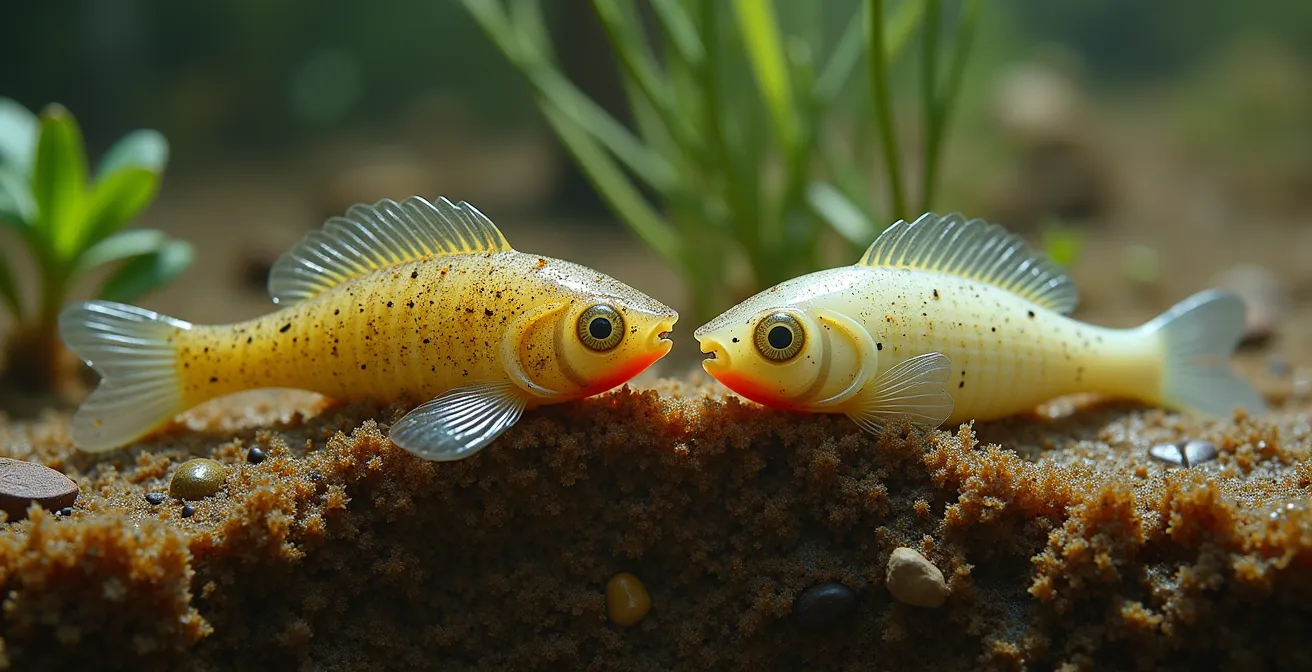
As the visualization shows, the difference over time is stark. The biodegradable option becomes part of the substrate, while the traditional plastic remains an artificial pollutant. For anglers who spend a lot of time punching thick vegetation where break-offs are frequent, making the switch to these more responsible options is a meaningful act of stewardship. Modern formulations have come a long way, offering action, durability, and scent dispersion that is highly competitive with traditional plastics. In some cases, their porous structure can even lead to superior scent release.
As a community, the more we prioritize and purchase these products, the more manufacturers will be incentivized to innovate, leading to even better and more environmentally friendly options for all anglers.
Why Closing the Bail Manually Reduces Line Twists by 80%?
Line twist is the silent killer of casting distance, sensitivity, and overall presentation. It creates frustrating wind knots, causes your line to wrap around the rod tip, and can make your bait spin unnaturally on the fall. While often blamed on lures or line type, the primary culprit for spinning reel users is the simple act of turning the handle to engage the bail. Though convenient, this automatic bail trip is a mechanical flaw that introduces a small twist into your line with every single cast.
Here’s what happens: when you turn the handle, the mechanism violently snaps the bail wire shut. This process allows a small, loose loop of line to form between the roller and the spool before the line comes under tension. That tiny loop is the origin of the twist. When this is repeated hundreds of times a day, those small twists accumulate and compound, eventually creating the dreaded “bird’s nests” and coils that spring off your spool. The impact is so significant that it’s estimated to be responsible for up to 80% of line twist issues on spinning tackle.
The solution is simple, yet it requires breaking a long-held habit: close the bail by hand. After you complete your cast, manually flip the bail wire over with your non-reeling hand. This one small motion does two critical things. First, it ensures the line goes directly onto the line roller under proper tension, preventing that initial loose loop from forming. Second, it puts you in direct contact with your line, allowing you to feel for any slack or potential issues before you begin your retrieve. It forces a moment of mindfulness and control over your gear.
For a tournament angler, where every cast needs to be perfect and tackle failures are not an option, making the switch to manual bail closing isn’t just a “pro tip”—it’s a fundamental requirement for peak performance and efficiency on the water.
Frequently Asked Questions on Texas Rig vs Carolina Rig: Which Soft Plastic Setup Is Best for Weedy Bottoms?
How long do water-soluble biodegradable baits actually take to decompose?
Water-soluble biodegradable baits typically dissolve within 24-72 hours in water, while plastisol-based ‘bio-baits’ require specific anaerobic conditions found at lake bottoms and can take 2-5 years to fully decompose, not the 200+ years of traditional plastics.
Do biodegradable soft plastics perform as well as traditional plastics?
Modern biodegradable formulations have significantly improved, offering comparable action and durability to traditional plastics, with some providing superior scent dispersion due to their porous structure.
Why should anglers fishing heavy cover prioritize biodegradable options?
When fishing heavy cover where losing rigs is inevitable, biodegradable plastics reduce long-term environmental impact, especially important in sensitive spawning areas where traditional plastics can accumulate and persist for decades.