
The key to triggering strikes from pressured fish isn’t random movement; it’s the calculated manipulation of their predatory brain to force an instinctual, unthinking reaction.
- A sudden change in lure speed or direction bypasses a predator’s analysis, triggering a neurological shortcut to attack.
- In cold water, a lure’s pause must be long enough to offer a significant “caloric profit” to an energy-conserving fish.
Recommendation: Instead of just varying your retrieve, focus on creating specific, sharp contrasts in movement—like a long pause followed by a sudden bolt—to exploit these hardwired predatory responses.
Every seasoned angler has felt the frustration: a large, lethargic predator follows a lure with casual interest, only to turn away at the last second. The common advice is to “vary your retrieve” or “change your lure color,” but these are symptoms, not the cure. This approach treats the fish as a creature of simple preference, when in reality, it is a highly efficient predator governed by a complex web of instinct, energy calculation, and neurological triggers. Most anglers are merely presenting an object; the expert is staging a psychological drama designed to provoke an unavoidable response.
The truth is that in high-pressure waters, fish have been “educated.” They have learned to distinguish between authentic prey and a repetitive, mechanical retrieve. To overcome this, we must stop thinking like fishermen and start thinking like predator behaviorists. The secret lies not in the lure itself, but in how its action manipulates the fish’s brain. It’s about understanding the deep-seated instincts that govern a predator’s decision to commit. An erratic, unpredictable action isn’t just movement; it’s a language that speaks directly to the most primitive part of the fish’s mind, bypassing logic and forcing a reaction.
This guide deconstructs the predatory brain. We will move beyond generic tips and explore the specific mechanisms that turn a hesitant follower into a committed biter. By understanding the ‘why’ behind the ‘how’—from the science of metabolic rates in cold water to the psychological impact of a lure’s entry splash—you will learn to create moments of opportunity that even the most lethargic and pressured fish cannot resist. This is the art of transforming your lure from a simple attractant into a tool of precise psychological manipulation.
This article dissects the core principles of predatory behavior to make your lure irresistible. Explore the concepts below to understand how to turn observation into action.
Summary: The Predator’s Brain: A Guide to Manipulating Strike Triggers
- How Long Should You Pause a Jerkbait in Cold Water?
- Rattles vs Silent Lures: When Does Noise Spook Rather Than Attract?
- The Speed Change Technique That Forces Following Fish to Commit
- Silver vs Gold Blades: Which Flash Trigger Works on Cloudy Days?
- Why Fish Strike at the Boat-Side and How to Prepare for It?
- Green Pumpkin or Black/Blue: Which Color Works in Stained Water?
- Why Slowing Down Your Retrieve Triggers Bites in Cold Water?
- The Splash Entry Mistake That Scares Shallow Water Fish Instantly
How Long Should You Pause a Jerkbait in Cold Water?
The pause is not an absence of action; it is the most critical action of all, especially in cold water. For a cold-blooded predator, every movement is an energy calculation. A fish’s metabolism is directly tied to water temperature, and crucial research on fish metabolism shows that its rate can double with a mere 10°C rise. In frigid conditions, a predator’s primary directive is to conserve energy. It will not expend significant effort to chase prey unless the potential reward—the caloric profit—is overwhelmingly positive.
A long, suspending pause transforms your jerkbait from a fleeting, high-effort target into a stationary, high-profit meal. It presents an opportunity for the predator to acquire maximum calories with minimal energy expenditure. The question is, how long is long enough? The answer is dictated by the fish’s metabolic state. In extremely cold water (below 5°C or 40°F), pauses of 10, 15, or even 30 seconds are not excessive. This extended suspension gives a lethargic fish the time to approach, assess, and commit to what it perceives as a dying or stunned baitfish—an easy meal it cannot afford to ignore. As the water warms, the fish’s metabolism speeds up, and it becomes more willing to chase. Consequently, your pauses can become shorter and your retrieve more aggressive.
Experimentation is key, but the principle is constant: the colder the water, the longer the pause. You are not just waiting; you are presenting a compelling economic argument to the predator’s brain.
- Start with an erratic retrieve but be prepared to experiment with pause duration daily based on fish response.
- In colder water, systematically extend the pause duration to match the reduced metabolic rates of predators.
- Ensure you begin and finish each jerk with slack in your line to achieve the optimal side-to-side darting action.
- Use the temperature as a rule of thumb: start with 10-15 second pauses in extreme cold and shorten to as little as 1 second in warmer pre-spawn conditions.
Rattles vs Silent Lures: When Does Noise Spook Rather Than Attract?
A lure’s sound is a powerful tool, but it’s a double-edged sword. Predators use their lateral line to detect vibrations and “hear” prey from a distance, long before they can see it. In stained or murky water, a rattling lure is invaluable, acting as a beacon that expands your lure’s “drawing power” and calls fish in to investigate. The noise cuts through the low visibility, announcing the presence of a potential meal. However, in clear water, this same asset can become your biggest liability, leading to what behaviorists call sensory conflict.
This is a an extreme close-up of the internal rattle chamber of a fishing lure, showing the small metallic balls that create its acoustic signature.
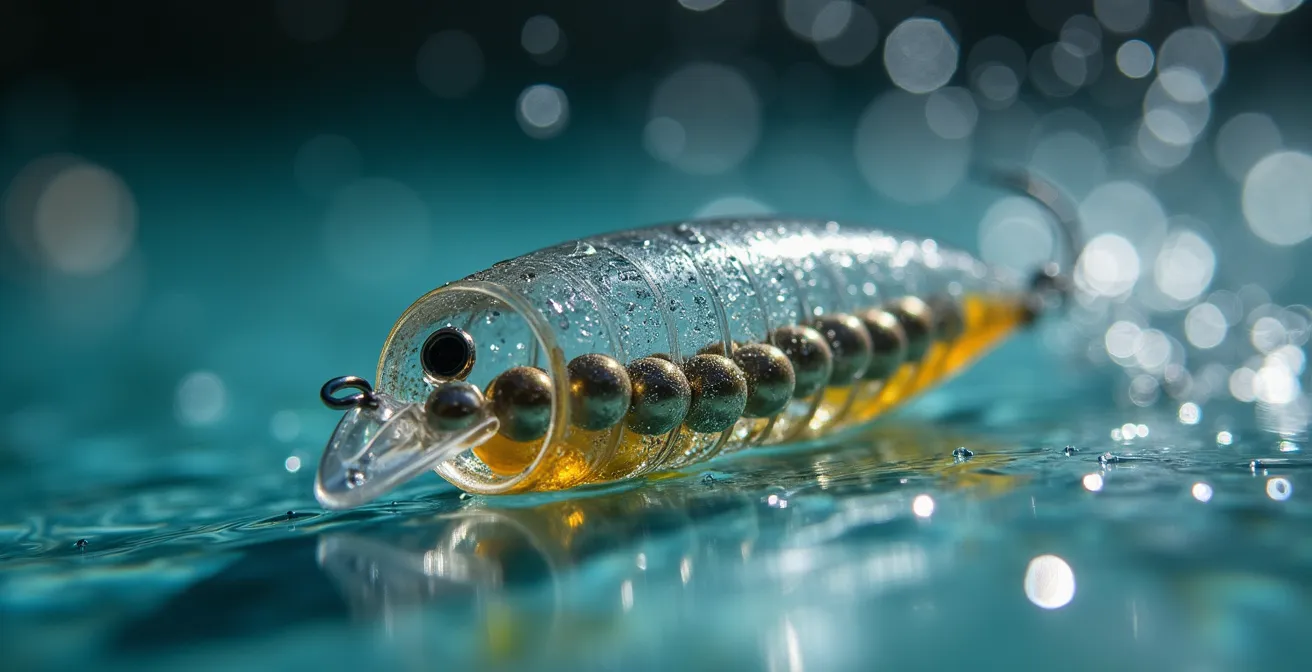
In high-visibility conditions, a savvy, pressured predator sees a small, wounded baitfish but hears an unnaturally loud or sharp rattle. The visual and auditory signals don’t match. This mismatch creates suspicion and triggers a flight response instead of a feeding one. The fish’s brain registers the conflicting information as a potential trap. For this reason, silent or “thudding” lures are often far more effective in clear water. Their subtle sound signature is more consistent with a natural baitfish, reassuring the predator that the visual target is authentic. The rule is simple: use noise to help fish find your lure in low visibility, but rely on silence and visual triggers when the fish can see it clearly.
The Speed Change Technique That Forces Following Fish to Commit
A fish following a lure at a steady pace is an analyzing predator. It is weighing the caloric profit, assessing the target for signs of artificiality, and deciding whether to commit. To break this cycle of analysis, you must trigger a neurological shortcut. The most effective way to do this is with a sudden, dramatic change in speed or direction. A lure that is retrieved slowly and then suddenly bolts forward mimics the exact behavior of prey that has just detected the predator. This is the moment of truth.
This panicked “escape” movement bypasses the fish’s analytical forebrain and stimulates its reactive midbrain. The instinct to capture escaping prey is one of the most powerful drivers in a predator’s world. It can’t risk letting an easy meal get away. The sudden acceleration transforms the lure from an object of curiosity into an urgent target. This is the predatory commit point. The fish stops thinking and starts reacting. As expert angler and guide Benjamin Nowak notes, this is a purely instinctual response.
The following fish is analyzing, but when the lure suddenly bolts, it bypasses the analytical brain and triggers an impulsive, instinctual reaction.
– Benjamin Nowak, MONSTERBASS Jerkbait Fishing Guide
This technique is not about retrieving faster overall. It’s about creating sharp, unpredictable contrasts. A dead-stick pause followed by two violent rips. A slow, steady crank that suddenly accelerates for five feet before stopping dead again. Each change of pace is a question posed to the predator’s instincts, and the sudden bolt is the one that demands an immediate, aggressive answer.
Silver vs Gold Blades: Which Flash Trigger Works on Cloudy Days?
Flash is a primary visual trigger, mimicking the glint of scales from a fleeing or injured baitfish. However, not all flashes are created equal. The effectiveness of a blade’s color—primarily silver versus gold—is dictated by the physics of light penetration in water and the prevailing weather conditions. Choosing the right color is not a matter of a fish’s preference but of pure optical science.
On bright, sunny days in clear water, a silver or chrome blade is supreme. It reflects the maximum amount of available light, creating a brilliant, high-frequency flash that can be seen from great distances. However, on cloudy or overcast days, the light spectrum shifts. Shorter, blue-end wavelengths penetrate deeper into the water column than longer, red-end wavelengths. Silver, reflecting these blue tones, remains highly visible and effective. In contrast, gold and copper blades excel in stained or tannic water. The warmer, longer-wavelength colors they reflect remain more visible in murky conditions where blue light is scattered and absorbed. This is why a gold spinnerbait can be deadly in a muddy river, while a silver one seems to disappear.
The following table, based on extensive on-the-water observation, breaks down blade performance by conditions. As this comparative analysis demonstrates, matching your blade to the light and water clarity is a critical tactical decision.
| Condition | Silver/Chrome | Gold/Copper | Reasoning |
|---|---|---|---|
| Clear Water + Sun | Excellent | Good | Maximum flash reflection |
| Cloudy Days | Excellent | Fair | Blue wavelengths penetrate better |
| Stained Water | Good | Excellent | Warmer colors visible in murk |
| Matching Shad | Excellent | Poor | Natural color match |
| Matching Perch | Poor | Excellent | Natural color match |
Why Fish Strike at the Boat-Side and How to Prepare for It?
The boat-side strike is one of the most startling and revealing events in fishing. A fish that has followed a lure all the way from its casting point without committing suddenly lunges in a last-ditch effort. This is not a random act; it is a calculated ambush predicated on a change in the environment. The boat itself is the catalyst. From an underwater perspective, the hull of the boat creates a large, dark shadow—an artificial piece of cover.
This is an underwater view looking up toward the boat’s hull, which creates a dramatic shadow zone where a predator can ambush prey.
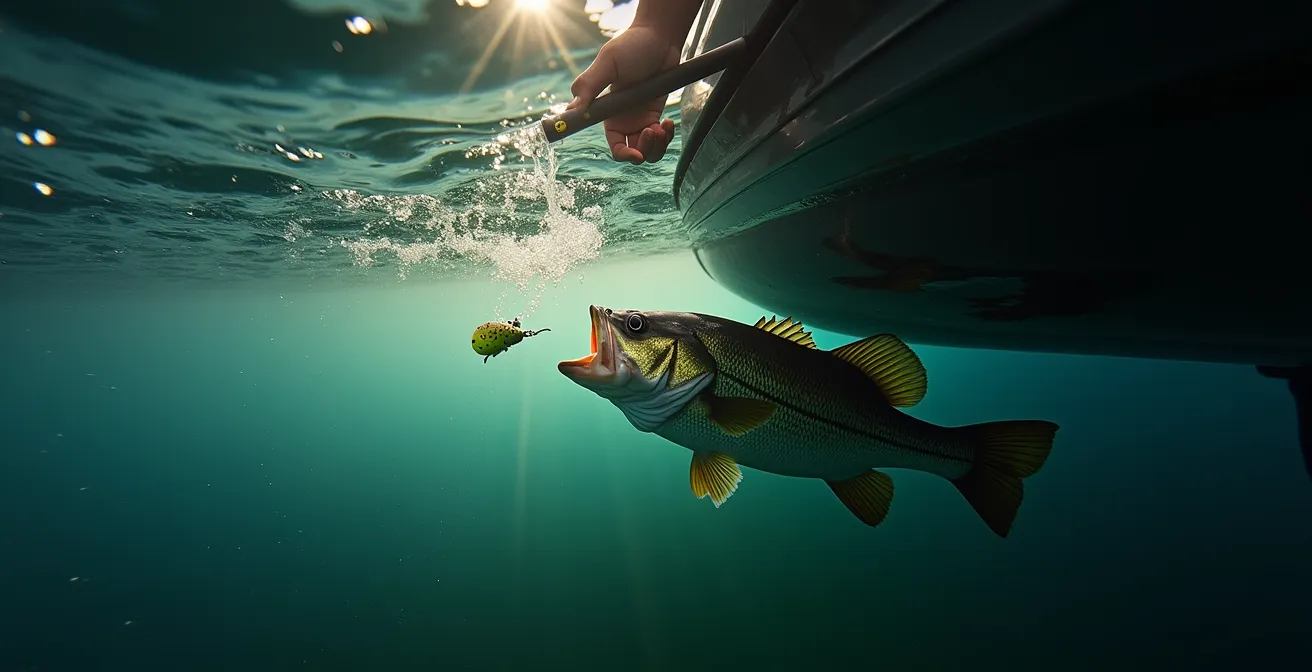
Predators are hardwired to use edges and shadows as ambush points. As your lure is retrieved out of the open water and approaches this shadow line, the following fish perceives it as prey seeking shelter. The predator’s brain registers this as a “now or never” moment. If it doesn’t strike before the prey reaches the safety of the “cover” (the boat’s shadow), the opportunity will be lost. This triggers an aggressive, last-second attack.
To capitalize on this, you must fish your lure all the way back to the rod tip. Never pull your lure from the water prematurely. As the lure nears the boat, impart a sharp, erratic turn or pause. An expert technique is the “figure-8,” where you plunge your rod tip into the water and trace a large figure-8 pattern. This keeps the lure in the strike zone and often converts a follower into a biter. Always be prepared for that boat-side explosion; it’s a testament to the predator’s unwavering instinct to use cover to its advantage.
Green Pumpkin or Black/Blue: Which Color Works in Stained Water?
In stained water, where visibility is limited, color selection moves beyond simple “matching the hatch” and into the realm of silhouette and light spectrum science. The two dominant choices, Green Pumpkin and Black/Blue, work for entirely different, and often misunderstood, reasons. The correct choice depends on the type of stain and the position of the predator relative to the lure.
Black/Blue is the master of maximum silhouette contrast. In muddy or heavily stained water, a predator often attacks from below, looking up toward the brighter surface. A dark black and blue lure blocks the most light, creating a sharp, well-defined outline against the sky. It doesn’t look “natural”; it simply provides the most obvious and unmistakable target for the fish to hit. Conversely, Green Pumpkin excels through camouflage and subtlety. In water with an algae or plankton bloom (a greenish stain), Green Pumpkin blends into the background. A predator sees this as a natural part of the environment, allowing your lure to approach without alarming it. It’s a stealth approach, effective when fish are wary.
A further layer is the use of UV-reactive colors. Since research on light penetration shows the UV spectrum penetrates deeper than visible light in stained water, adding chartreuse or orange highlights with UV dye can make a lure “pop” in a light spectrum invisible to the human eye but highly visible to fish.
Your Action Plan: Color Selection for Stained Water
- Assess the stain type: Is it muddy/silty (favoring black/blue for contrast) or is it a green, algae/tannin stain (favoring green pumpkin for blending)?
- Use black/blue lures to create the strongest possible silhouette when fish are likely looking up in low-visibility conditions.
- Opt for green pumpkin to present a more natural, less alarming profile when a stealthy approach is needed in algae-stained water.
- Enhance your chosen color by adding UV-reactive dyes or accents, especially in chartreuse or orange, to be visible in a different light spectrum.
- Always test both color patterns; the fish’s reaction on any given day is the ultimate deciding factor.
Why Slowing Down Your Retrieve Triggers Bites in Cold Water?
The decision to slow down in cold water is a direct concession to the fundamental law of a predator’s existence: the law of caloric profit. As we’ve established, a fish’s metabolism plummets in the cold. It cannot afford to burn precious energy chasing a fast-moving, uncertain meal. Every potential prey item is subconsciously evaluated through a simple cost-benefit analysis: “Will the energy I gain from eating this be greater than the energy I expend to catch it?”
A fast-moving lure in cold water represents a high-energy chase with a low probability of success. For a lethargic predator, this is a bad deal. It will watch it go by, conserving its resources for a better opportunity. A slow retrieve, however, completely changes the equation. A lure crawling along the bottom or a suspending bait hanging motionless presents itself as a low-effort, high-reward target. It is the underwater equivalent of a free lunch. The predator can leisurely approach, inspect, and consume the target with a minimal outlay of energy. This makes the caloric “profit” of the meal exceptionally high.
A slow retrieve presents a target that requires minimal energy to catch, making the caloric ‘profit’ of eating it worthwhile.
– Temperature Impact Research Team, Understanding Bass Behavior Study
By slowing down, you are not just adapting to the fish’s reduced speed; you are presenting it with an economic proposition it cannot refuse. You are directly appealing to its most basic survival instinct: to gain the most energy while spending the least. This is why techniques like dead-sticking, dragging jigs, and incredibly slow-rolling swimbaits are dominant tactics in the coldest months.
Key Takeaways
- A predator’s strike is often a forced, instinctual reaction to a specific trigger, not a conscious decision.
- In cold water, the length of a lure’s pause must be sufficient to offer a high “caloric profit” to an energy-conserving fish.
- Sudden changes in lure speed or direction bypass a fish’s analysis and exploit a hardwired neurological shortcut to attack.
The Splash Entry Mistake That Scares Shallow Water Fish Instantly
In the world of a shallow-water predator, a sudden, loud splash from above means one thing: danger. It is the sound signature of a diving bird of prey, a swooping heron, or another terrestrial threat. This sound is hardwired into their DNA as a signal to flee, not to feed. The common casting mistake of a high, arcing trajectory that ends in a loud “plop” can clear out a promising area before your lure even begins its retrieve. You have inadvertently signaled “danger” to every fish within earshot.
The goal is to have your lure enter the water with the subtlety of a natural event, such as an insect falling from a branch or a frog sliding off a lily pad. This requires a conscious change in casting mechanics. A low, flat, side-arm cast that sends the lure skimming across the surface before settling is far superior. This technique, known as “feathering,” is critical. By gently applying pressure to the spool with your thumb (on a baitcaster) or forefinger (on a spinning reel) just before the lure hits the water, you can dramatically slow its entry and reduce the splash to a minimum. The ideal entry is a soft “kiss” rather than a loud “smack.”
Mastering a quiet entry is a non-negotiable skill for shallow water success. It ensures your presentation begins in stealth mode, allowing you to engage the fish’s predatory instincts rather than its survival instincts.
- Employ a low, flat casting trajectory instead of a high, arcing one to reduce the lure’s vertical impact angle.
- Feather the line by applying gentle thumb pressure on the spool just before water impact to decelerate the lure.
- Aim for a forward-skipping motion on the water’s surface, which mimics fleeing baitfish, rather than a vertical plunge.
- Practice precise thumb control on baitcasting reels to halt the spool rotation at the exact moment of entry, eliminating splash.
- When possible, choose lighter lures for shallow water applications, as their reduced mass naturally lessens the force of impact.
By understanding these psychological triggers—from caloric profit to sensory conflict—you elevate your fishing from a game of chance to a science of calculated provocation. It is this shift in mindset that separates the consistently successful angler from the rest. The next step is to take this knowledge and apply it consciously on every cast, turning your lure into an extension of a predator’s own mind.