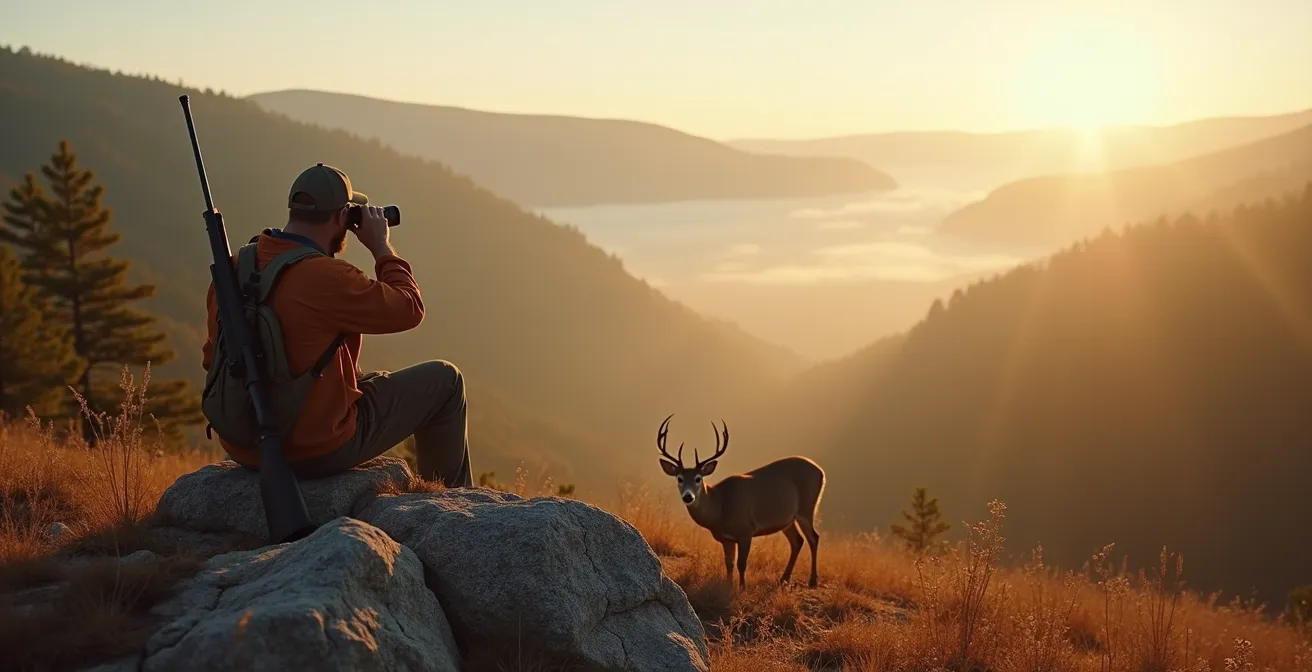
Fair Chase is not merely a set of rules to follow; it is the internal ethical framework that gives hunting its meaning and secures its future in a skeptical world.
- It demands the hunter prioritize woodsmanship and personal skill over technological shortcuts that eliminate the challenge.
- It transforms the harvest into an act of profound respect, extending from the moment of the shot to the full utilization of the animal and its portrayal to society.
Recommendation: Embrace these principles not as limitations, but as the very path to becoming a true, responsible participant in the natural world.
For the new hunter, the landscape of rules and regulations can seem like a dense forest. There are laws dictating seasons, bag limits, and legal methods of take. Yet, beyond the statutes lies a deeper, more profound set of guidelines that are not written into law but are etched into the very soul of ethical hunting: the principles of Fair Chase. Many assume that as long as an action is legal, it is acceptable. This is a fundamental misunderstanding. The law defines the absolute minimum standard of behavior, while ethics define the maximum standard to which we should aspire. Fair Chase is this higher standard.
The concept can feel abstract, often reduced to the simple phrase “giving the animal a sporting chance.” But this simplistic view fails to capture its true depth. The core of Fair Chase is not about creating a “fair fight,” as nature is not a boxing ring. Instead, it is an ethical compass, an internal code of conduct that guides a hunter’s decisions when no one else is watching. It is the conscious choice to accept restraint, to rely on skill and patience, and to engage with the wild on its terms. This philosophy separates hunting from simple killing and elevates it to an act of participation in the ecosystem.
This article will not just list the rules of Fair Chase. It will explore its philosophical underpinnings, examining why these principles are the bedrock of the modern hunter’s identity and the most powerful tool we have for preserving wildlife and our hunting heritage for generations to come. We will deconstruct how this ethical framework applies to technology, the decision to shoot, our responsibility after the harvest, and our role as ambassadors to the non-hunting public.
This guide unpacks the essential dimensions of Fair Chase, moving from the personal ethics of the individual hunter to the broader impact on ecosystems and public perception. Each section builds upon the last, creating a comprehensive moral framework for responsible hunting.
Summary: Why Fair Chase Principles Are Critical for the Future of Public Hunting?
- Drones and Smart Scopes: Where Do We Draw the Line on Technology?
- Why Taking a Risky Shot Is the Ultimate Sign of Disrespect to Game?
- Nose-to-Tail: How to Utilize Offal and Bones to Honor the Animal?
- The Social Media Photo Mistake That Fuels Anti-Hunting Sentiment
- How to Teach Ethics to Young Hunters Before They Shoot Their First Round?
- Carrying Capacity: Why Too Many Deer Can Destroy a Forest Ecosystem?
- The Line-of-Fire Mistake That Endangers Hunting Partners in Brush
- Why Adhering to Harvest Quotas Actually Increases Game Populations Long-Term?
Drones and Smart Scopes: Where Do We Draw the Line on Technology?
The modern hunter walks a fine line between using technology to be more efficient and humane, and using it to eliminate the very skills that define the hunt. The ethical dilemma is not whether technology is “good” or “bad,” but at what point it subverts the principle of Fair Chase. Drones that scout for game from miles away, live-feed trail cameras that text you when an animal is present, and smart scopes that automate ballistics calculations challenge the core of woodsmanship. The question is not “Can we?” but “Should we?” The essence of Fair Chase is the pursuit, the acquisition of knowledge about an animal and its habitat, and the development of personal skill.
When a piece of technology replaces a fundamental hunting skill—like tracking, stalking, or range estimation—it crosses an ethical boundary. It shifts the balance from a contest of skill and senses to a simple act of execution. According to Arizona Game and Fish Department’s fair chase policy, technology becomes unethical when it allows for remote hunting without physical presence or eliminates the need for skill development. This is the internal compass at work: the ethical hunter chooses to rely on their own abilities, using technology as a tool to enhance them, not replace them. The goal is a clean, humane harvest achieved through skill, not a guaranteed kill achieved by removing all challenge and uncertainty.
Your Ethical Technology Checklist: Questions to Ask Yourself
- Does this technology replace a core woodsmanship skill like tracking or range estimation?
- Does it automate the kill decision or does it still require my full human judgment at the critical moment?
- Does using it distance me from the environment, or does it help me become more immersed in it?
- Would using this tool give me an improper or unfair advantage over the game’s natural defenses?
- Does this reduce the experience of hunting to merely shooting, rather than a holistic pursuit?
Why Taking a Risky Shot Is the Ultimate Sign of Disrespect to Game?
The moment before the shot is where the hunter’s entire ethical framework is tested. It is a moment of profound moral gravity. All the scouting, stalking, and patience culminates in a single decision: to shoot or not to shoot. Taking a risky shot—one at an extreme distance, through brush, or at a running animal—is not a sign of confidence, but the ultimate act of disrespect. It prioritizes the hunter’s desire for a kill over their solemn responsibility to ensure a quick, humane death. An ethical hunter understands that the animal’s life is not a prize to be won at any cost, but a gift that must be taken with the utmost care and certainty.
This principle is perfectly encapsulated by the Boone and Crockett Club’s creed, which states that an ethical hunter “knows his or her limitations and stretches the stalk, not the shot.” The true skill is not in making a “miracle” shot, but in closing the distance, controlling one’s breath and excitement, and waiting for the perfect opportunity where a clean harvest is virtually guaranteed. Choosing to pass on a marginal shot is the hallmark of a mature, respectful hunter. It demonstrates a commitment to the animal that transcends the ego, affirming that the well-being of the game and the integrity of the hunt are more important than a notched tag.
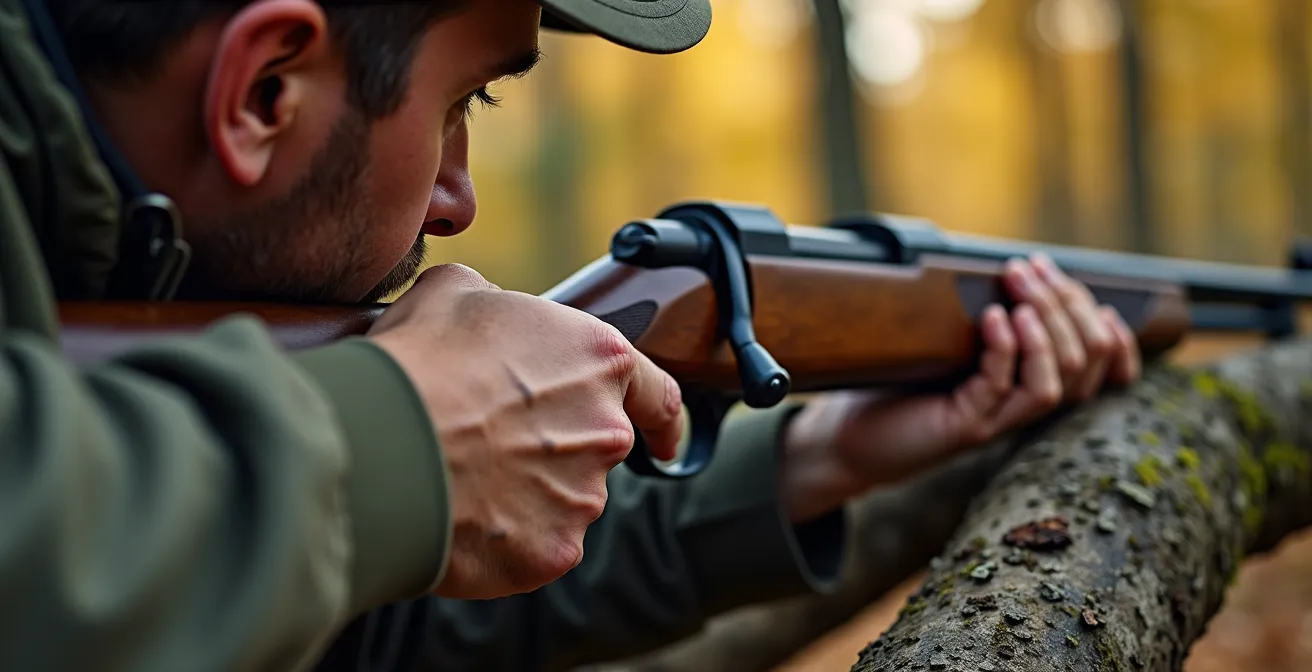
As this image conveys, the focus is on patience, stability, and absolute certainty. Every element is aligned to honor the animal by ensuring a perfect shot. This is the opposite of a rushed, hopeful attempt. It is the physical manifestation of respect, where the hunter’s hands do the work that their ethical compass has already dictated. Wounding and losing an animal is the gravest failure in hunting, a direct consequence of disrespecting one’s own limitations.
Nose-to-Tail: How to Utilize Offal and Bones to Honor the Animal?
The ethical responsibility of Fair Chase does not end when the animal is down. In fact, one of the most crucial acts of respect begins after the shot. The principle of full utilization—often called “nose-to-tail”—is the tangible expression of gratitude for the animal’s life. To harvest an animal only for its prime cuts or antlers, while leaving the rest to waste, is to treat the animal as a mere commodity. The ethical hunter sees it differently; they see the harvest as a profound gift of sustenance and resources, and it is their duty to honor that gift by using as much of it as possible.
The Boone and Crockett Club’s official statement on Fair Chase makes this clear, framing the hunt as an “act of participation” in the ecosystem. It emphasizes that this participation includes making “full use of game animals taken.” Discarding edible meat, organs, or other useful parts is viewed as a direct violation of the respect owed to the animal and the natural world. This practice connects modern hunters to a long tradition of human subsistence, where our ancestors wasted nothing. It transforms the hunter from a simple consumer into a thoughtful provider who values every part of the harvest.
Case Study: Complete Animal Utilization as Fair Chase Completion
The Boone and Crockett Club emphasizes that fair chase hunters ‘care about and respect all wildlife and the ecosystems that support them, which includes making full use of game animals taken.’ This principle extends the ethical obligation beyond the hunt itself to the complete utilization of the harvested animal, viewing waste as a violation of the respect owed to the game.
Practicing nose-to-tail utilization is both an art and a science, reconnecting us with traditional skills. It involves more than just butchering; it’s about seeing potential in every part:
- Organ Meats: The heart, liver, and kidneys (offal) are incredibly nutrient-dense and should be processed quickly for optimal freshness. The heart, a pure muscle, is often one of the most delicious cuts.
- Bones and Sinew: Slow-simmering bones for 24-48 hours creates a rich, collagen-packed bone broth. Sinew from the legs can be dried and used for traditional cordage or crafting.
- Fat: Rendering tallow from suet provides a stable cooking oil and can be used for waterproofing leather goods or making soap and candles.
- Hides: Tanning the hide, using either traditional or modern methods, creates a durable and beautiful material for clothing, rugs, or crafts, preserving a lasting memory of the animal.
The Social Media Photo Mistake That Fuels Anti-Hunting Sentiment
In the digital age, every hunter is an ambassador for the entire hunting community, whether they choose to be or not. A single photograph posted on social media has the power to either build a bridge of understanding with the non-hunting public or burn it to the ground. The most common and damaging mistake is the “trophy photo,” where the hunter is depicted as a conqueror and the animal as a vanquished object. Photos showing hunters straddling an animal, captions using disrespectful language like “smoked him” or “dirt nap,” and gruesome images with excessive blood and lolling tongues do immense harm. They reinforce the worst stereotypes and fuel anti-hunting sentiment.
The Boone and Crockett Club wisely notes the political reality of our traditions:
In any democracy, society decides what is acceptable or unacceptable, and therefore what stays and what goes. Hunting traditions are potentially at risk if the majority of citizens develop a negative perception of hunting.
– Boone and Crockett Club, Fair Chase Statement 2016
This is the core of our stewardship contract with society. To secure the future of hunting, we must present it in a way that is respectful, solemn, and focused on the narrative of the hunt, not just the kill. This means taking the time to clean the animal, position it in a natural and dignified way, and choose a caption that expresses gratitude and reverence, not dominance. The focus should be on the experience, the landscape, and the sustenance provided, rather than solely on the size of the antlers.
The distinction between a problematic trophy photo and a respectful narrative photo is critical for every hunter to understand. The following comparison breaks down the key differences in approach and impact.
| Trophy Photo (Problematic) | Narrative Photo (Respectful) |
|---|---|
| Hunter dominates frame, animal appears subordinate | Hunter and animal shown with equal dignity |
| Focus on antler size and score | Focus on the hunt experience and habitat |
| Captions: ‘Smoked him’, ‘Dirt nap’ | Captions: ‘Grateful for this harvest’, ‘Respect to this magnificent animal’ |
| Blood visible, tongue hanging | Animal cleaned, positioned naturally |
| Straddling or sitting on animal | Kneeling beside animal respectfully |
How to Teach Ethics to Young Hunters Before They Shoot Their First Round?
The future of ethical hunting rests entirely on our ability to pass down the principles of Fair Chase to the next generation. This education must begin long before a young hunter ever shoulders a firearm. Teaching ethics is not about memorizing a list of rules; it is about building an ethical scaffolding of respect, reverence, and responsibility. The most effective way to do this is to immerse the apprentice hunter in the natural world, teaching them to see the ecosystem through a hunter’s eyes before they are tasked with the gravity of taking a life.
A powerful mentorship approach, emphasized in many modern hunter education programs, is to have new hunters first learn to “hunt” with binoculars, field guides, and a journal. This initial phase focuses on developing core woodsmanship skills: identifying tracks, understanding animal behavior, reading the wind, and observing how different species interact with their habitat. This “pre-hunting” year builds a deep foundation of respect and wonder for the wildlife they are observing. It ensures the young hunter understands that hunting is fundamentally about becoming part of the natural world and accepting the profound responsibility that comes with that role, not merely about the act of shooting.
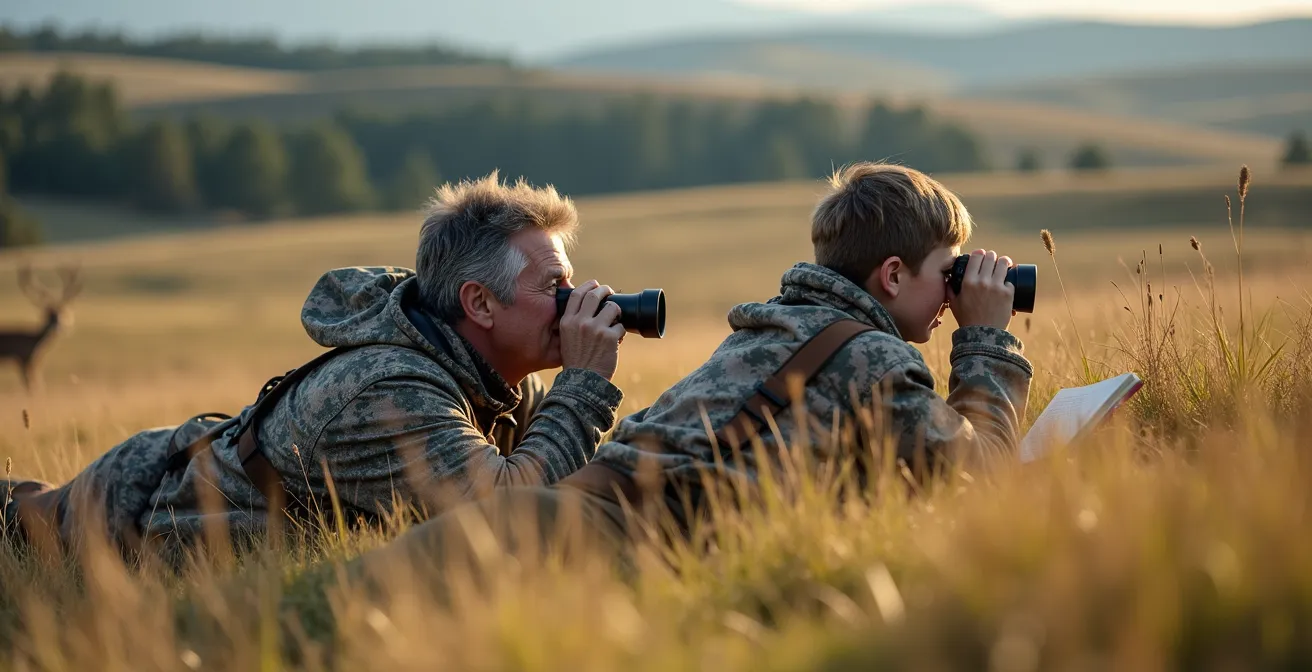
The role of the mentor, as shown here, is to guide observation and instill patience. By removing the firearm from the initial equation, the focus shifts entirely to learning and appreciation. The mentor can use this time to ask Socratic questions that build the young hunter’s internal compass: “Why is it important that the animal doesn’t know you’re there?” “What makes this experience different from just killing?” “When is choosing NOT to shoot the bravest and most ethical decision?” This process ensures that when the time comes to take their first shot, the young hunter is armed not just with a rifle, but with a fully formed conscience.
Carrying Capacity: Why Too Many Deer Can Destroy a Forest Ecosystem?
A common misconception among the non-hunting public is that hunting is a detriment to wildlife populations. The ecological reality is that regulated, science-based hunting is one of the most crucial tools for ensuring their health and stability. This is rooted in the concept of carrying capacity: the maximum number of a species that an ecosystem can sustainably support. When a population, such as white-tailed deer, exceeds its habitat’s carrying capacity due to a lack of natural predators, the consequences can be devastating for the entire ecosystem.
Overabundant deer herds can literally eat themselves out of house and home, creating a visible “browse line” on trees where they consume every leaf and twig within reach. This destruction of the forest understory has a cascading effect. It eliminates habitat and food sources for countless other species, including ground-nesting birds like ovenbirds and grouse, and removes the host plants necessary for native insects and pollinators. Forest regeneration grinds to a halt as new saplings are devoured before they can grow. Ultimately, this leads to widespread starvation and disease within the deer herd itself. In this context, the hunter becomes a vital part of the ecological system.
Case Study: The Ecological Role of the Hunter
In ecosystems where natural predators like wolves and mountain lions have been eliminated, hunters who fill antlerless tags serve as surrogate predators. By participating in regulated harvests, they help maintain the deer population in balance with the habitat, preventing the creation of destructive browse lines, protecting biodiversity for other species, and ensuring the long-term health of the deer herd itself by preventing mass starvation events.
This role fulfills the very definition of modern conservation, which, as defined by the Boone and Crockett Club’s conservation principles, involves the regulated harvest of individual animals in a manner that conserves and perpetuates the entire population. The ethical hunter understands this role; they are not simply taking from nature, but are actively participating in its management and preservation under their stewardship contract.
The Line-of-Fire Mistake That Endangers Hunting Partners in Brush
While much of Fair Chase philosophy focuses on our relationship with the animal and the environment, its bedrock is an unwavering commitment to safety. An unethical act toward wildlife is a failure of character; an unsafe act toward a human is an unforgivable transgression. The most sacred responsibility of any hunter is the safety of their partners and anyone else who may be in the woods. In dense brush or driven hunt scenarios, the risk of a line-of-fire incident increases dramatically. The cardinal rule, as one expert source puts it, is absolute certainty:
Never take a shot you cannot clearly identify—species, backdrop, and what lies beyond the target.
– Hunting Streets, Hunting Ethics & Fair Chase Guidelines
This rule is absolute. There is no trophy, no animal, worth the slightest risk to human life. To manage this risk in challenging terrain, ethical hunting parties establish rigid safety protocols before they even take a step into the field. This involves establishing clear zones of fire for each hunter, ensuring everyone knows which directions are safe to shoot and which are not. This is not a static plan; it’s a dynamic mental map that must be constantly updated with every step taken by every member of the party. Constant communication, whether verbal or through hand signals, is non-negotiable.
Effective teams conduct pre-hunt safety briefs every single time, regardless of experience. They agree on signals for “stop,” “target sighted,” and “unsafe shot.” They practice the discipline of never assuming they know their partner’s location; if visual contact is lost for more than a few moments, all action stops until it is re-established. This meticulous attention to safety is the ultimate sign of respect for your hunting partners. It is the practical application of the ethical framework, recognizing that our privilege to hunt depends on a perfect safety record. A hunter who is careless with their firearm is a liability to everyone and has no place in the field.
Key takeaways
- Fair Chase is an internal code of conduct, not just legal compliance, that prioritizes personal skill and profound respect for the animal.
- Every stage of the hunt, from the technological choices made beforehand to the social media post made after, is governed by this ethical responsibility.
- Adhering to these principles is the hunter’s most direct and powerful contribution to wildlife conservation and the positive public perception of hunting.
Why Adhering to Harvest Quotas Actually Increases Game Populations Long-Term?
The principles of Fair Chase and the success of wildlife conservation in North America are inextricably linked. The proof lies in the history of the North American Model of Wildlife Conservation, a system built on the premise that wildlife is a public trust resource, managed by science, and funded primarily by hunters. Adhering to harvest quotas is not just a legal requirement; it is the engine of this conservation model. It is the collective action of individual, ethical hunters that allows wildlife populations to thrive in a way that would otherwise be impossible in the modern world.
To understand the power of this model, one only needs to look back to the late 19th and early 20th centuries. Before regulated hunting, commercial market hunting had decimated many of North America’s most iconic species. White-tailed deer, now a common sight, were on the brink of extinction in many areas. It was hunters themselves who recognized this crisis and advocated for the establishment of game laws, bag limits, and the science-based agencies to enforce them. They willingly agreed to tax their own equipment through acts like the Pittman-Robertson Act to create a dedicated funding stream for conservation.
The North American Model Success Story
The success of this hunter-led conservation movement is one of the greatest environmental stories ever told. The implementation of science-based quotas funded by hunters has restored populations of white-tailed deer from an estimated 500,000 in 1900 to over 30 million today. Similar success stories can be told for wild turkeys, pronghorn, and elk. This demonstrates, with undeniable data, that regulated hunting is the cornerstone of successful, large-scale wildlife conservation.
When a hunter abides by harvest quotas, they are doing more than just following a rule. They are an active participant in this grand conservation success story. They are ensuring that scientists have the data they need to set sustainable limits, and they are providing the funding necessary to protect and enhance habitat for countless species, both hunted and non-hunted. Adhering to the law, in this sense, becomes the final and most powerful expression of the Fair Chase ethic: a personal commitment to a collective good that has yielded incredible results for wildlife.
Embrace these principles not as restrictions, but as the very foundation of your identity as a responsible hunter and a true steward of the wild.