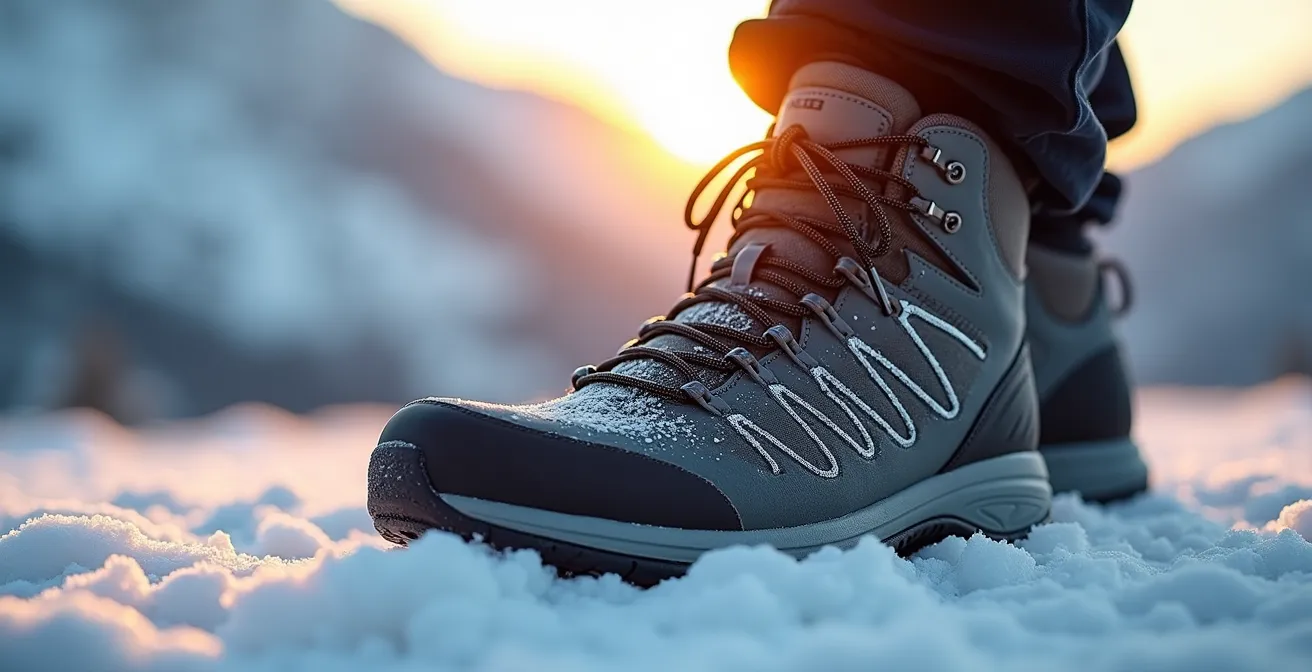
Contrary to popular belief, preventing frozen laces isn’t about waterproof sprays; it’s about choosing materials that are non-absorbent at a molecular level.
- Standard synthetic laces like nylon and paracord will still absorb water and freeze, creating a critical system failure.
- Truly hydrophobic materials like UHMWPE are completely waterproof, preventing ice crystal formation that causes abrasion and breakage.
Recommendation: Immediately replace your stock boot laces with a pair made from UHMWPE to guarantee reliability in sub-zero conditions.
Out on the ice, the smallest failure can cascade into a life-threatening situation. A frozen boot lace is not a minor inconvenience; it’s a critical gear failure. You can’t tighten your boot for stability, you can’t loosen it to restore circulation, and you certainly can’t take it off in an emergency. For years, the common advice has been to use synthetic laces and maybe a waterproofing spray. This is dangerously incomplete.
The real enemy isn’t the water on the outside of the lace; it’s the moisture that works its way *inside* the fibers. Once absorbed, that water freezes, turning your flexible lace into a rigid, icy wire and your secure knot into a frozen block. A survey even found that 38% of outdoor footwear failures were related to lace issues, a statistic that underlines the severity of this often-overlooked component. This isn’t just about keeping your feet dry; it’s about maintaining the integrity of your most critical piece of equipment.
The secret to absolute reliability isn’t a temporary chemical barrier. It’s a principle I call molecular hydrophobia—using a material that is inherently incapable of absorbing water. This guide will deconstruct the entire system: the materials that work, the knots that hold, and the lacing techniques that prevent injury. We will move beyond the superficial tips and into the science of why laces fail in the cold, ensuring your gear never lets you down.
This article breaks down the essential components for achieving fail-proof lacing in winter conditions. From material science to knot-tying and emergency preparedness, you’ll gain a complete system for total reliability.
Contents: The Ultimate Guide to Winter-Proofing Your Boot Laces
- Nylon vs Cotton Laces: Which Dries Faster in High Humidity?
- How to Tie a Surgeon’s Knot That Won’t Slip When Wet?
- Paracord Laces: Are They Really Better Than Stock Laces for Hiking?
- The Eyelet Friction Problem That Snaps Laces at the Worst Moment
- Why You Should Always Carry Spare Laces in Your First Aid Kit?
- Lock Lacing vs Surgeon’s Knot: Which Holds the Heel Better?
- The Lacing Mistake That Destroys Heel Linings in Under a Year
- What to Pack in an Altoids Tin Survival Kit for Day Hikes?
Nylon vs Cotton Laces: Which Dries Faster in High Humidity?
The conversation about lace materials often starts and ends with “don’t use cotton.” While true, this advice is dangerously simplistic. Cotton acts like a sponge, absorbing water, losing its strength, and freezing solid. But the common alternative, nylon, is not the perfect solution many believe it to be. While it resists water better than cotton, nylon still has a degree of moisture absorption. In high-humidity or prolonged wet conditions, a nylon lace will eventually become saturated, stretch, and freeze. This is a slow-burn system failure waiting to happen.
To truly understand material performance, we must look beyond “water-resistant” and focus on materials that are genuinely hydrophobic. This is where advanced polymers come into play. Materials like Polyester offer a significant step up, repelling water effectively. But for expedition-grade reliability, the gold standard is Ultra-High-Molecular-Weight Polyethylene (UHMWPE). This material is, for all practical purposes, completely waterproof. Its fibers do not absorb moisture, meaning it cannot freeze, lose strength, or stretch when wet. It maintains its flexibility and knot integrity in the most brutal sub-zero temperatures.
The following table, based on an in-depth analysis of lace materials, clearly illustrates the hierarchy of water resistance. It’s not a choice between good and bad, but a spectrum of reliability.
| Material | Water Resistance Rating | Key Properties |
|---|---|---|
| UHMWPE | 10/10 | Completely waterproof, never freezes, ultra-light |
| Polyester | 8/10 | Repels water well, maintains shape when wet |
| Nylon | 7/10 | Resists water, dries quickly, slight stretch when wet |
| Kevlar | 6/10 | Better than natural fibers but absorbs moisture over time |
| Leather | 4/10 | Stretches and degrades with repeated exposure |
| Cotton | Not rated | Absorbs water like a sponge, weakens when wet |
Choosing the right material from the outset eliminates the primary cause of frozen laces. In expedition settings, where your life depends on your gear, starting with a foundation of molecular hydrophobia is non-negotiable.
How to Tie a Surgeon’s Knot That Won’t Slip When Wet?
Even with the best hydrophobic laces, a poor knot is a point of failure. The standard shoelace knot (a reef knot) is notoriously unreliable, especially under tension and in wet or icy conditions. It can slip, work itself loose, or become impossible to untie. For true expedition reliability, you need a knot that provides superior kinetic security—one that tightens under load and resists the constant motion of walking and hiking. My go-to knot, and the one I trust my life with, is the Surgeon’s Knot.
The genius of the Surgeon’s Knot is its simplicity and friction. It’s essentially a standard shoelace knot, but with one crucial difference: you make an extra wrap on the first part of the tie. This double wrap creates significantly more friction, which locks the knot in place and prevents it from slipping while you tie the second part (the bow). This initial lock is what makes all the difference when your fingers are cold and you’re working with stiff, icy laces. It holds the tension for you.
Here’s how to execute it perfectly:
- Start as you would a normal shoelace knot, crossing the left lace over the right.
- Wrap the left lace under and around the right lace two full times. This is the key step.
- Pull both ends tight. You’ll feel the knot lock into place. It will not slip.
- Finish by tying a standard bow on top. For added security, you can even double-knot the bow.
This illustration breaks down the crucial double-wrap technique.
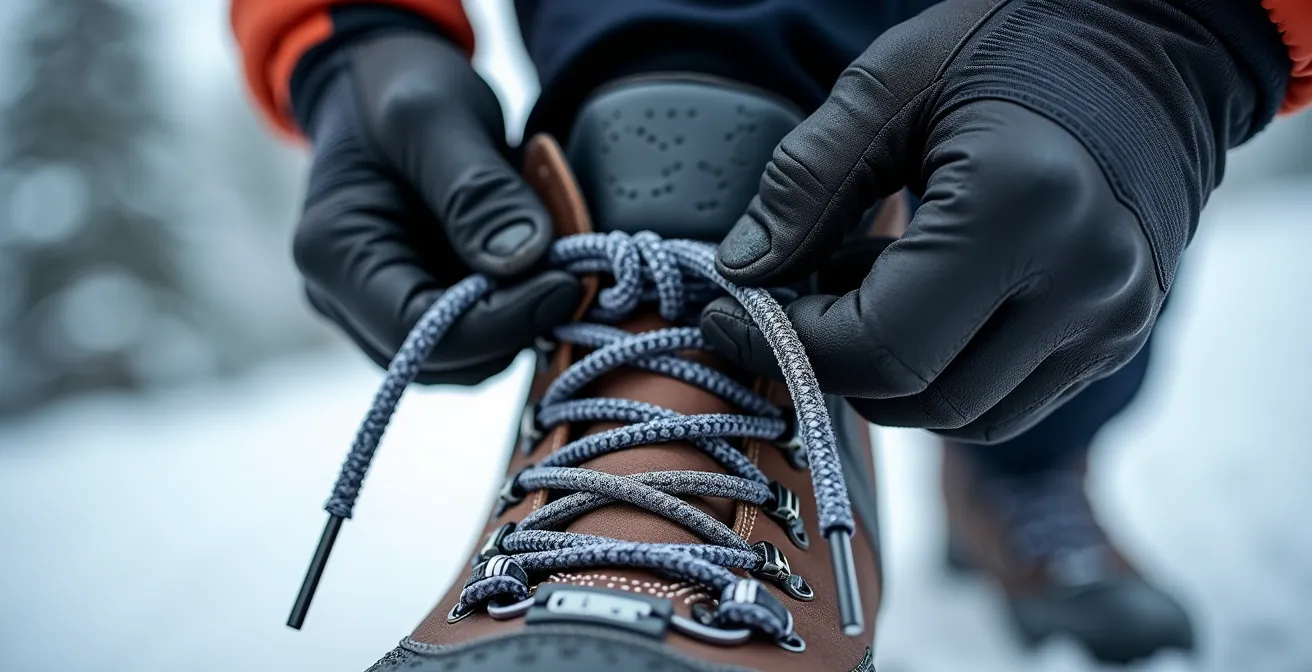
Mastering this technique gives you a knot that will not come undone accidentally, yet remains relatively easy to untie, even with gloves on. It’s the perfect balance of security and practicality for harsh environments.
This knot is a simple, no-cost upgrade to your lacing system that dramatically increases its reliability. It’s a skill every winter explorer should master.
Paracord Laces: Are They Really Better Than Stock Laces for Hiking?
Paracord is often touted in survivalist circles as the ultimate do-it-all cordage, and many hikers swap their stock laces for it. Its high tensile strength and multi-strand core give it a reputation for toughness. However, for winter expeditions specifically, paracord is a suboptimal and potentially dangerous choice. The widespread belief in its superiority is a myth that ignores the fundamental principles of moisture management in cold environments.
The primary flaw lies in its construction. Standard mil-spec paracord has a woven outer sheath, almost always made of nylon. As we’ve established, nylon absorbs water. When you’re trekking through snow or slush, this nylon sheath becomes saturated. At night, or when temperatures plummet, that moisture freezes solid. The paracord becomes a stiff, icy rod, and any knot you’ve tied becomes a block of ice. Furthermore, the inner strands can also hold moisture, creating a lace that is perpetually wet and prone to freezing from the inside out.
Field Test: UHMWPE vs. Traditional Paracord
To demonstrate this, Adventure Andy’s field testing directly compared UHMWPE laces against paracord in winter conditions. The results were stark: the paracord’s nylon sheath saturated with water and froze solid, making it difficult to handle and untie. In contrast, the UHMWPE laces remained completely waterproof and flexible. They absorbed no water, even after being stored wet for months, and never froze. This test proves that for critical winter use, a material’s inherent waterproofness is far more important than its raw tensile strength. UHMWPE is not only waterproof but also has a strength-to-weight ratio 15 times that of steel, making it superior in every relevant metric.
While paracord is an excellent tool to have in your pack for general-purpose tasks, it does not belong on your boots when facing sub-zero temperatures. Relying on it is a classic case of using the right tool for the wrong job, and it introduces a significant, unnecessary risk into your gear system.
The Eyelet Friction Problem That Snaps Laces at the Worst Moment
Lace failure often happens catastrophically and at the worst possible time—not because the lace was weak, but because it was destroyed by a hidden enemy: eyelet friction. Every time you tighten your boots, the lace abrades against the metal or fabric eyelets. This wear and tear is dramatically accelerated in winter conditions, a phenomenon I call “ice crystal abrasion.” It’s a key aspect of friction mechanics that most hikers overlook.
When a lace absorbs moisture—even a small amount—and then freezes, microscopic ice crystals form within its fibers. These tiny, sharp crystals act like internal sandpaper. As the lace moves back and forth through the eyelets, these ice crystals grind away at the fibers from the inside, drastically reducing the lace’s strength. This damage is concentrated at the points of highest friction, typically the eyelets near the ankle where you pull the tightest. The lace doesn’t just wear out; it’s actively being cut apart from within.
Lab Analysis: Ice Crystal Abrasion Effect
This isn’t just theory. A lab test specifically analyzed this effect by repeatedly freezing, thawing, and running different lace materials through eyelets. Traditional nylon and cotton laces showed wear rates three times faster when subjected to these freeze-thaw cycles. Failure points consistently occurred at the mid-eyelet stress zones after about 500 cycles. In stark contrast, UHMWPE laces, with their incredibly smooth and non-absorbent molecular structure, demonstrated superior resistance. Ice crystals simply cannot form within their fibers, eliminating this internal abrasive effect and preserving the lace’s integrity.
This is why materials like Kevlar, despite their legendary strength, can also be a poor choice for cold weather. As experts Jassal and Ghosh noted in their 2022 Boot Laces Material Study, “When Kevlar boot laces get wet and cold, they freeze and become hard to untie.” This stiffness increases friction and abrasion at the eyelets.
Ultimately, the solution to the eyelet friction problem comes back to material choice. By using a truly hydrophobic, low-friction material like UHMWPE, you remove the root cause of ice crystal abrasion and ensure your laces can withstand the immense stresses of a winter expedition.
Why You Should Always Carry Spare Laces in Your First Aid Kit?
On an expedition, every piece of gear should be evaluated for its utility and potential for multi-purpose use. A spare set of boot laces is not just a simple backup; it is one of the most versatile and valuable items you can carry. I don’t just pack them; I integrate them into my first aid and survival kits. This concept of redundancy as a tool transforms a simple item into a problem-solving powerhouse, but only if you choose the right kind of spare lace.
A spare cotton or nylon lace is just that—a spare. But a spare hydrophobic UHMWPE lace is a high-strength, waterproof, non-freezing, lightweight cordage that can be deployed in countless emergency scenarios. Its refusal to absorb moisture (including blood) or freeze makes it uniquely suited for critical repairs and improvisation in the field where other materials would fail. A broken snowshoe binding, a snapped tent guy-line, or the need for an emergency splint can all be addressed with this single, compact item.
Thinking of your spare laces as a survival tool fundamentally changes your approach to preparedness. It’s not about planning for one failure (a broken lace), but about carrying a solution for dozens of potential failures.
Action Plan: 5 Lifesaving Uses for a Spare Lace
- Emergency snowshoe binding repair: Use the lace to re-secure your boot to the snowshoe deck when plastic buckles crack in extreme cold.
- Friction fire bow drill: A strong, non-stretching UHMWPE lace makes an excellent bowstring for an emergency fire-starting kit.
- Gaiter strap field repair: Improvise a new under-boot strap for a broken gaiter to maintain crucial snow protection and keep your feet dry.
- Temporary splint lashing: Its high strength and inability to absorb blood or freeze solid make it ideal for securing a splint in a first-aid situation.
- Emergency shelter guy-line: The lace maintains its full strength even when covered in ice, providing a reliable anchor for a tarp or emergency bivy.
Don’t just throw a spare pair of laces in your bag. Choose a high-performance set, coil them tightly, and place them in your survival kit. You’re not just carrying a backup; you’re carrying a solution.
Lock Lacing vs Surgeon’s Knot: Which Holds the Heel Better?
While the Surgeon’s Knot provides ultimate knot security, addressing heel slip requires a different approach that focuses on the lacing pattern itself. A loose heel is more than an annoyance; it’s a primary cause of blisters, fatigue, and loss of control on uneven terrain. The most effective technique I’ve found for locking the heel in place is aptly named the Heel Lock, also known as “lock lacing” or a “runner’s loop.” It creates a pulley system at the ankle that cinches the boot securely around your foot, preventing your heel from lifting.
The Surgeon’s Knot and the Heel Lock serve two different but complementary purposes. The Surgeon’s Knot prevents the entire lacing system from coming untied. The Heel Lock specifically targets the fit around the ankle to prevent internal foot movement. For winter hiking, where boots are often stiffer and feet are more prone to blisters, using both is the optimal strategy. You use the Heel Lock pattern to secure the fit, then tie it off with a Surgeon’s Knot for bombproof security.
Here’s how to create the Heel Lock:
- Lace your boots normally, but stop at the second-to-last eyelet.
- Instead of crossing the laces over, run each lace up the same side and through the top eyelet, creating a small vertical loop on each side of the boot.
- Now, cross the laces over, threading each one through the opposite loop you just created.
- Pull downwards and outwards to tighten. You’ll feel the boot cinch snugly around your ankle, locking your heel into the back of the boot.
- Finish by tying a Surgeon’s Knot.
This visual shows the final configuration of the Heel Lock lacing pattern.
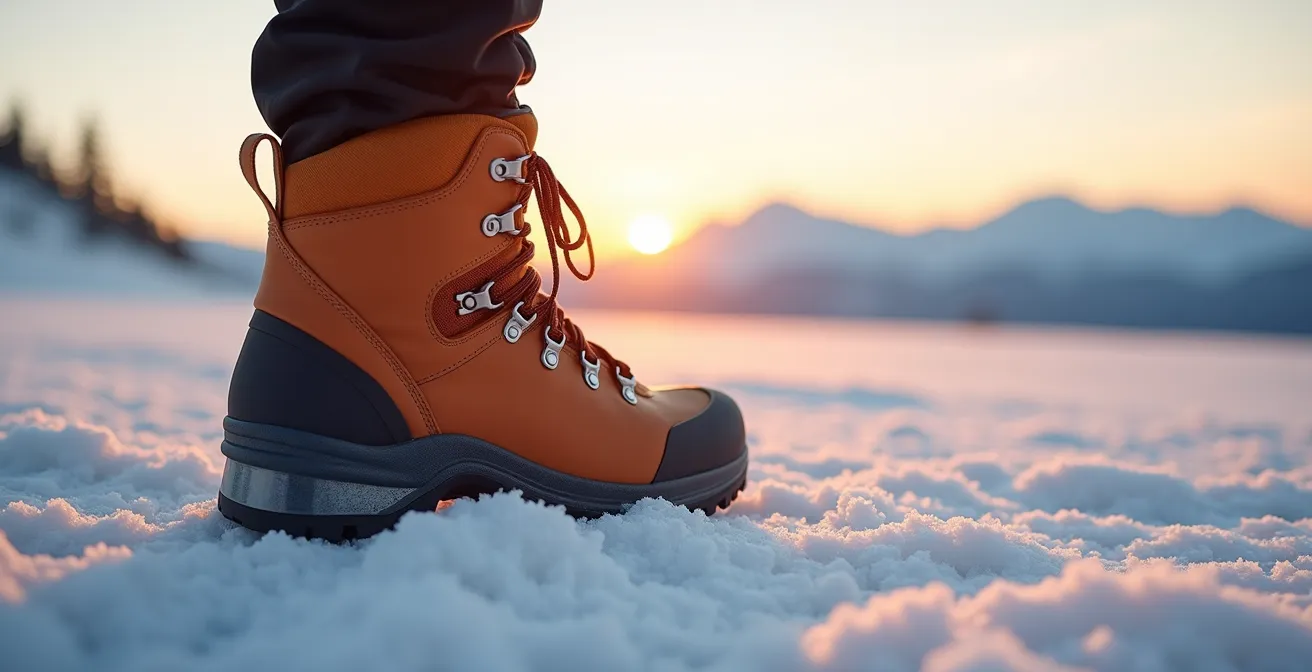
Heel Lock Technique Effectiveness Study
The American Hiking Society endorses this method, and for good reason. A study on heel lock techniques demonstrated its effectiveness, showing that creating these loops at the final eyelets can reduce heel slippage by up to 40% compared to standard lacing. This significant reduction in movement is critical for preventing blisters and foot fatigue during long winter treks.
By combining a superior lacing pattern with a secure knot, you create a complete system that addresses both fit and security, ensuring comfort and performance on the trail.
The Lacing Mistake That Destroys Heel Linings in Under a Year
The most common lacing mistake isn’t an exotic knot or a complex pattern; it’s simply not lacing tight enough to prevent heel slip. This single error is the silent killer of expensive winter boots and the number one cause of debilitating blisters. Every step you take with even a millimeter of heel lift creates friction. Your sock rubs against your skin, and the inside of your boot rubs against your sock. Over thousands of steps, this constant, low-grade abrasion wears through your sock, your skin, and the soft lining of your boot’s heel cup, destroying it in under a single season.
Many hikers blame their boots or socks when the real culprit is a flawed lacing system. They fail to achieve a proper heel lock, allowing for micro-movements that initiate a cascade of friction. According to wilderness medicine research, blisters are the most common medical issue guides are asked for advice on, highlighting how pervasive this problem is. It’s not just a comfort issue; a bad blister can end an expedition.
Solving this requires thinking of your foot-boot interface as a complete system. Proper lacing is the foundation, but socks and even direct skin protection play a role, especially for those prone to blisters.
Despite using moleskin, hockey tape, and Merino wool socks, an AT skier reported persistent heel blisters within one day of touring. The solution required a combination of duct tape strips on each heel plus double-layered WrightSocks that transfer friction between sock layers rather than skin. This combination worked even in -30C conditions, demonstrating that heel protection in winter requires multiple defensive layers, not just proper lacing.
– Winter AT Skier, as reported on Newschoolers.com
By using the Heel Lock technique discussed previously, ensuring your laces are tight, and considering a multi-layered sock system, you can eliminate heel slip. This not only saves your feet from blisters but also preserves the life of your expensive footwear by stopping the destructive friction before it starts.
Key Takeaways
- Material Is Paramount: The single most important factor is using a truly hydrophobic lace material like UHMWPE that cannot absorb water and freeze.
- Technique Creates Security: A Surgeon’s Knot prevents your laces from coming undone, while a Heel Lock lacing pattern prevents blisters by eliminating heel slip.
- It’s a Complete System: Reliable lacing is an integrated system of the right material, the right knot, the right lacing pattern, and even the right socks.
What to Pack in an Altoids Tin Survival Kit for Day Hikes?
The philosophy of an Altoids tin survival kit is about packing the highest possible utility into the smallest possible space. It’s for the unexpected overnight, the wrong turn that becomes a challenge, or the minor gear failure that could become major. Every item must be scrutinized for its weight, size, and multi-purpose potential. While items like a small blade, fire starter, and water purification tablets are standard, one of the most overlooked and valuable additions is a tightly-wound hank of high-performance cordage.
But not just any cordage. This is where the principles of this entire guide culminate. You don’t want a bulky, absorbent piece of paracord. You want about 10-15 feet of UHMWPE lace. It packs down to an incredibly small volume, weighs almost nothing, and brings expedition-grade capabilities to your pocket-sized kit. Its uses are limited only by your ingenuity: repairing gear, creating a friction bow for fire, lashing a splint, or even as an emergency fishing line. Its waterproof nature means it won’t fail you when you need it most.
A well-curated Altoids tin kit should include:
- Fire: A mini ferro rod and a small, waterproof tinder bundle (e.g., cotton balls with petroleum jelly).
- Cutting: A single-edge razor blade or a small scalpel blade, wrapped safely in tape.
- Cordage: 10-15 feet of tightly wrapped UHMWPE shoelace.
- Water: 2-3 water purification tablets sealed in a tiny plastic bag.
- Signaling: A small signal mirror and a pealess whistle.
- First Aid: A few adhesive bandages, an antiseptic wipe, and a small amount of medical tape wrapped around the cordage.
This tiny kit, weighing only a few ounces, provides a profound safety net. The inclusion of the UHMWPE cordage ties the kit directly into a philosophy of high-performance reliability.
Before your next day hike, take thirty minutes to assemble this kit. It’s a critical investment in your own safety, proving that preparedness is not about carrying more, but about carrying smarter.