Switching to biodegradable lures isn’t just about reducing plastic waste; it’s a critical engineering decision to prevent the direct poisoning of the aquatic food web with toxic chemicals like phthalates leached from traditional PVC baits.
- Traditional PVC (polyvinyl chloride) baits can take over 200 years to break down, leaching harmful plasticizers and endocrine disruptors into the water the entire time.
- Modern bio-baits are proven in tests to have statistically similar—or even better—fishing performance and are designed to decompose in a span of months to a few years, not centuries.
Recommendation: Treat your lure choice as a technical decision. Prioritize understanding material science and following proper end-of-life disposal protocols to actively improve ecosystem health on every fishing trip.
Every angler knows the sharp, frustrating snap of a line snagged on a submerged log. That lost lure represents more than just a few dollars vanished into the depths; it’s a piece of plastic abandoned in the environment, a small but persistent monument to a day on the water. For the growing number of anglers concerned about conservation, this accumulation of lost tackle feels like an unavoidable, uncomfortable truth. The common wisdom is often a resigned shrug: try to be more careful, lose fewer lures, and accept that plastic pollution is part of the sport.
But what if we reframe this issue not as a simple problem of physical litter, but as one of material science? As a sustainable materials engineer, I argue that the most significant, yet often invisible, impact of lost lures is not their physical presence, but their chemical composition. The critical question isn’t just “how long will that plastic worm be there?” but rather “what toxic substances is it leaching into the ecosystem while it sits there?” The conversation must evolve beyond just reducing waste to fundamentally upgrading the materials we use.
This is where biodegradable soft plastics represent a true engineering upgrade, not just a substitution. They challenge the status quo by offering a solution designed for a complete and safe lifecycle. This article will deconstruct the science behind traditional PVC versus modern bio-baits. We will examine the toxic reality of what happens when a bass swallows a plastic worm, compare decomposition rates measured in months versus centuries, analyze on-the-water performance data, and provide a clear guide to the entire lifecycle of these innovative materials, from their price to their proper disposal.
This comprehensive analysis will explore the key facets of this material revolution. By understanding the science, anglers can move from passive concern to active conservation, making every cast a vote for healthier waterways.
Summary: A Material Science Approach to Sustainable Angling
- What Happens When a Bass Swallows a Traditional PVC Worm?
- 2 Years vs 200 Years: How Fast Do Bio-Baits Actually Break Down?
- Do Biodegradable Baits Have the Same Action as Traditional Plastics?
- The Price Premium of Eco-Baits: Is It Affordable for Daily Use?
- Compost or Trash: How to Properly Dispose of Used Eco-Lures?
- The Soap Mistake That Kills Aquatic Insects Near Camp
- How to Repair Torn Soft Plastics to Save Money on Tackle?
- Why Anglers Must Kill Invasive Carp to Save Native Biodiversity?
What Happens When a Bass Swallows a Traditional PVC Worm?
When a bass or other predator fish strikes and swallows a traditional soft plastic lure, two distinct threats emerge. The first is a well-understood physical risk: gastrointestinal blockage. These lures are indigestible, and a large worm or creature bait can become lodged in the fish’s digestive tract, leading to starvation and death. But the more insidious threat is chemical. The vast majority of standard soft plastic baits are made from polyvinyl chloride (PVC), a polymer that requires additives called plasticizers to achieve its signature softness and flexibility. These additives are not chemically bonded to the PVC and can leach out over time, especially in an acidic environment like a fish’s stomach.
Many of these plasticizers are phthalates, a class of chemicals known to be endocrine disruptors. When a fish ingests a PVC lure, it’s not just swallowing a piece of inert plastic; it’s ingesting a chemical delivery system that can interfere with its hormonal functions, affecting reproduction, development, and overall health. This chemical payload can then move up the food chain, bioaccumulating in predators—including birds of prey and even humans.
This is the fundamental design flaw of using PVC for fishing lures. In contrast, manufacturers of biodegradable baits are focusing on material safety from the ground up. As Daniel Nussbaum of Z-Man Fishing points out, material choice is paramount for mitigating this risk. His company’s alternative material highlights a different philosophy:
ElaZtech baits are 100-percent non-toxic and contain no PVC, plastisol or phthalates
– Daniel Nussbaum, Z-Man Fishing
Choosing a bait made from a non-toxic, stable polymer eliminates the risk of leaching harmful chemicals, ensuring that even if a fish swallows the lure, it isn’t being exposed to a dose of hazardous additives. This shifts the lure from a potential toxic time bomb to a much more benign object, focusing the problem solely on the physical, rather than chemical, hazard.
2 Years vs 200 Years: How Fast Do Bio-Baits Actually Break Down?
The starkest contrast between traditional PVC lures and their biodegradable counterparts lies in their end-of-life timeline. A standard PVC plastic worm lost in a lake can persist for 200 to 500 years, slowly breaking into smaller and smaller microplastics but never truly disappearing. It remains a physical and chemical hazard for centuries. Biodegradable lures, on the other hand, are engineered for decomposition. Their breakdown is not a matter of if, but when, and is driven by microbial action that converts the material back into biomass, water, and CO2.
However, “biodegradable” is not a monolithic term. The speed and conditions required for decomposition vary significantly based on the specific polymer used. Some are designed to break down in water, while others require the specific environment of a compost pile or a managed landfill. For instance, industry testing on popular bio-baits provides a concrete timeline. A study showed that Berkley Gulp baits take about 2 years to disintegrate in saltwater, and around 8-10 months in a well-run landfill. While not instantaneous, this is a world of difference compared to the multi-century lifespan of PVC.
This visual comparison helps to contextualize the vast difference in decomposition timelines between the two materials.
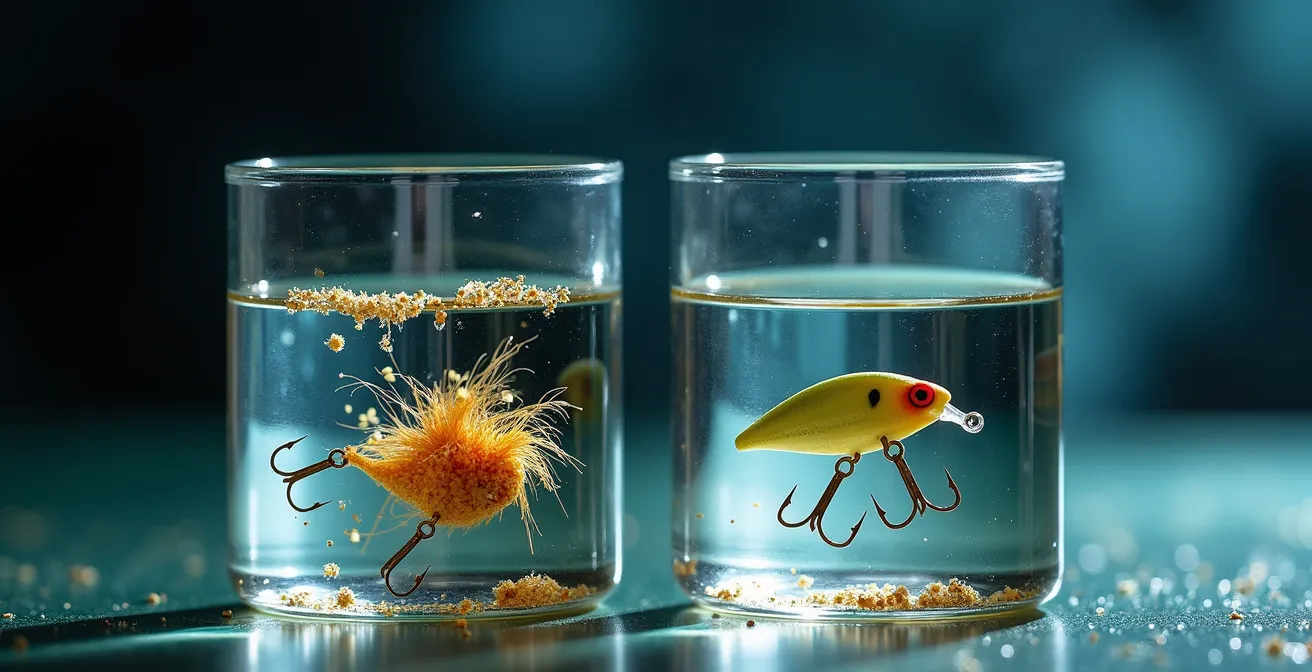
The key takeaway for an engineer—and an angler—is that the material’s formulation dictates its decomposition pathway. Factors like water temperature, oxygen levels, and the presence of specific bacteria all play a role. Unlike PVC, which is designed for maximum durability and permanence, bio-baits are designed with their eventual demise in mind, turning a centuries-long pollution problem into a manageable, years-long natural cycle.
Do Biodegradable Baits Have the Same Action as Traditional Plastics?
The most common hesitation among anglers considering a switch to biodegradable lures is performance. Does “eco-friendly” mean sacrificing the action, durability, and fish-catching ability they’ve come to trust from traditional plastics? From a materials engineering perspective, the goal is to replicate or even exceed the performance of PVC using non-toxic, decomposable polymers. Rigorous testing shows this is not just possible, but already a reality.
The argument that bio-baits are inferior is often based on anecdote rather than data. In fact, scientific comparisons reveal a much more compelling story. A notable example provides clear, empirical evidence:
High School Student’s Award-Winning Lure Performance Testing
In a science fair project that gained national recognition, student Ethan Albright conducted a series of controlled tests comparing his homemade biodegradable lures to standard plastisol baits. According to an article in Outdoor Life, his tests for light transmission and buoyancy showed the two lure types were “statistically similar at an alpha value of .05.” Most surprisingly, in the durability test measuring the breaking point, Albright’s bio-lures were actually statistically stronger than their plastic counterparts.
Beyond simple action and durability, the material properties of bio-baits can offer other environmental advantages. Buoyancy is a key factor. As Daniel Nussbaum of Z-Man notes, the density of the material has a direct impact on its potential as a pollutant.
PVC sinks and a discarded lure ends up on the bottom where another fish could eat it, or it just sits there forever. A floating bait can be retrieved by the angler, or eventually floats to the bank
– Daniel Nussbaum, Z-Man Fishing Products
This highlights a secondary performance benefit: a floating or neutrally buoyant lure is more easily recovered after a snag or break-off, preventing it from becoming permanent lake-floor debris in the first place. Therefore, the evidence suggests that biodegradable baits are not a compromise. They are a viable, and in some cases superior, alternative engineered to meet the demands of serious anglers while eliminating the toxic legacy of PVC.
The Price Premium of Eco-Baits: Is It Affordable for Daily Use?
There’s no denying that many biodegradable soft plastics come with a higher price tag than their traditional PVC counterparts. This price premium can be a significant barrier for the average angler who goes through dozens, if not hundreds, of lures in a season. When a bag of bio-baits costs twice as much, the decision to switch can feel economically unfeasible. However, it’s essential to contextualize this cost against the sheer volume of plastic entering our waterways. The scale of the problem is staggering; field research demonstrates that just 50 tournament participants can leave behind over 12 pounds of discarded soft plastics. When viewed through this lens, the higher cost of a safer alternative starts to look more like a necessary investment in the health of the fishery.
For anglers who are budget-conscious but still want to reduce their environmental impact, there is a third option: creating your own biodegradable lures. The process is rooted in basic kitchen chemistry and allows for infinite customization of shape, color, and scent at a fraction of the retail cost. By sourcing simple, food-grade ingredients, you can take full control of your tackle’s material composition.
Your Action Plan: Key Components for a DIY Bio-Lure Formula
- Material Base: Start with a mixture of approximately 80 ml of water combined with 16 g of beef gelatin and 4 ml of glycerine to create the basic polymer structure.
- Heating and Mixing: Gently heat the mixture to around 194°F (90°C) in a microwave-safe container, stirring regularly to ensure all components are fully dissolved and integrated.
- Preservative Addition: To inhibit mold growth and increase shelf life, add salt water at a concentration of about 3.5%, mimicking the salinity of seawater.
- Hardening Process: For increased durability and reduced water solubility, soak the finished and cooled baits in a tannin solution (like strong black tea) for one minute to promote cross-linking.
- Melting Point Adjustment: If fishing in very warm water, consider adding a small amount of fruit pectin to the initial mixture to increase the final lure’s melting temperature.
While the initial price of commercial bio-baits is higher, the true cost of using PVC is externalized onto the environment. By reframing the purchase as an investment in ecosystem health, or by embracing DIY solutions, anglers can make the switch to safer materials both practical and affordable.
Compost or Trash: How to Properly Dispose of Used Eco-Lures?
Switching to biodegradable lures is a massive step forward, but the responsibility doesn’t end when the bait is torn or the fishing day is over. The term “biodegradable” can be misleading if it’s interpreted as a license to litter. Proper disposal is a critical final step in the material’s lifecycle, ensuring it breaks down as intended without causing unintended harm. Unlike a banana peel, a bio-lure should never be casually tossed into the water or onto the bank. Its decomposition is engineered for specific conditions which are rarely met in the open environment.
The correct disposal method depends entirely on the lure’s specific chemical makeup and certification. Manufacturers are increasingly providing this information, and it’s the angler’s job to read and follow it. Sorting your used baits is as important as sorting your household recycling.
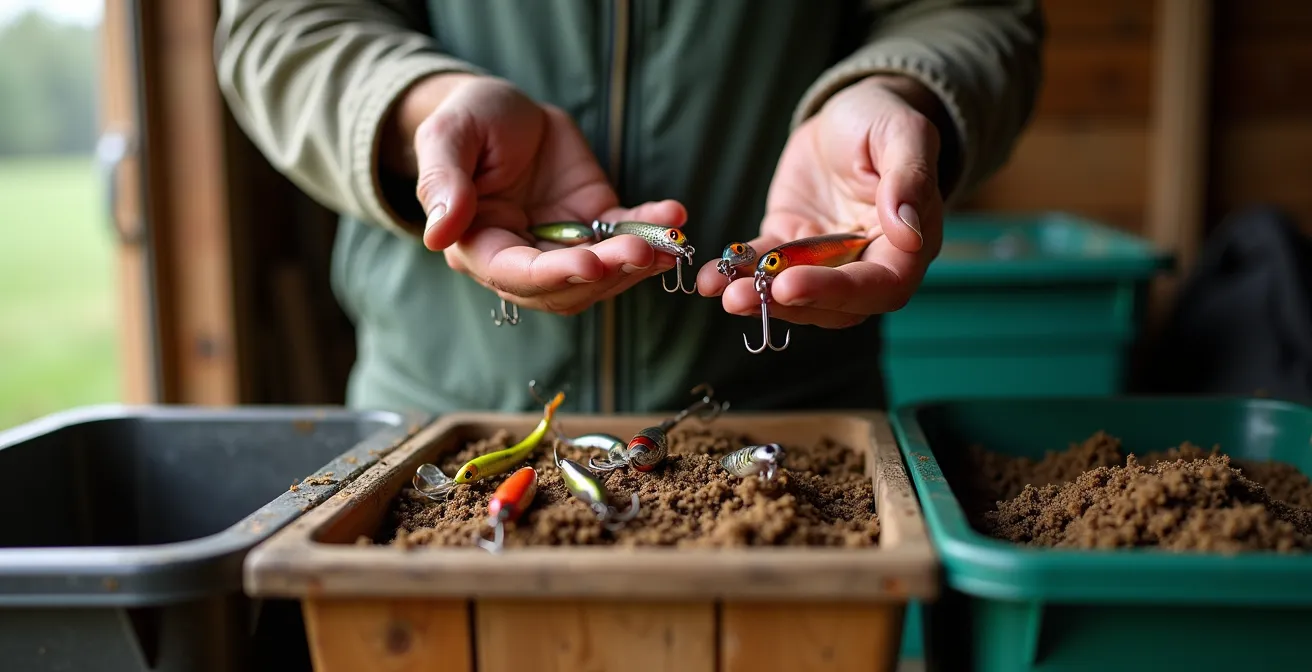
To navigate this, anglers need a clear decision-making framework. The following guide, based on common certifications and material types, clarifies the correct end-of-life pathway for your used baits. As this comparative analysis from Captn Greenfin shows, the right choice depends on the product’s specific design.
| Lure Type | Disposal Method | Breakdown Time | Environmental Impact |
|---|---|---|---|
| Home Compostable Certified | Home compost bin | Several weeks in water | Minimal – converts to biomass |
| Industrial Compostable | Municipal composting or landfill | 8-10 months in managed facility | Low if properly processed |
| Water-soluble (PVA-based) | Specialized facility only | Dissolves at 140°F water | Requires controlled conditions |
| No certification | Landfill (safest option) | Variable/unknown | Better than littering |
When in doubt, the safest and most responsible option is always the landfill. While it may seem counterintuitive to throw a “biodegradable” product in the trash, a modern, managed landfill contains the microbial activity needed to break down these materials far more effectively and safely than a roadside or lake bottom. Responsible disposal is the final act of a conscious angler.
The Soap Mistake That Kills Aquatic Insects Near Camp
Most conscientious campers know the “soap mistake”: washing dishes directly in a lake or stream. Even biodegradable soap can harm aquatic life by breaking down the surface tension of the water, which insects like water striders need to survive. It’s a classic example of an unseen chemical impact from a seemingly harmless action. Anglers, however, are making a similar—and far more toxic—chemical mistake with every cast of a traditional PVC lure. The damage isn’t from soap, but from a constant, low-level release of industrial chemicals.
A soft plastic bait isn’t an inert object. It is a chemical sponge, actively leaching its components into the water. Recent scientific inquiry has confirmed this long-held suspicion with alarming clarity. A 2024 study investigated the chemical release from commercially available soft baits, and the German research team findings show that 10 of 16 baits released various plasticizers, including harmful phthalates, over a 61-day period. The study also identified 45 other persistent, mobile, and toxic plastic additives, with one sample even exhibiting hormonal activity from unknown substances.
This data transforms our understanding of lure loss. A lost PVC worm is not just a piece of litter; it is a miniature pollution point, a toxic depot slowly poisoning the immediate environment. This inherent toxicity is why environmental groups have long targeted this specific polymer.
Green Peace called PVC ‘the most environmentally damaging of all plastics’
– Green Peace, Environmental Impact Report
By choosing PVC baits, anglers are unknowingly participating in this widespread chemical contamination. The switch to non-toxic, biodegradable alternatives is the only way to stop making this “chemical mistake” and ensure our tackle isn’t actively working against the health of the ecosystems we cherish.
How to Repair Torn Soft Plastics to Save Money on Tackle?
A significant advantage of many biodegradable lure formulations, particularly those based on gelatin, is their capacity for repair and recycling. Unlike PVC baits, which require high heat and toxic fumes to weld or melt, many bio-baits can be easily repaired or completely remolded using simple, non-toxic methods. This not only saves money but also introduces a circular-economy mindset into an angler’s tackle management, drastically reducing waste.
A torn bio-bait doesn’t have to be discarded. It can be given a new lease on life, a process that is both safe and effective enough to be done in a home kitchen. This approach embodies the principle of “reduce, reuse, recycle” at the tackle-box level.
Non-Toxic Repair with Gelatin-Based Lures
The repair process for gelatin-based baits is remarkably straightforward and safe. Because the lures are made from food-grade gelatin and glycerin, they can be gently melted and reformed without releasing toxic fumes. A torn tail or a hook-damaged body can be seamlessly fused back together with a bit of heat from a lighter or by pressing the pieces against a warm metal surface. The entire operation can be done in your kitchen without any health risks, turning what would be trash into a perfectly functional lure.
This philosophy of reuse can be taken even further. Anglers can collect all their unusable bio-bait fragments and recycle them into entirely new creations. This practice not only saves money but minimizes your tackle footprint to near zero.
- Save and Store: Keep all torn pieces, old baits, and molding scraps in a dedicated glass jar.
- Create “Franken-Baits”: Gently melt the fragments together in a microwave-safe container. The mixture of colors will create unique, multi-colored “Franken-baits” that can then be poured into molds.
- Biodegradable Chum: Alternatively, the melted material can be poured into ice cube trays and frozen. These blocks can be used as a slow-release, biodegradable chum to attract fish to your location without introducing synthetic chemicals.
By embracing these repair and recycling techniques, anglers transform a disposable product into a reusable resource, saving money and taking a definitive step toward a zero-waste fishing practice.
The Bottom Line
- Traditional PVC lures are a source of long-term pollution, leaching toxic plasticizers like phthalates directly into aquatic ecosystems.
- Modern bio-baits offer statistically identical fishing performance and are engineered to break down in a matter of years, not centuries.
- Proper disposal is critical; “biodegradable” is not a license to litter. Check certifications and use a managed landfill when in doubt about the correct procedure.
Why Anglers Must Kill Invasive Carp to Save Native Biodiversity?
The duty of an angler-conservationist has long been understood to include active ecosystem management. For example, in many regions, anglers are required or strongly encouraged to kill invasive species like Asian Carp upon capture. This is not done out of cruelty, but out of a deep understanding of an angler’s role as a steward of the environment. These invasive species outcompete native fish, destroy habitat, and disrupt the entire food web. Removing them is a direct, impactful action to preserve native biodiversity. Today, a new and equally critical stewardship duty is emerging: managing our material footprint.
Just as we’ve learned to recognize the threat of an invasive species, we must now learn to recognize the threat of a persistent, toxic material like PVC. The good news is that the angling community is ready and willing to have this conversation. A desire for more sustainable practices is growing from the grassroots level, with anglers themselves demanding better options and more transparency from manufacturers. This sentiment was captured perfectly in a recent scientific study.
The majority of participants were concerned about the potential ecological impact of soft plastic bait and were in favor of labeling the ingredients and legal restrictions on toxic ingredients
– German Angler Survey, Thünen Institute Study 2024
This shows a clear shift in mindset. The modern angler understands that true conservation goes beyond catch-and-release or managing fish populations. It extends to every piece of gear we use. Choosing a biodegradable lure over a PVC one is no different from choosing to remove an invasive carp. Both are conscious decisions to actively protect and improve the health of our aquatic ecosystems for future generations. It is the evolution of the angler’s conservation ethic.
Begin upgrading your tackle box today by evaluating the material composition of your soft baits. Read the packaging, research the brands, and make your next lure purchase a conscious, informed choice for conservation. Your actions, multiplied across the entire angling community, have the power to fundamentally change our sport’s relationship with the environment.